

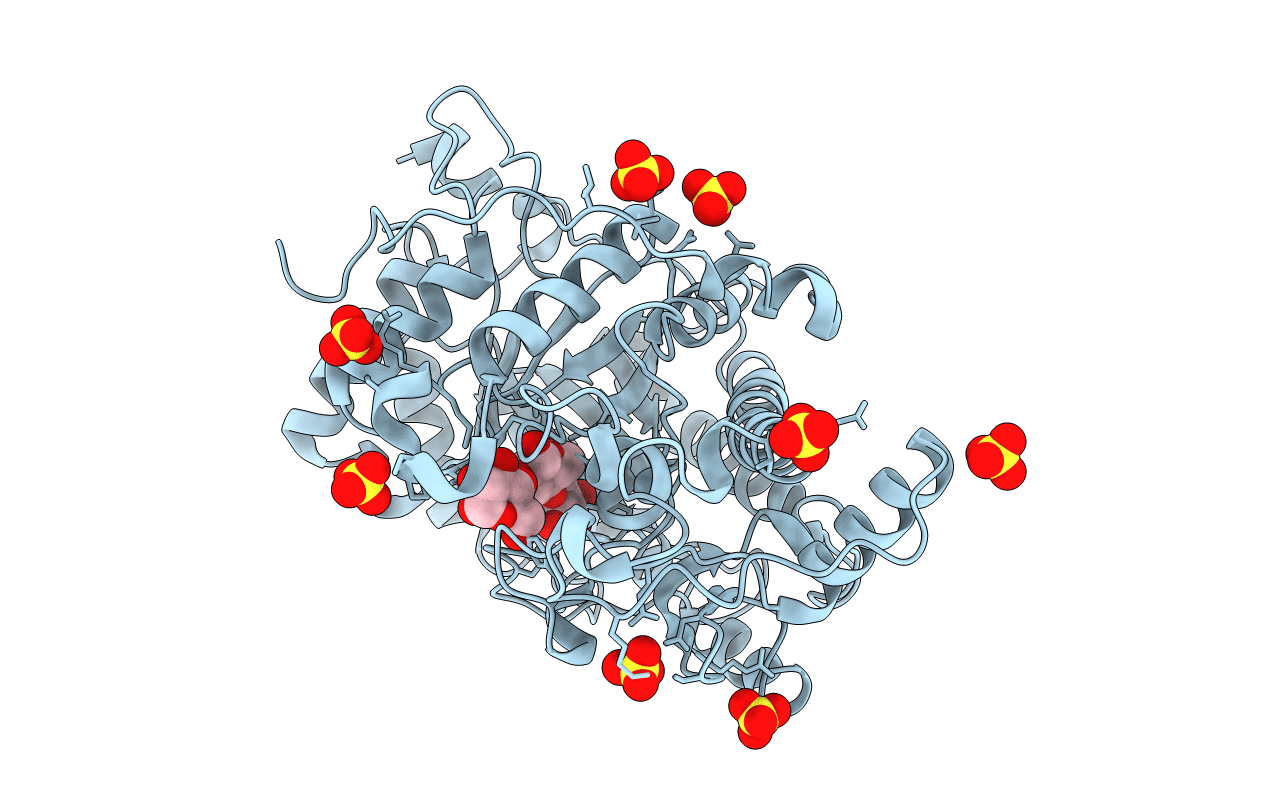
1WDS image
Deposition Date 2004-05-17
Release Date 2005-04-05
Last Version Date 2024-05-29
Entry Detail
PDB ID:
1WDS
Keywords:
Title:
The role of an inner loop in the catalytic mechanism of soybean beta-amylase
Biological Source:
Source Organism(s):
Glycine max (Taxon ID: 3847)
Expression System(s):
Method Details:
Experimental Method:
Resolution:
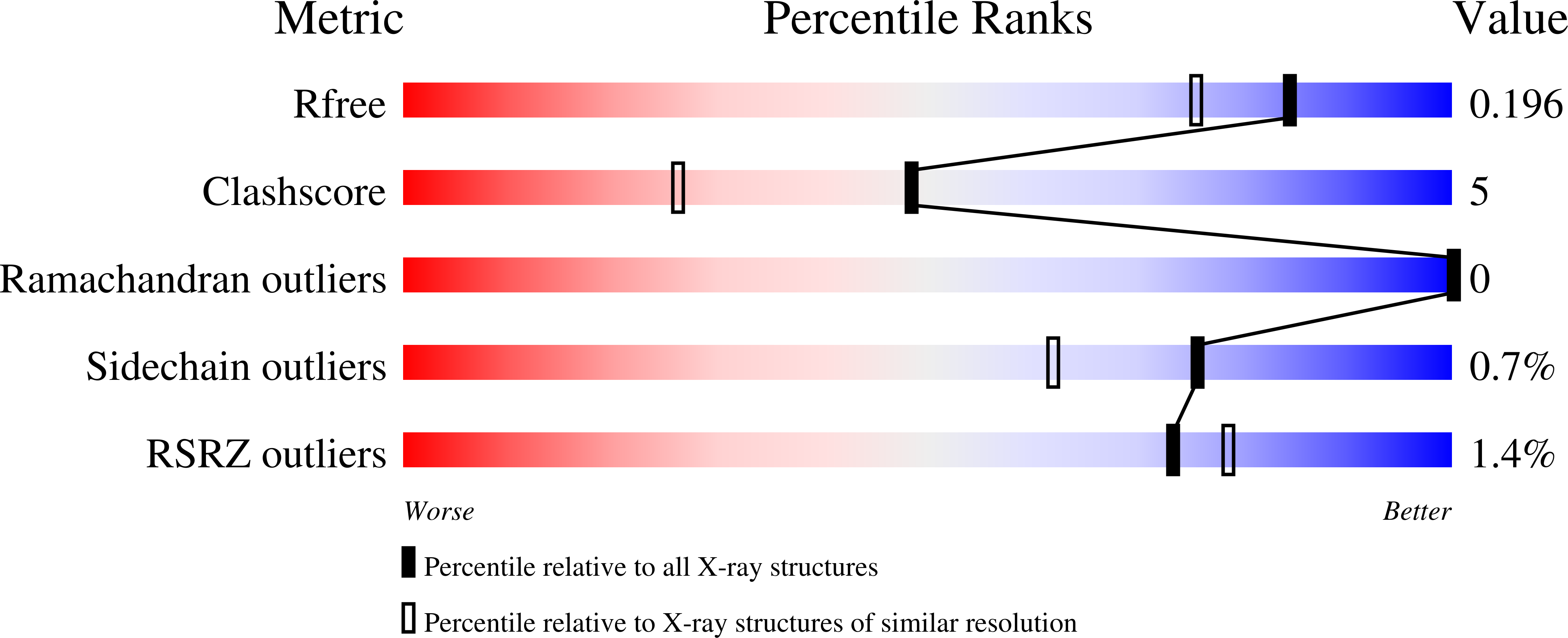
1.64 Å
R-Value Free:
0.2
R-Value Work:
0.17
R-Value Observed:
0.17
Space Group:
P 31 2 1
Macromolecular Entities
Polymer Type:polypeptide(L)
Molecule:Beta-amylase
Gene (Uniprot):BMY1
Mutagens:T342A
Chain IDs:A
Chain Length:495
Number of Molecules:1
Biological Source:Glycine max
Peptide-like Molecules
PRD_900018
Primary Citation
Structural analysis of threonine 342 mutants of soybean beta-amylase: role of a conformational change of the inner loop in the catalytic mechanism.
Biochemistry 44 5106 5116 (2005)
PMID: 15794648 DOI: 10.1021/bi0476580

Abstact

Two different conformations of the inner loop (residues 340-346) have been found in the soybean beta-amylase structures. In the "product form", the Thr 342 residue creates hydrogen bonds with Glu 186 (catalytic acid) and with the glucose residues at subsites -1 and +1, whereas most of those interactions are lost in the "apo form". To elucidate the relationship between the structural states of the inner loop and the catalytic mechanism, Thr 342 was mutated to Val, Ser, and Ala, respectively, and their crystal structures complexed with maltose were determined together with that of the apo enzyme at 1.27-1.64 A resolutions. The k(cat) values of the T342V, T342S, and T342A mutants decreased by 13-, 360-, and 1700-fold, respectively, compared to that of the wild-type enzyme. Whereas the inner loops in the wild-type/maltose and T342V/maltose complexes adopted the product form, those of the T342S/maltose and T342A/maltose complexes showed the apo form. Structural analyses suggested that the side chain of Thr 342 in product form plays an important role in distorting the sugar ring at subsite -1, stabilizing the deprotonated form of Glu 186, and grasping the glucose residue of the remaining substrate at subsite +1. The third hypothesis was proved by the fact that T342V hydrolyzes maltoheptaose following only multichain attack in contrast to multiple attack of the wild-type enzyme.

Legend

Protein

Chemical

Disease

Primary Citation of related structures
Feedback Form
Name
Email
Institute
Feedback