



About Us
The Indian Crop Phenome Database (ICPD), developed by the Indian Biological Data Centre (IBDC) at the Regional Centre for Biotechnology, Faridabad, is an open-access platform for the archiving, management, analysis, and sharing of crop phenome data. Although a large volume of crop phenotyping data is generated through agricultural trials worldwide, much of it remains unpublished and inaccessible to the wider research community.
ICPD organises and preserves multi-crop phenome data in compliance with the MIAPPE standard and the FAIR principles. Each submitted dataset undergoes curation and is assigned a unique, persistent IBDC accession. ICPD is a member database of the AgBioData Consortium and is registered in FAIRsharing.
Updates
Big milestone for Indian crop science! The Indian Crop Phenome Database (ICPD) @IBDCIndia is now registered on @FAIRsharing — DOI: 10.25504/FAIRsharing.0d626c
Date: June 5, 2026ICPD is now registered with FAIRsharing and has received a persistent FAIRsharing DOI, enhancing its discoverability, citation, and alignment with global FAIR data principles. You can cite this record as FAIRsharing.org: ICPD;Indian Crop Phenome Database, DOI: 10.25504/FAIRsharing.0d626c, Last Edited: Monday, April 13th 2026, 21:31, Last Editor:allysonlister,Last Accessed:Friday, June 5th 2026, 10:19,Last Reviewed:Monday, April 13th 2026, 21:31
Read MoreMs. Isha Saini, delivered an oral presentation titled “Towards FAIR Phenome: Introducing Indian Crop Phenome Database" at CCSA-2K26, Karnal
Date: April 1, 2026Ms. Isha Saini, delivered an oral presentation titled “Towards FAIR Phenome: Introducing Indian Crop Phenome Database" at National Conference on Climate-Smart Regenerative Agriculture for Food, Health and Environment Security (CCSA-2K26) held in Karnal from March 20-21, 2026
Read MoreDr. Sonia Balyan, delivered an oral presentation titled “FAIR Plant Science Data at Scale"
Date: Feb. 18, 2026In her talk, Dr. Balyan highlighted the importance of adopting FAIR (Findable, Accessible, Interoperable, and Reusable) data principles in plant science research and showcased the resources and platforms developed at IBDC to enable large-scale management, sharing, and reuse of biological data. The presentation emphasized how national data infrastructures can support researchers in making plant science data more accessible and reusable for the broader scientific community.
Read MoreWheatGain- Wheat Mission Project WebPage is Now Live at ICPD!
Date: Jan. 28, 2026A dedicated track is developed for the wheat mission project "Wheat Genomics for Agricultural Innovation and Nutritional Improvements-Developing Climate-resilient Wheat with Enhanced Productivity and Nutritional Quality using Genomics Approaches"
Read MoreICPD 2.1 Enhancements Successfully Integrated
Date: Nov. 21, 2025All planned improvements under ICPD version 2.1 have now been fully integrated into the live ICPD platform. This update brings several key enhancements aimed at improving usability, security, and project tracking. The major upgrades include: Improved and updated Policy Page Complete integration of the data submission and curation workflow CAPTCHA implementation for secure form submissions Addition of the Safflower Mission Project (KUSUM) track Updated and refined menu bar Correction and validation of internal links across the platform With these upgrades now live, ICPD offers a more streamlined, secure, and user-friendly experience for all users.
Read MoreWhy FAIR Phenome Matters
Data Statistics
Submission Overview
-
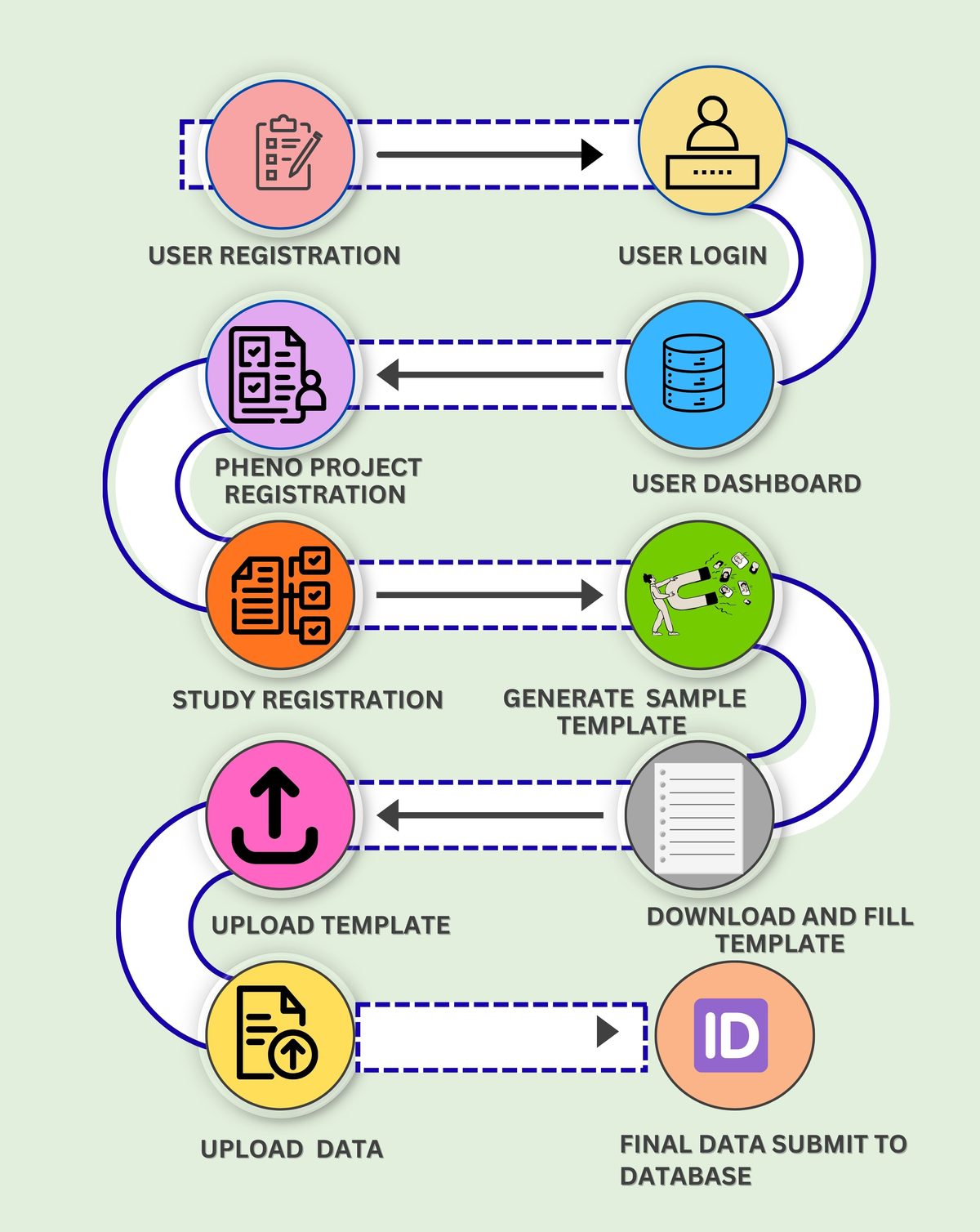
Step 1: User Registration
To begin submitting data to ICPD, users must create an account on the ICPD portal. Visit the registration page and fill in the required details to create your ICPD user account.
-
Step 2: Login to User Dashboard
After successful registration, log in to your ICPD account. You will be redirected to your personal dashboard. From here, you can create, manage, and track all your phenotype data submissions.
-
Step 3: Project Registration
Users can register one or more individual or collaborative projects under their account. Each project requires basic metadata such as project basic information, publications, data access and sharing modes, team, organism and funding details.
-
Step 4: Study Registration
Multiple studies can be created under a single project. For each study, users need to provide detailed study-level metadata, including design, meta-trait, authors, location, and experimental conditions.
-
Step 5: Add Genotype Information & Generate Template
Users add genotype details, biological as well as technical replication details for each study. Based on this information, the system automatically generates a standardized data template.
-
Step 6: Populate and Upload Data
Download the generated template, fill in the phenotype data, and upload it. The system performs basic checks during upload.
-
Step 7: Upload Associated Data
Users can upload any related files such as images, reports, or supplementary datasets. These files support and enrich the submitted phenotype data.
-
Step 8: Accession and Confirmation
After successful submission and validation, an accession number is generated. This accession is sent to the user’s registered email. It can be used to track, cite, and share the dataset.