

9XN4 image
Deposition Date 2025-11-12
Release Date 2026-09-30
Last Version Date 2026-09-30
Entry Detail
PDB ID:
9XN4
Title:
Glucagon receptor-Gs complex activated by the small molecule agonist SIM1
Biological Source:
Source Organism(s):
Bos taurus (Taxon ID: 9913)
Rattus norvegicus (Taxon ID: 10116)
Lama glama (Taxon ID: 9844)
Homo sapiens (Taxon ID: 9606)
Expression System(s):
Method Details:
Experimental Method:
Resolution:
2.53 Å
Aggregation State:
PARTICLE
Reconstruction Method:
SINGLE PARTICLE
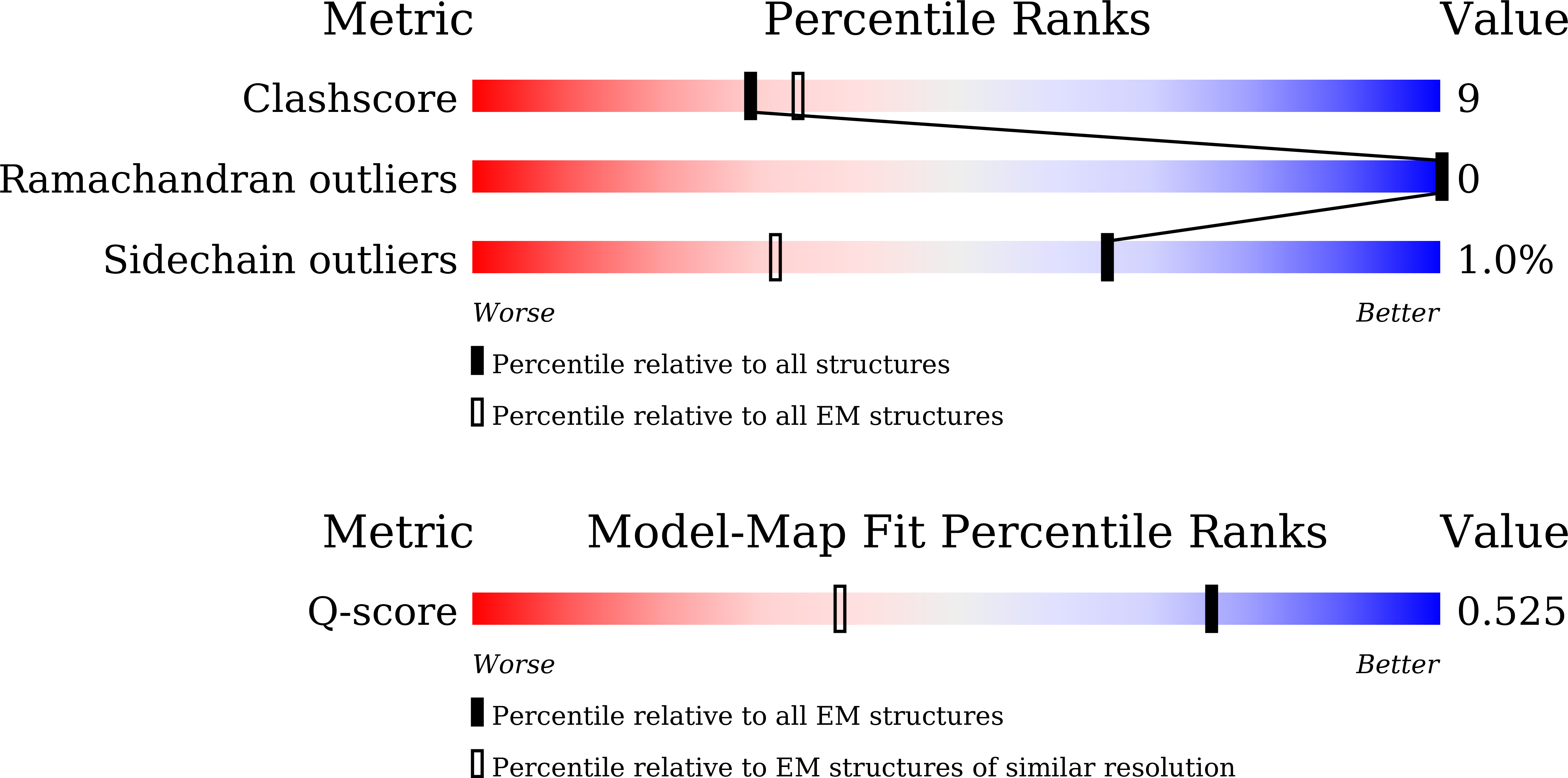
Macromolecular Entities
Structural Superimposition Protein Blast
Polymer Type:polypeptide(L)
Molecule:Guanine nucleotide-binding pr
Chain IDs:A
Chain Length:394
Number of Molecules:1
Biological Source:Bos taurus
Polymer Type:polypeptide(L)
Molecule:Guanine nucleotide-binding pr
Gene (Uniprot):Gnb1
Chain IDs:B
Chain Length:345
Number of Molecules:1
Biological Source:Rattus norvegicus
Polymer Type:polypeptide(L)
Molecule:Guanine nucleotide-binding pr
Gene (Uniprot):GNG2
Chain IDs:C
Chain Length:71
Number of Molecules:1
Biological Source:Bos taurus
Structural Superimposition Protein Blast
Polymer Type:polypeptide(L)
Molecule:Nanobody 35
Chain IDs:D (auth: N)
Chain Length:130
Number of Molecules:1
Biological Source:Lama glama
Polymer Type:polypeptide(L)
Molecule:Glucagon receptor
Gene (Uniprot):GCGR
Chain IDs:E (auth: R)
Chain Length:407
Number of Molecules:1
Biological Source:Homo sapiens
Ligand Molecules
Primary Citation
Structural basis for small-molecule agonism at GCGR and GIPR via a conserved intracellular allosteric site.
Acta Pharmacol.Sin. ? ? ? (2026)
PMID: 42736455 DOI: 10.1038/s41401-026-01923-5

Abstact

The glucagon receptor (GCGR) and gastric inhibitory polypeptide receptor (GIPR) are class B GPCRs that regulate glucose homeostasis and energy balance, making them key targets for type 2 diabetes and obesity. Achieving preferential G(s) signaling at these receptors with small molecules remains an unmet challenge. Here, we report SIM1, developed through optimization of the PCO371 scaffold, which exhibits preferential G(s) signaling at GCGR and GIPR with minimal detectable beta-arrestin recruitment and substantially improved efficacy at GIPR. Cryo-EM structures of SIM1-GCGR-G(s) (2.53 A) and SIM1-GIPR-G(s) (2.74 A) reveal a shared intracellular allosteric interface at the receptor-G protein coupling region, distinct from extracellular peptide recognition. Structural comparison with GLP1R suggests that intracellular conformational constraints contribute to differential SIM1 responsiveness, which is restored by targeted mutations. Guided by these insights, analogs SIM2 and SIM3 exhibited up to 20-fold enhanced potency while maintaining an apparent preferential G(s) signaling profile. These findings reveal a conserved intracellular allosteric activation mechanism across multiple class B GPCRs and identify SIM1 and its analogs as valuable chemical tools for investigating receptor-specific intracellular allosteric regulation and G protein-preferential signaling.

Legend

Protein

Chemical

Disease

Primary Citation of related structures
Feedback Form
Name
Email
Institute
Feedback