

11UF image
Deposition Date 2026-03-13
Release Date 2026-09-23
Last Version Date 2026-10-21
Entry Detail
PDB ID:
11UF
Title:
GluA2-y5-CNIH1 open state + RR2b + Glu (LBD-TMD)
Biological Source:
Source Organism(s):
Rattus norvegicus (Taxon ID: 10116)
Homo sapiens (Taxon ID: 9606)
Expression System(s):
Method Details:
Experimental Method:
Resolution:
3.39 Å
Aggregation State:
PARTICLE
Reconstruction Method:
SINGLE PARTICLE
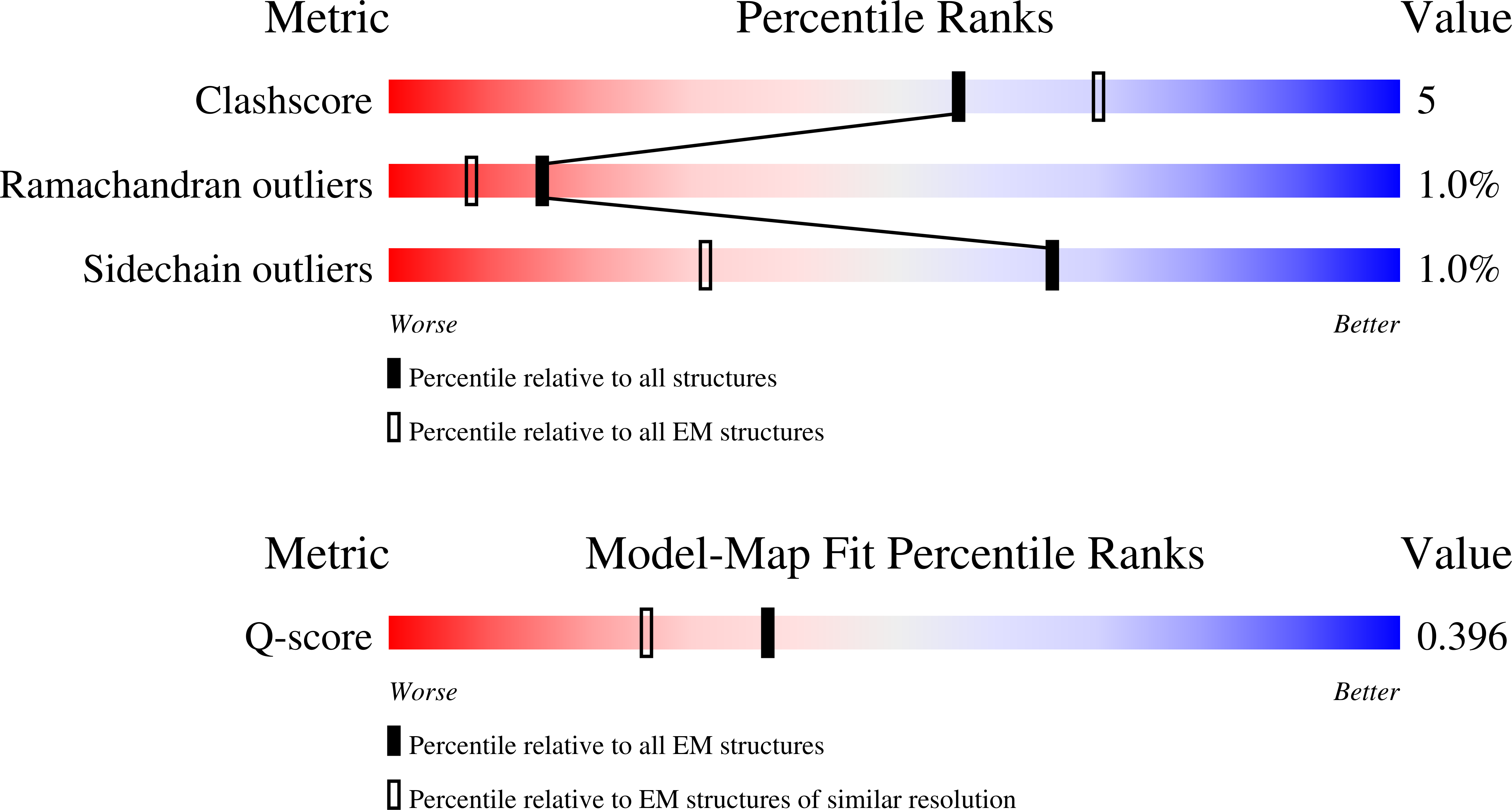
Macromolecular Entities
Structural Superimposition Protein Blast
Polymer Type:polypeptide(L)
Molecule:Isoform Flip of Glutamate rec
Gene (Uniprot):Gria2, Cacng5
Chain IDs:A, B, C, D
Chain Length:1049
Number of Molecules:4
Biological Source:Rattus norvegicus
Polymer Type:polypeptide(L)
Molecule:Protein cornichon homolog 1
Gene (Uniprot):CNIH1
Chain IDs:E, F
Chain Length:144
Number of Molecules:2
Biological Source:Homo sapiens
Primary Citation
Tuning of AMPA receptor activation by inhibitory auxiliary subunits and epilepsy-associated disease mutations.
Nat Commun 17 ? ? (2026)
PMID: 42830315 DOI: 10.1038/s41467-026-77416-0

Abstact

AMPA receptors (AMPARs) facilitate excitatory neurotransmission and are implicated in neurological and neuropsychiatric disorders. Binding of the neurotransmitter glutamate triggers AMPAR activation, which is modulated by potentiating and inhibitory auxiliary subunits. While modulation by potentiating auxiliary subunits has been studied extensively, activation involving inhibitory subunits has not been examined. Here, we present structures of the activated GluA2 AMPAR alone and in complex with inhibitory subunits GSG1L or gamma5. Our results suggest that gating kinetics strongly depend on auxiliary subunit identity, while pore size and conductance do not. We find that receptor deactivation becomes slower if an auxiliary subunit promotes tightening of the interface between two ligand-binding domain dimers during activation. In addition, we functionally characterize the effects of epilepsy-associated disease mutations on AMPAR activation and desensitization kinetics, displaying strong dependence on the type of bound auxiliary subunit. Modulation by auxiliary subunits therefore has to be considered when designing AMPAR-targeting therapeutics.

Legend

Protein

Chemical

Disease

Primary Citation of related structures
Feedback Form
Name
Email
Institute
Feedback