

9ZVX image
Deposition Date 2025-12-31
Release Date 2026-09-09
Last Version Date 2026-09-16
Entry Detail
PDB ID:
9ZVX
Keywords:
Title:
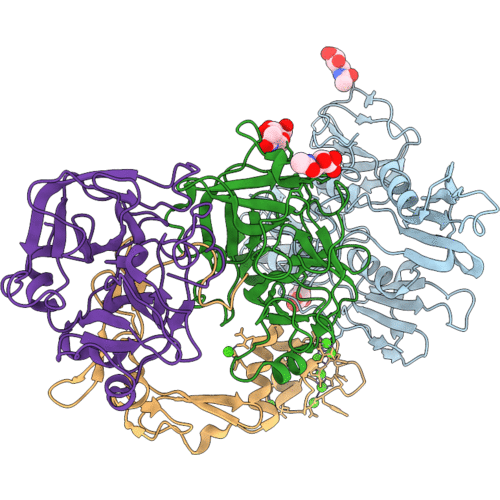
Structural insights into the exosite-mediated activation of Factor IX by Factor XIa using cryoEM
Biological Source:
Source Organism(s):
Homo sapiens (Taxon ID: 9606)
Expression System(s):
Method Details:
Experimental Method:
Resolution:
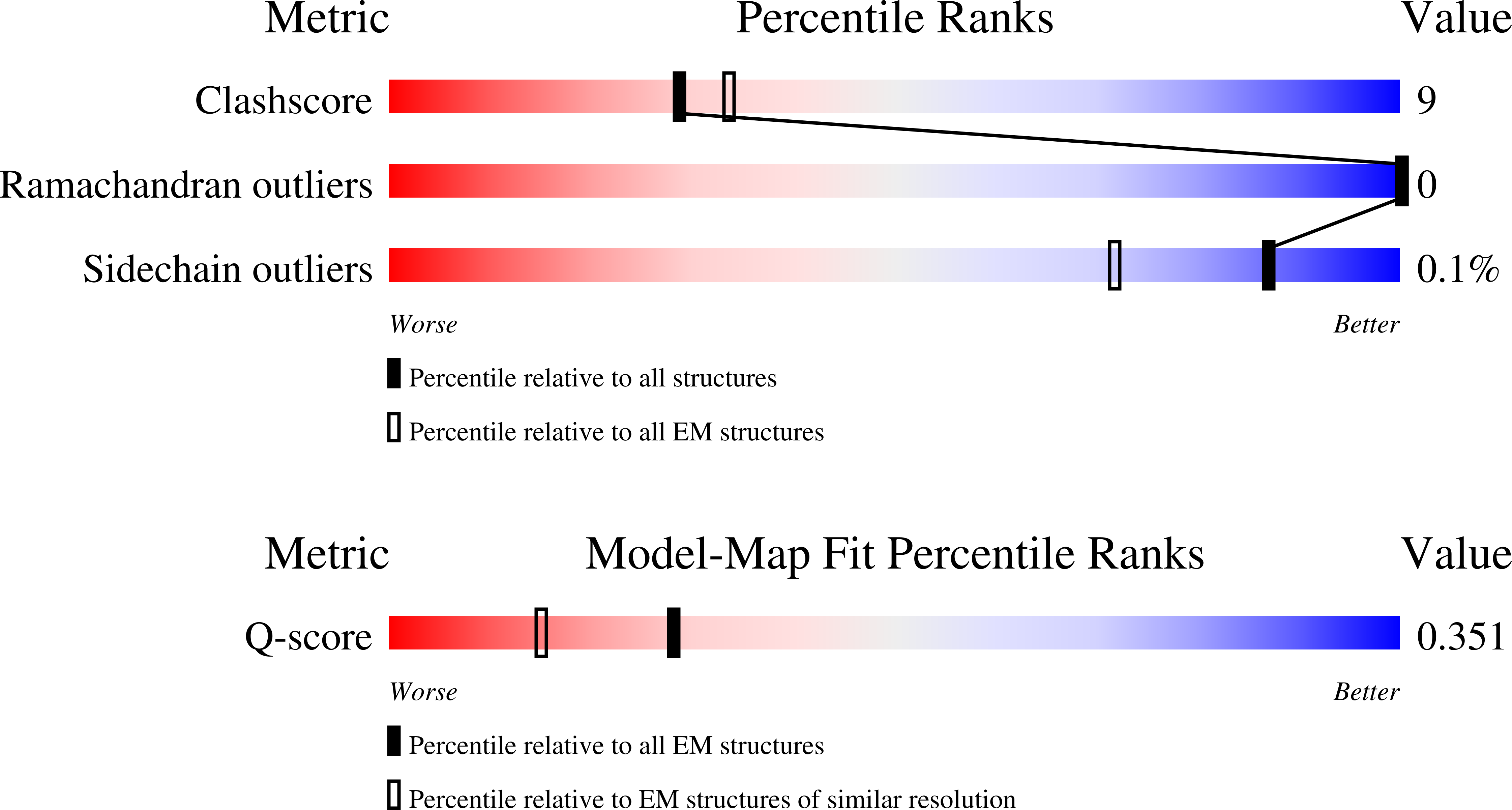
3.00 Å
Aggregation State:
PARTICLE
Reconstruction Method:
SINGLE PARTICLE
Macromolecular Entities
Polymer Type:polypeptide(L)
Molecule:Coagulation factor XIa heavy
Gene (Uniprot):F11
Chain IDs:A
Chain Length:369
Number of Molecules:1
Biological Source:Homo sapiens
Polymer Type:polypeptide(L)
Molecule:Coagulation factor XIa light
Gene (Uniprot):F11
Mutagens:S557A
Chain IDs:B
Chain Length:236
Number of Molecules:1
Biological Source:Homo sapiens
Polymer Type:polypeptide(L)
Molecule:Coagulation factor IXa light
Gene (Uniprot):F9
Chain IDs:C
Chain Length:145
Number of Molecules:1
Biological Source:Homo sapiens
Polymer Type:polypeptide(L)
Molecule:Coagulation factor IXa heavy
Gene (Uniprot):F9
Chain IDs:D
Chain Length:235
Number of Molecules:1
Biological Source:Homo sapiens
Modified Residue
Compound ID Chain ID Parent Comp ID Details 2D Image
CGU C GLU modified residue
Primary Citation
Structural insights into the exosite-mediated activation of factor IX by factor XIa using cryogenic electron microscopy.
J.Thromb.Haemost. ? ? ? (2026)
PMID: 42628751 DOI: 10.1016/j.jtha.2026.08.015

Abstact

BACKGROUND: Factor (F)XI occupies a unique and clinically significant niche, bridging the tissue factor-driven and contact-driven coagulation pathways. Irrespective of the trigger, activated factor XI (FXIa) contributes to clotting by activating FIX. Biochemical studies established that this reaction requires the membrane-binding FIX-Gla domain to engage an exosite on the FXIa Apple 3 (A3) domain, which only becomes available upon FXI activation. Structural data for FXIa, FIX, FIXabeta and the FXIa:FIX complex are lacking; current understanding relies on zymogen FXI crystal structures and homology modeling of FXIa after kallikrein. OBJECTIVES: Elucidate the high-resolution structure of FXIa in a functionally relevant conformation in complex with FIX. METHODS: We utilized cryo-electron microscopy to determine the structures of human FXIa in complex with its full-length substrate, FIX, and activated product, FIXabeta. RESULTS: We report the first cryo-electron microscopy structures of FXIa in complex with its substrate, FIX, and activated FIX (FIXabeta). The structures capture a functionally relevant conformational change in the FXIa catalytic domain and reveal the first view of the entire FIX and FIXabeta. Critically, we visualize the FIX-Gla domain precisely docked to the FXIa-A3 exosite on both subunits of the FXIa dimer. We also define the first step of proteolysis, visualizing the FIX Arg145 inserted into the primary specificity pocket of FXIa. CONCLUSIONS: The structures define the full FXIa:FIX interface, providing a structural template for understanding the sequential activation of FIX and for developing a new class of selective allosteric antithrombotic agents.

Legend

Protein

Chemical

Disease

Primary Citation of related structures
Feedback Form
Name
Email
Institute
Feedback