

9Z6I image
Deposition Date 2025-11-14
Release Date 2026-05-27
Last Version Date 2026-06-03
Entry Detail
PDB ID:
9Z6I
Keywords:
Title:
Cryo-EM structure of the open state of cIL RNA at 4.3 A resolution
Biological Source:
Source Organism(s):
Method Details:
Experimental Method:
Resolution:
4.32 Å
Aggregation State:
PARTICLE
Reconstruction Method:
SINGLE PARTICLE
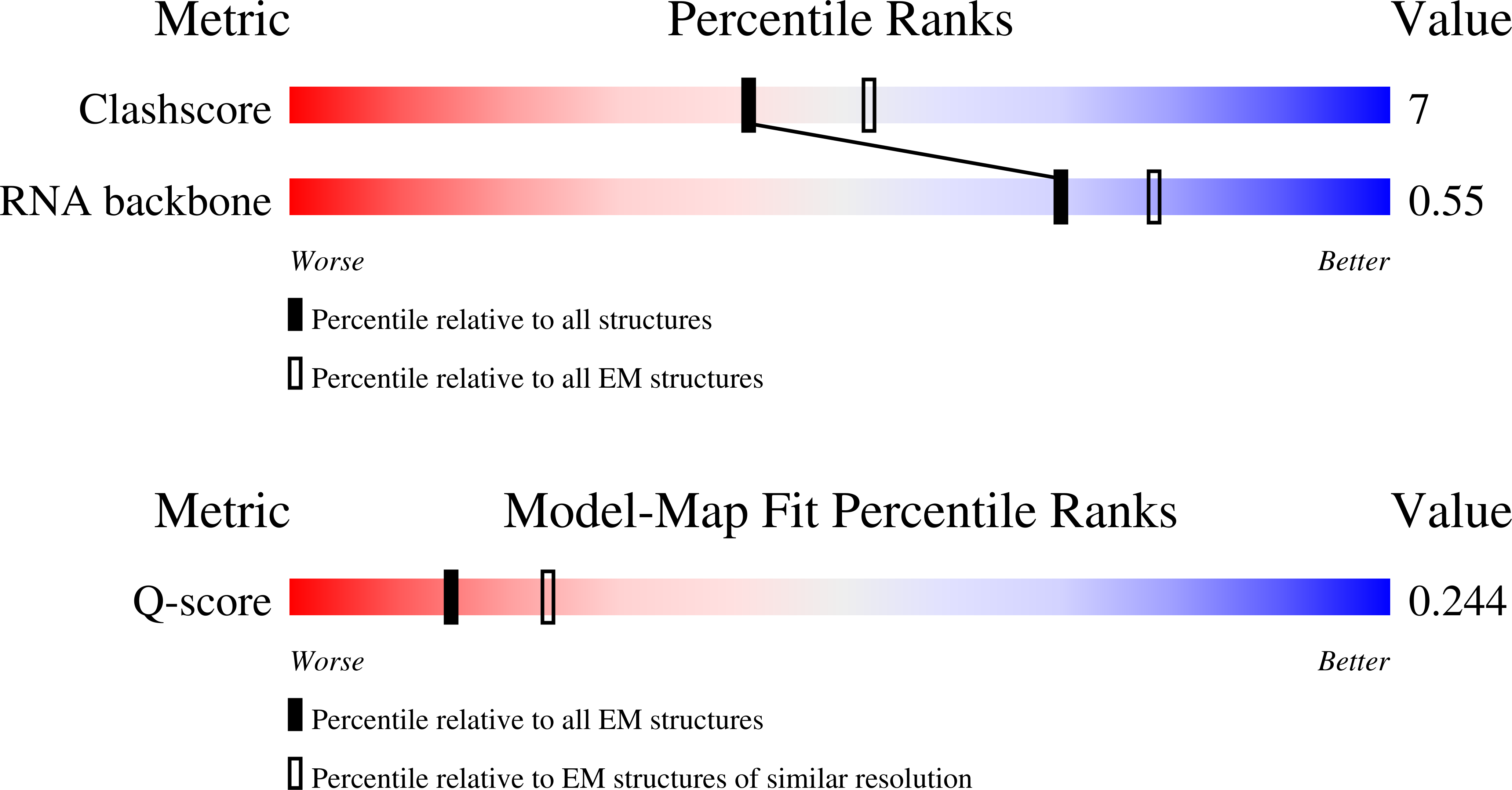
Macromolecular Entities
Polymer Type:polyribonucleotide
Molecule:RNA (155-MER)
Chain IDs:A
Chain Length:155
Number of Molecules:1
Biological Source:synthetic construct
Ligand Molecules
Primary Citation
A universal Fab targeting a conserved U1A-RNA epitope for RNA structure determination by cryo-EM.
Nucleic Acids Res. 54 ? ? (2026)
PMID: 42165126 DOI: 10.1093/nar/gkag502

Abstact

Recent advances in cryo-electron microscopy (cryo-EM) have made antigen-binding fragments (Fabs) essential tools in the field of structural biology. Fabs facilitate image alignment, thereby enhancing three-dimensional (3D) reconstruction, and increase the effective size of proteins, aiding in their structural elucidation. In this study, we sought to broaden the use of Fabs as fiducial markers to elucidate the structures of RNA molecules. Identifying an appropriate Fab for a specific RNA target can be particularly challenging due to RNA's inherent flexibility and tendency to assume multiple conformations, which complicate the process and prolong the structure determination timeline. To address this challenge, we designed a universal Fab that specifically recognizes a U1A-RNA epitope, thereby reducing the need for Fab selection tailored to each individual RNA target. We determined the cryo-EM structure of the class I ligase ribozyme complexed with a portable U1hpII loop bound to the U1A protein and the Fab. The resulting structure revealed that the Fab interacts with a conserved U1A-RNA binding region, which can be engineered into other RNA molecules. This strategy presents significant potential for streamlining the structural determination of various RNAs, which are essential for biological and biomedical research.

Legend

Protein

Chemical

Disease

Primary Citation of related structures
Feedback Form
Name
Email
Institute
Feedback