

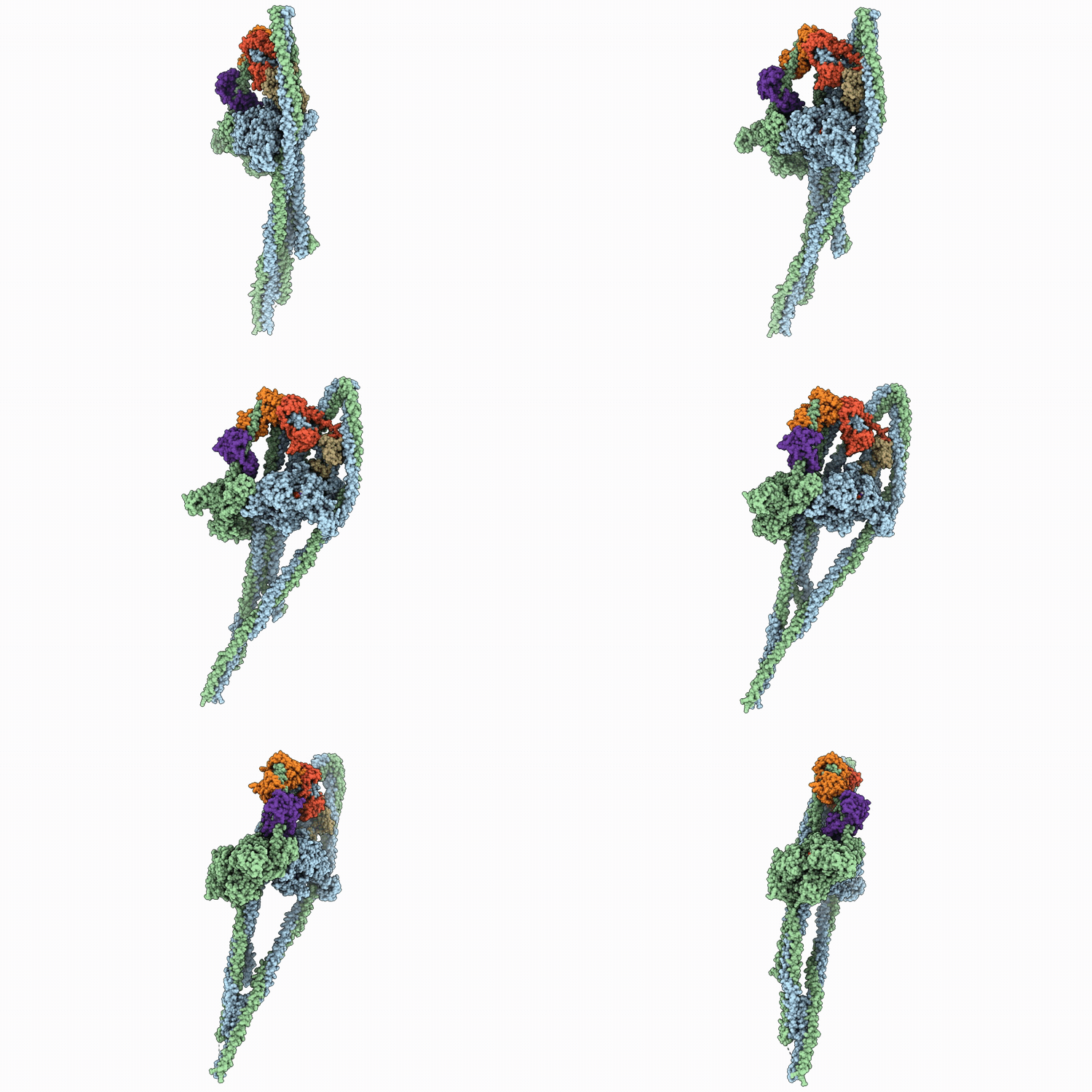
9Z3Z image
Deposition Date 2025-11-07
Release Date 2026-07-08
Last Version Date 2026-08-19
Entry Detail
PDB ID:
9Z3Z
Keywords:
Title:
Cryo-EM structure of human nonmuscle myosin-2B, Class 2
Biological Source:
Source Organism(s):
Homo sapiens (Taxon ID: 9606)
Expression System(s):
Method Details:
Experimental Method:
Resolution:
5.24 Å
Aggregation State:
PARTICLE
Reconstruction Method:
SINGLE PARTICLE
Macromolecular Entities
Polymer Type:polypeptide(L)
Molecule:Myosin-10
Gene (Uniprot):MYH10
Chain IDs:A, B
Chain Length:1976
Number of Molecules:2
Biological Source:Homo sapiens
Polymer Type:polypeptide(L)
Molecule:Myosin light polypeptide 6
Gene (Uniprot):MYL6
Chain IDs:C, F
Chain Length:151
Number of Molecules:2
Biological Source:Homo sapiens
Polymer Type:polypeptide(L)
Molecule:Myosin regulatory light chain
Gene (Uniprot):MYL12B
Chain IDs:D, E
Chain Length:171
Number of Molecules:2
Biological Source:Homo sapiens
Primary Citation
Structural basis of nonmuscle myosin-2 autoinhibition mechanisms.
Nat Commun 17 ? ? (2026)
PMID: 42323327 DOI: 10.1038/s41467-026-74674-w

Abstact

Nonmuscle myosin-2 (NM2) is a fundamental actin-based mechanochemical ATPase that regulates cellular architecture, migration, adhesion, and force generation across diverse biological contexts. NM2 function is tightly regulated by a structural transition between an autoinhibited monomeric (10S) conformation in which ATPase activity, actin binding, and filament assembly are coordinately suppressed and an enzymatically active, filamentous conformation. The autoinhibited conformation is critical for the spatial and temporal control of contractility in nonmuscle cells, yet structural insights into the 10S conformation remain largely elusive. Here, we report a ~53-nm elongated full-length structure of NM2B in the 10S conformation and four distinct cryo-EM structures representing the conformational landscape within the human NM2B 10S state. These structures reveal a tri-segmented tail fold that sequesters interfaces essential for actin binding and filament assembly. The asymmetric arrangement of myosin heavy and light chains provides a mechanistic foundation for understanding how regulatory post-translational modifications and disease-associated mutations shift NM2 conformational equilibria and may enable the development of structure-based interventions for cytoskeletal diseases including hearing loss, neurodegeneration, and cancer.

Legend

Protein

Chemical

Disease

Primary Citation of related structures
Feedback Form
Name
Email
Institute
Feedback