

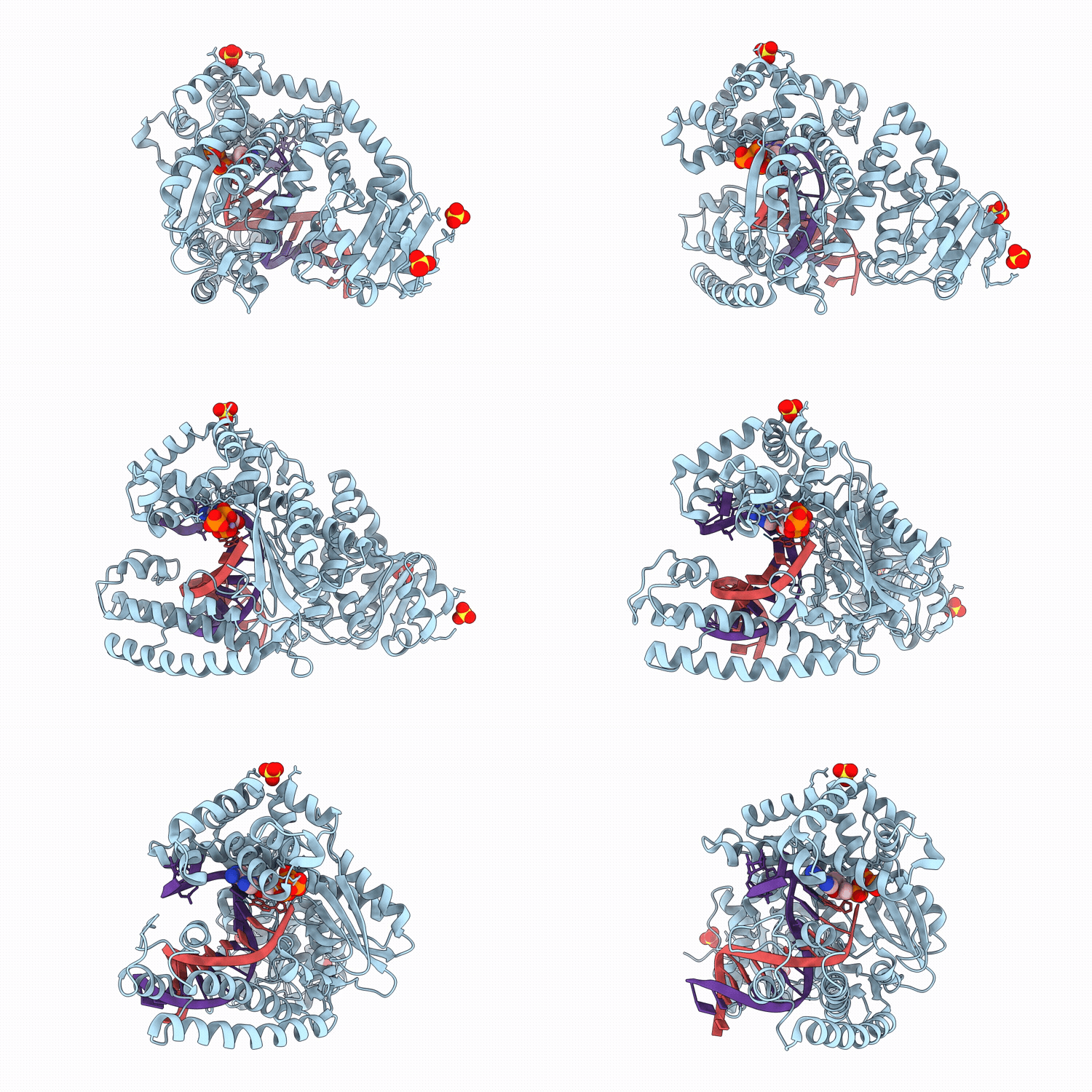
9YD2 image
Deposition Date 2025-09-20
Release Date 2026-06-24
Last Version Date 2026-07-15
Entry Detail
PDB ID:
9YD2
Keywords:
Title:
Ternary complex of DNA polymerase I from Bacillus stearothermophilus, large fragment, bound to DNA containing a thymine dimer and dATP
Biological Source:
Source Organism(s):
Expression System(s):
Method Details:
Experimental Method:
Resolution:
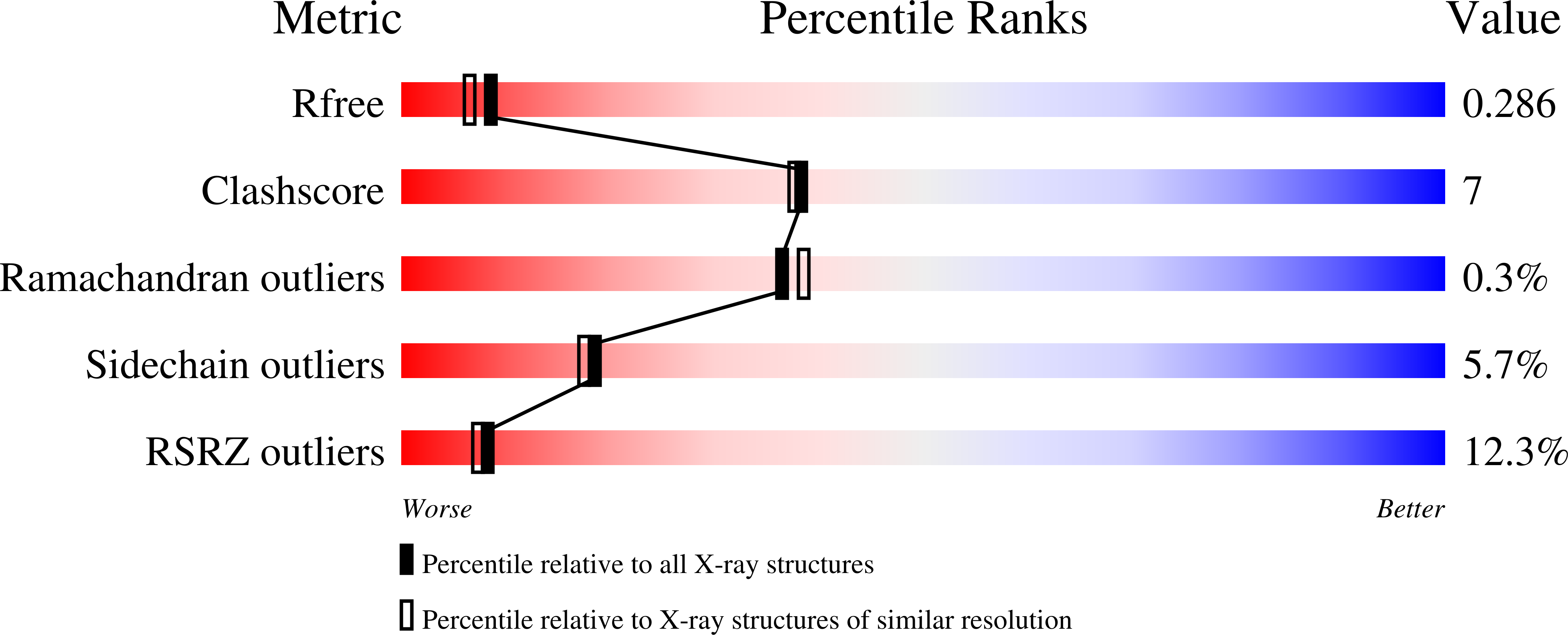
2.25 Å
R-Value Free:
0.28
R-Value Work:
0.22
Space Group:
P 31 2 1
Macromolecular Entities
Polymer Type:polypeptide(L)
Molecule:DNA polymerase I
Gene (Uniprot):DPO1
Mutagens:D598A
Chain IDs:A
Chain Length:581
Number of Molecules:1
Biological Source:Geobacillus stearothermophilus
Polymer Type:polydeoxyribonucleotide
Molecule:DNA (5'-D(*CP*AP*AP*GP*GP*AP*
Chain IDs:B
Chain Length:11
Number of Molecules:1
Biological Source:synthetic construct
Polymer Type:polydeoxyribonucleotide
Molecule:DNA (5'-D(*AP*(TTD)P*CP*AP*CP
Chain IDs:C
Chain Length:15
Number of Molecules:1
Biological Source:synthetic construct
Primary Citation
A Thymine Dimer Stalls a High-Fidelity DNA Polymerase by Providing No Template Information in the Same Manner as an Abasic Site.
Biochemistry 65 2147 2155 (2026)
PMID: 42329088 DOI: 10.1021/acs.biochem.5c00781

Abstact

Cyclobutane pyrimidine dimers are photolesions that form when UV-B irradiation causes adjacent thymine or cytosine bases to covalently bond and can arrest DNA synthesis by replicative polymerases. To gain insight into the effects of cis-syn cyclobutane thymine dimers (T=T) on DNA replication in a model polymerase, we conducted solution and crystallographic studies of the Bacillus DNA polymerase I large fragment (BF) in complex with a T=T-containing template and an incoming dNTP. A thymine dimer lesion blocked nucleotide addition by BF in solution. The crystal structure of the BF-T=T-dATP complex indicated that the thymine dimer is too large to enter the template insertion site, preventing the lesion from providing any information to copy. We compare the T=T ternary complex with a BF ternary complex with an abasic site analogue and show that both lesions are noninstructional and induce nearly identical conformations in the polymerase and the substrate dATP. The incoming dATP inserts too far into the active site in the absence of a template base and distorts into a structure that is not conducive for catalysis with the primer 3'-hydroxyl. Together, our results show that thymine dimers and abasic sites can stall DNA synthesis by providing an absence of information through similar mechanisms.

Legend

Protein

Chemical

Disease

Primary Citation of related structures
Feedback Form
Name
Email
Institute
Feedback