

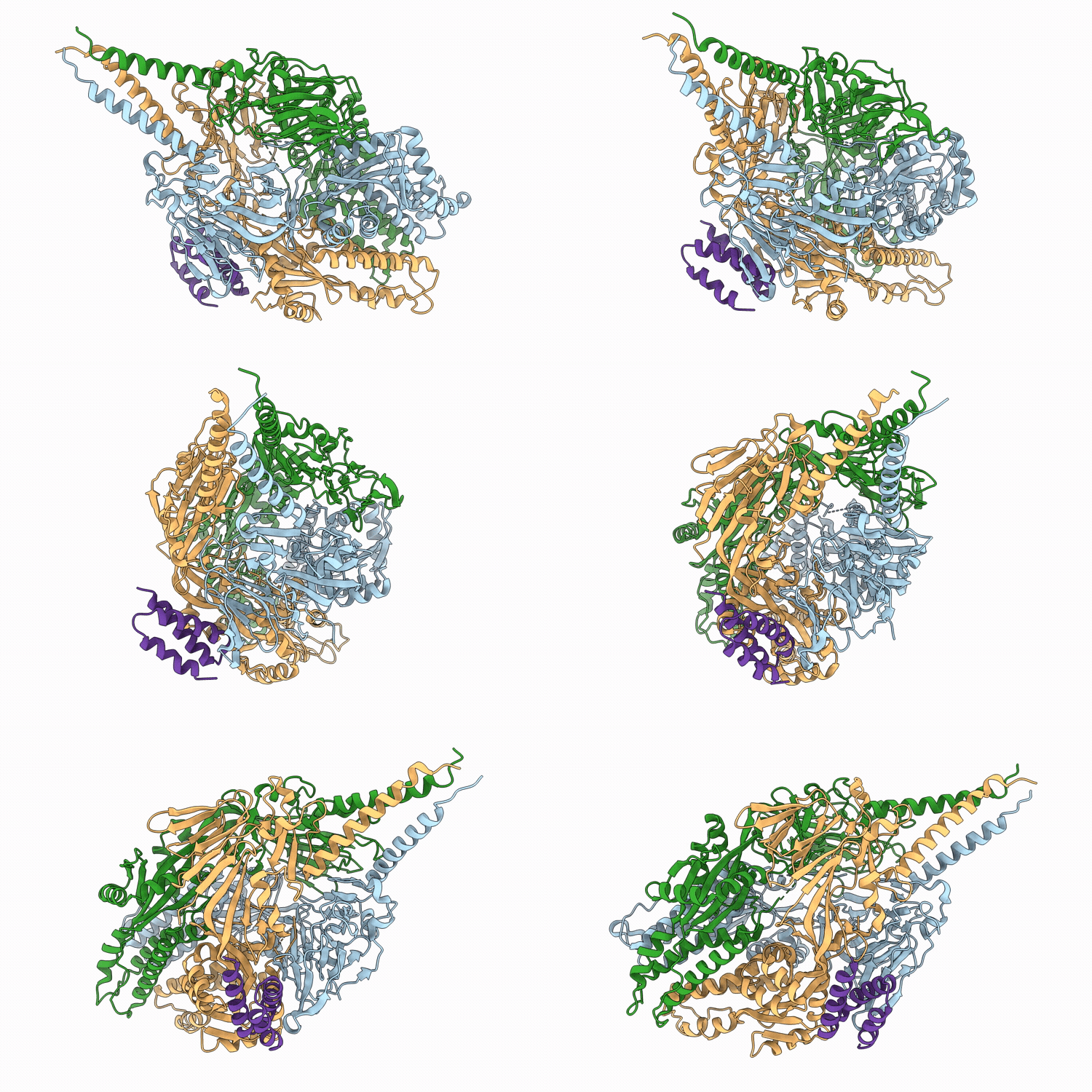
9YCF image
Deposition Date 2025-09-18
Release Date 2026-07-15
Last Version Date 2026-09-30
Entry Detail
PDB ID:
9YCF
Keywords:
Title:
RSV-F SC-DM bound to a designed protein minibinder, cb13
Biological Source:
Source Organism(s):
Expression System(s):
Method Details:
Experimental Method:
Resolution:
4.63 Å
Aggregation State:
PARTICLE
Reconstruction Method:
SINGLE PARTICLE
Macromolecular Entities
Polymer Type:polypeptide(L)
Molecule:Fusion glycoprotein F0
Gene (Uniprot):F
Chain IDs:B (auth: A), C (auth: B), D (auth: C)
Chain Length:509
Number of Molecules:3
Biological Source:Homo sapiens
Structural Superimposition Protein Blast
Polymer Type:polypeptide(L)
Molecule:cb13
Chain IDs:A (auth: G)
Chain Length:73
Number of Molecules:1
Biological Source:synthetic construct
Ligand Molecules
Primary Citation
Accelerating protein design by scaling experimental characterization.
Nat Commun 17 ? ? (2026)
PMID: 42754580 DOI: 10.1038/s41467-026-76740-9

Abstact

Recent advances in de novo protein design have greatly outpaced standard protein biochemistry workflows, making experimental validation a bottleneck. Here, we describe workflows to address the scale, speed and reproducibility of common in vitro protein testing methods, enabling at least an order of magnitude increase in throughput while reducing wetlab time. Semi-Automated Protein Production (SAPP) is a rapid, modular, scalable and cost-effective protocol, enabling up to milligram-scale protein production and standardized characterization - including yield, dispersity, and oligomeric state - of hundreds of designs per day, at the cost-equivalent of a few DNA oligos per construct. End-to-end protocol execution takes 48 hours, with ~6 hours spent benchside using standard laboratory equipment. We showcase the platform by rapidly screening redesigned fluorescent proteins, as well as identifying de novo binders that potently neutralize respiratory syncytial virus. We also developed a barcoding and demultiplexing protocol (DMX) to further reduce gene synthesis cost 5-fold by leveraging oligo pools as input DNA for the generation of thousands of sequence-verified arrayed clones. These protocols which combine optimized molecular biology, automated analysis, and optional open-source robotics should be widely adoptable, accelerating protein design.

Legend

Protein

Chemical

Disease

Primary Citation of related structures
Feedback Form
Name
Email
Institute
Feedback