

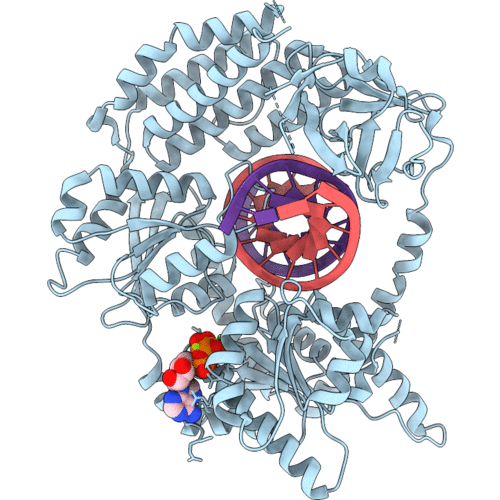
9Y4J image
Deposition Date 2025-09-03
Release Date 2026-09-09
Last Version Date 2026-10-21
Entry Detail
PDB ID:
9Y4J
Keywords:
Title:
CryoEM Structure of human MDA5 with dsRNA (one protein subunit on dsRNA)
Biological Source:
Method Details:
Experimental Method:
Resolution:
2.81 Å
Aggregation State:
PARTICLE
Reconstruction Method:
SINGLE PARTICLE
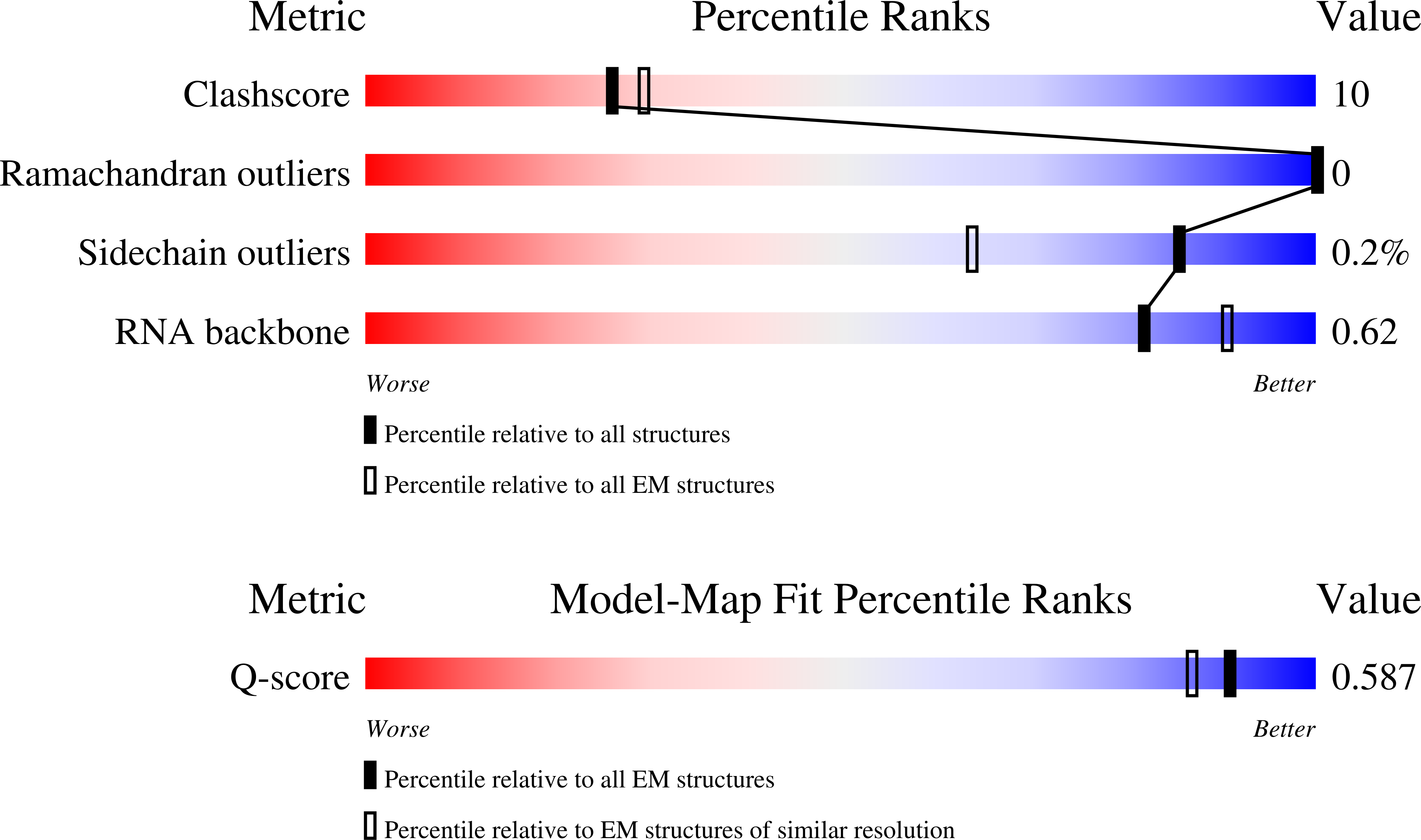
Macromolecular Entities
Polymer Type:polypeptide(L)
Molecule:Interferon-induced helicase C
Gene (Uniprot):IFIH1
Chain IDs:A
Chain Length:728
Number of Molecules:1
Biological Source:Homo sapiens
Polymer Type:polyribonucleotide
Molecule:RNA 13mer
Chain IDs:B
Chain Length:13
Number of Molecules:1
Biological Source:in vitro transcription vector pT7-Fluc(deltai)
Polymer Type:polyribonucleotide
Molecule:RNA 13mer
Chain IDs:C
Chain Length:13
Number of Molecules:1
Biological Source:in vitro transcription vector pT7-Fluc(deltai)
Primary Citation
Establishing the molecular basis for MDA5 mutation-linked autoimmunity.
Nucleic Acids Res. 54 ? ? (2026)
PMID: 42847245 DOI: 10.1093/nar/gkag941

Abstact

Melanoma differentiation-associated protein 5 (MDA5), a member of the RIG-I-like receptor family, is a cytoplasmic sensor essential for innate antiviral immunity. MDA5 distinguishes viral RNA from host RNA in part through its ATP hydrolysis activity, which promotes filament turnover on shorter endogenous double-stranded RNAs (dsRNAs). Here, we show that the gain-of-function T331I disease-linked mutation within the ATP-binding pocket disrupts this balance, resulting in constitutive interferon signaling. Through a combination of cryo-electron microscopy (cryoEM), biochemical assays, and cellular analyses, we reveal the extensive network of interactions that precisely position ATP for catalysis in the wild-type MDA5 ATP-binding pocket and also demonstrate that the T331I mutation impairs ATPase activity, thereby stabilizing MDA5-dsRNA complexes and leading to aberrant immune activation. These findings elucidate how MDA5 ATPase activity regulates antiviral specificity and prevents autoimmunity by controlling filament stability and downstream signaling, offering a mechanistic molecular explanation for disease pathogenesis.

Legend

Protein

Chemical

Disease

Primary Citation of related structures
Feedback Form
Name
Email
Institute
Feedback