

9XHH image
Deposition Date 2025-11-01
Release Date 2026-04-22
Last Version Date 2026-05-06
Entry Detail
PDB ID:
9XHH
Title:
Structure of the CCL19-CCR7-Gi-scFv16 complex
Biological Source:
Source Organism(s):
Homo sapiens (Taxon ID: 9606)
Mus musculus (Taxon ID: 10090)
Expression System(s):
Method Details:
Experimental Method:
Resolution:
3.00 Å
Aggregation State:
PARTICLE
Reconstruction Method:
SINGLE PARTICLE
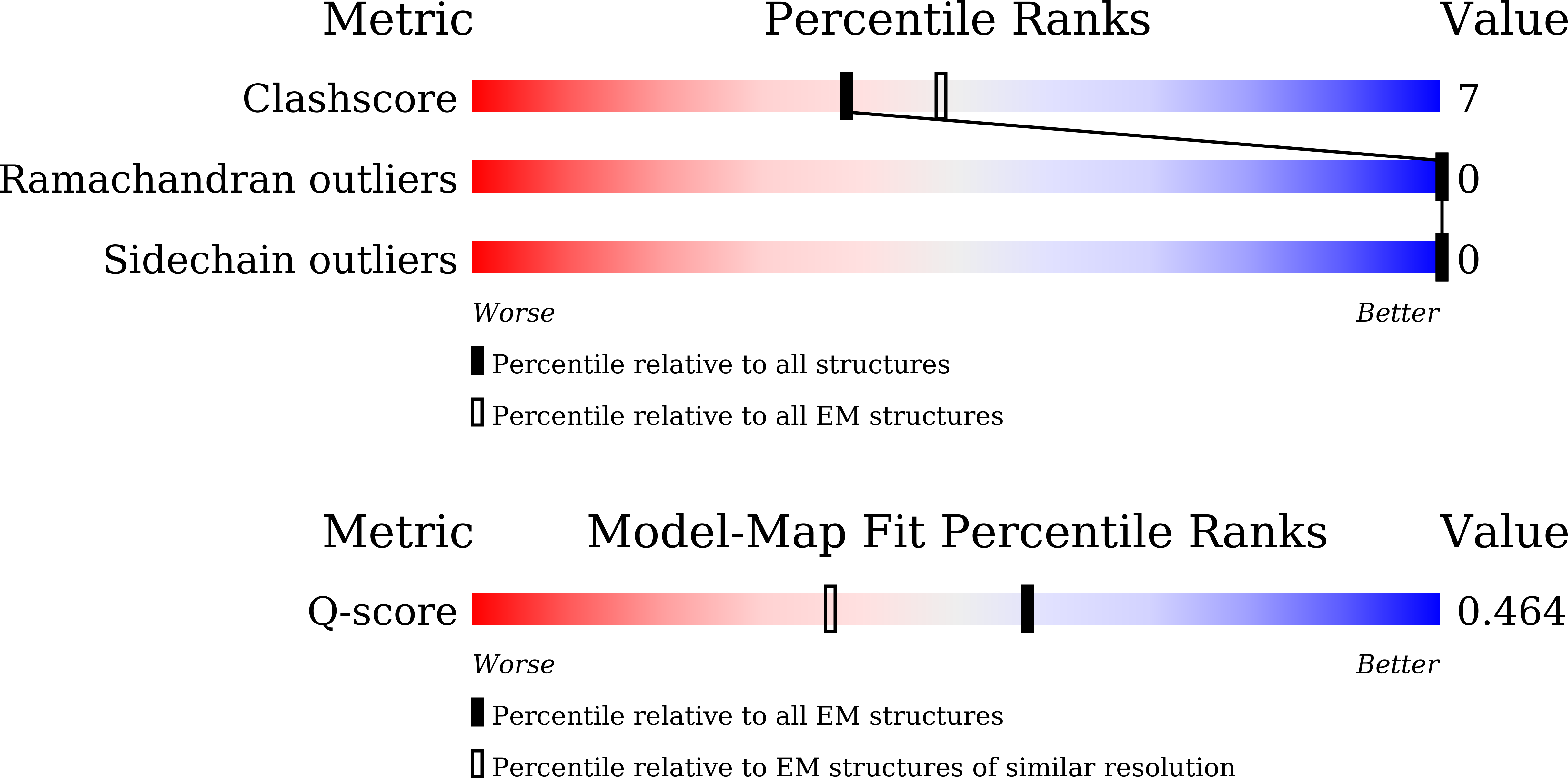
Macromolecular Entities
Structures with similar UniProt ID
Protein Blast
Polymer Type:polypeptide(L)
Molecule:Guanine nucleotide-binding pr
Gene (Uniprot):GNB1
Chain IDs:C (auth: B)
Chain Length:371
Number of Molecules:1
Biological Source:Homo sapiens
Protein Blast
Polymer Type:polypeptide(L)
Molecule:Guanine nucleotide-binding pr
Gene (Uniprot):GNG2, GNAI1
Chain IDs:D (auth: C), E (auth: A)
Chain Length:432
Number of Molecules:2
Biological Source:Homo sapiens
Protein Blast
Polymer Type:polypeptide(L)
Molecule:Antibody fragment scFv16
Chain IDs:F (auth: D)
Chain Length:256
Number of Molecules:1
Biological Source:Mus musculus
Structures with similar UniProt ID
Protein Blast
Polymer Type:polypeptide(L)
Molecule:C-C motif chemokine 19
Gene (Uniprot):CCL19
Chain IDs:A (auth: L)
Chain Length:92
Number of Molecules:1
Biological Source:Homo sapiens
Protein Blast
Polymer Type:polypeptide(L)
Molecule:C-C chemokine receptor type 7
Gene (Uniprot):CCR7
Chain IDs:B (auth: R)
Chain Length:551
Number of Molecules:1
Biological Source:Homo sapiens
Ligand Molecules
Primary Citation
Structural insights into biased signaling at chemokine receptor CCR7.
Proc.Natl.Acad.Sci.USA 123 e2533975123 e2533975123 (2026)
PMID: 42054364 DOI: 10.1073/pnas.2533975123

Abstact

CC chemokine receptor 7 (CCR7), which orchestrates adaptive immunity, exhibits a phenomenon known as biased agonism. CCL19 induces robust G-protein signaling and beta-arrestin recruitment, leading to transient signaling. In contrast, CCL21 preferentially activates G-protein pathways with minimal arrestin engagement, resulting in sustained signaling and differential functional outcomes. Here, we present the cryo-EM structures of the human CCR7-G(i) complex with either CCL19 or CCL21. The structures reveal that while both engage a conserved orthosteric pocket, they adopt markedly distinct binding poses. Notably, the compact 30s loop of CCL21 inserts deeply into the receptor's extracellular vestibule, whereas the corresponding loop of CCL19 rests atop extracellular loop 2. Molecular dynamics simulations further reveal that these distinct binding modes induce differential intracellular dynamics, linked to the rotameric state of Y83 at the intracellular end of transmembrane helix 1. We demonstrate that CCL19 stabilizes a flexible conformational ensemble with a highly dynamic helix 8, creating a lateral opening favorable for GPCR kinase engagement. Conversely, CCL21 restricts this flexibility, locking the receptor in a state that precludes kinase interaction while maintaining G-protein coupling. Corroborated by functional data, these findings provide key insights into the structural basis of biased agonism at CCR7 and establish a foundation for rational design of pathway-selective immunomodulators.

Legend

Protein

Chemical

Disease

Primary Citation of related structures
Feedback Form
Name
Email
Institute
Feedback