

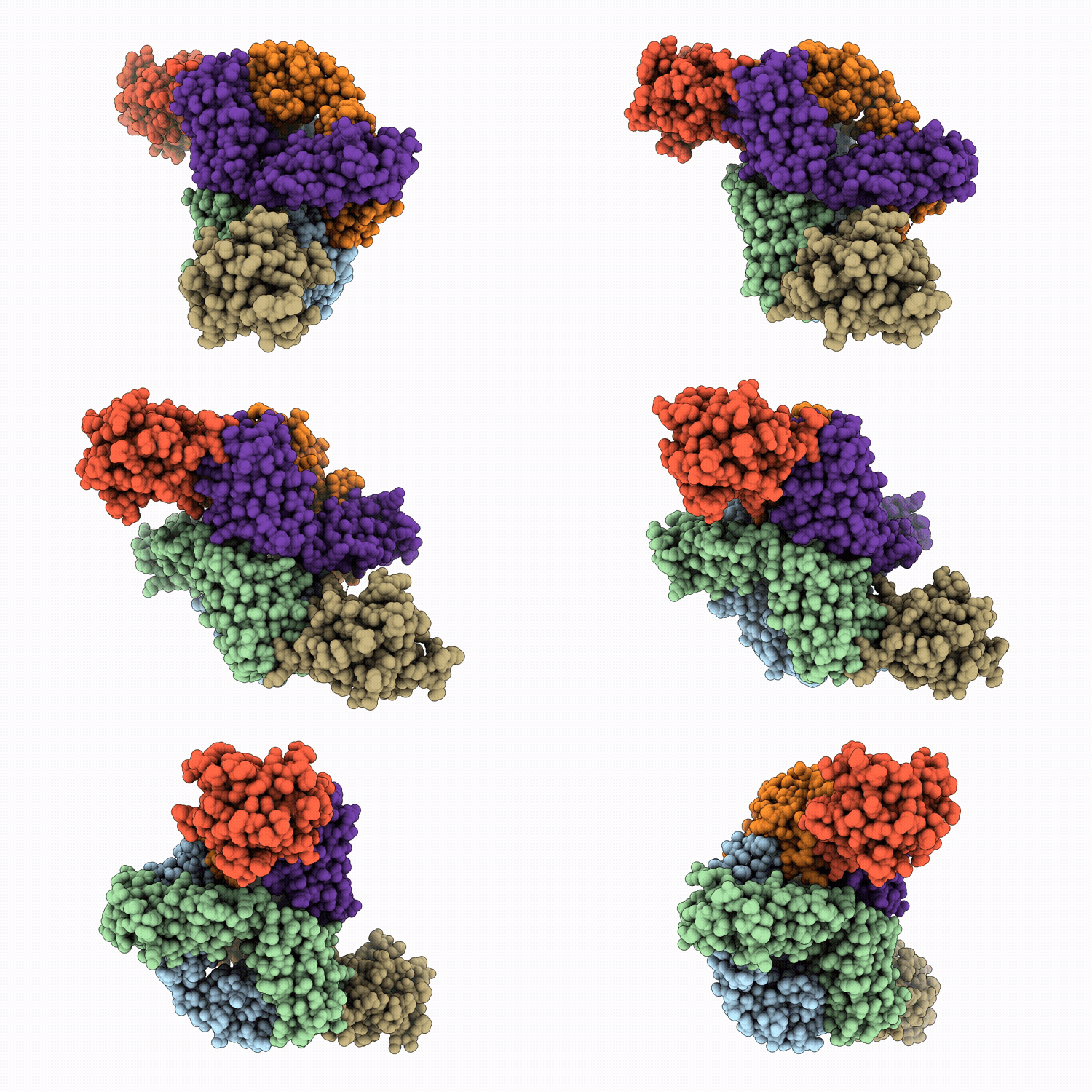
9WWH image
Deposition Date 2025-09-23
Release Date 2026-03-18
Last Version Date 2026-03-18
Entry Detail
PDB ID:
9WWH
Title:
Crystal structure of IL-33 and antibody Tozorakimab fab binary complex
Biological Source:
Source Organism(s):
Homo sapiens (Taxon ID: 9606)
Expression System(s):
Method Details:
Experimental Method:
Resolution:
3.51 Å
R-Value Free:
0.25
R-Value Work:
0.22
R-Value Observed:
0.23
Space Group:
P 21 21 21
Macromolecular Entities
Polymer Type:polypeptide(L)
Molecule:Interleukin-33 (109-270)
Gene (Uniprot):IL33
Chain IDs:E (auth: C), F (auth: D)
Chain Length:152
Number of Molecules:2
Biological Source:Homo sapiens
Polymer Type:polypeptide(L)
Molecule:Tozorakimab-Heavy chain
Chain IDs:A (auth: H), C (auth: A)
Chain Length:228
Number of Molecules:2
Biological Source:Homo sapiens
Polymer Type:polypeptide(L)
Molecule:Tozorakimab-Light chain
Chain IDs:B (auth: L), D (auth: B)
Chain Length:211
Number of Molecules:2
Biological Source:Homo sapiens
Ligand Molecules
Primary Citation
Structures of clinical antibodies bound to IL-33 uncover two distinct epitopes underlying differential efficacy.
Mabs 18 2639673 2639673 (2026)
PMID: 41765683 DOI: 10.1080/19420862.2026.2639673

Abstact

Interleukin-33 (IL-33), an alarmin cytokine of the IL-1 family, drives type 2 inflammation through signaling via the ST2 and IL-1RAcP receptors, making it a critical therapeutic target for inflammatory diseases such as asthma and chronic obstructive pulmonary disease. Current therapeutic strategies have primarily focused on antibodies that target IL-33 or ST2 to disrupt their specific interaction. However, the structural mechanisms underlying antibody-mediated neutralization of IL-33 remain poorly understood. Here, we report the structures of three antibodies in clinical trial - etokimab, itepekimab, and tozorakimab - complexed with IL-33, determined by X-ray crystallography and cryo-electron microscopy. Structural analysis reveals two distinct neutralizing epitopes on IL-33, termed Epitope 1 at IL-33/ST2 binding Site 1 and Epitope 2 at IL-33/ST2 binding Site 2. Tozorakimab, which targets Epitope 1, completely blocks ST2 engagement by sterically occluding the ST2 D1-D2 domain-binding interface. In contrast, etokimab and itepekimab, which recognize Epitope 2, interfere with IL-33 recognition of the ST2 D3 domain and thereby only partially inhibit ST2 binding. These structural and biochemical findings provide a molecular explanation for the differential efficacy of the three antibodies in inhibiting IL-33 signaling in cellular assays. Collectively, our results provide valuable insights into the molecular determinants of efficacy for existing IL-33 therapeutics and offer a structural framework for the rational design of next-generation IL-33 targeted inhibitors.

Legend

Protein

Chemical

Disease

Primary Citation of related structures
Feedback Form
Name
Email
Institute
Feedback