

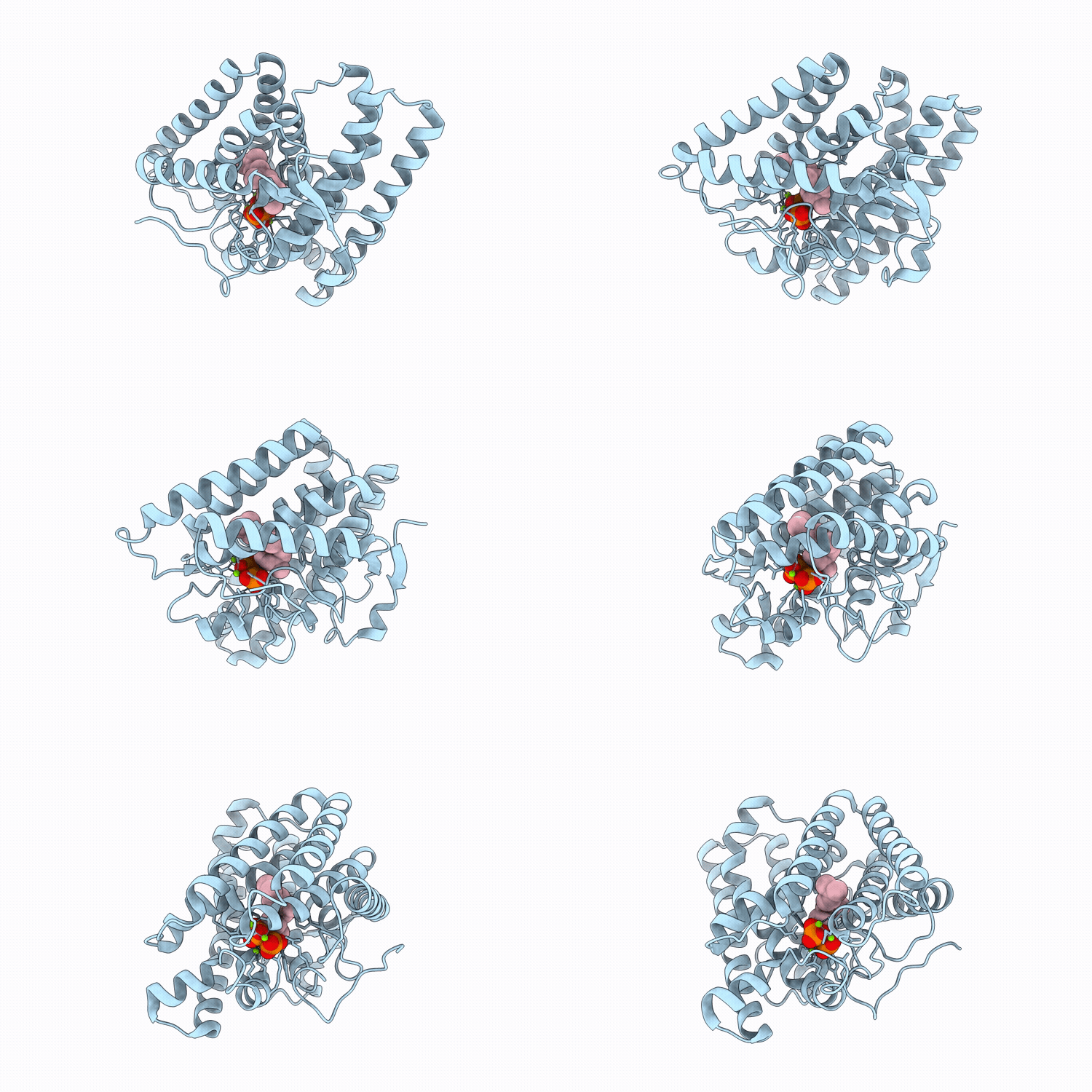
9VSI image
Deposition Date 2025-07-08
Release Date 2026-07-15
Last Version Date 2026-10-14
Entry Detail
PDB ID:
9VSI
Keywords:
Title:
The crystal structure of the germacrene A synthase FpGAS-T169F mutant in complex with beta-farnesene
Biological Source:
Source Organism(s):
Fusarium poae (Taxon ID: 36050)
Expression System(s):
Method Details:
Experimental Method:
Resolution:
2.43 Å
R-Value Free:
0.22
R-Value Work:
0.18
R-Value Observed:
0.18
Space Group:
P 31 2 1
Macromolecular Entities
Polymer Type:polypeptide(L)
Molecule:Terpene synthase
Gene (Uniprot):FPOA_01811
Mutagens:T169F
Chain IDs:A
Chain Length:313
Number of Molecules:1
Biological Source:Fusarium poae
Primary Citation
Reprogramming product selectivity and activity in promiscuous terpene synthases via substrate conformation engineering.
Nat Commun 17 ? ? (2026)
PMID: 42816480 DOI: 10.1038/s41467-026-77224-6

Abstact

Terpenoids are structurally diverse natural products with broad applications, yet their biosynthesis is often constrained by the low catalytic efficiency and poor product selectivity of terpene synthases (TPSs). Simultaneously enhancing product specificity and catalytic performance remains a major challenge in TPS engineering. Here, we elucidate the regio- and stereoselectivity of a fungal germacrene A synthase, which catalyzes the 1,10-cyclization of farnesyl diphosphate to form a central sesquiterpene intermediate. The side-chain volume of a non-catalytic residue (T169) adjacent to the substrate pocket modulates substrate-binding conformations, thereby redirecting the carbocation cascade and reshaping the product profile. Mechanism-guided pocket engineering further yielded terpene synthase variants with altered product specificity. Notably, one variant increased (+)-germacrene A production in Escherichia coli by 24.3-fold, reaching 15.8 g L(-)(1) in a bioreactor-the highest titer reported in this host to the best of our knowledge. These results provide mechanistic insight into substrate-conformation-mediated reprogramming of TPS specificity, highlighting a promising strategy for the development of high-performance terpenoid biocatalysts.

Legend

Protein

Chemical

Disease

Primary Citation of related structures
Feedback Form
Name
Email
Institute
Feedback