

9V2E image
Deposition Date 2025-05-19
Release Date 2026-11-04
Last Version Date 2026-11-04
Entry Detail
PDB ID:
9V2E
Keywords:
Title:
CTP synthase dDON-condition state 4
Biological Source:
Source Organism(s):
Method Details:
Experimental Method:
Resolution:
2.99 Å
Aggregation State:
FILAMENT
Reconstruction Method:
SINGLE PARTICLE
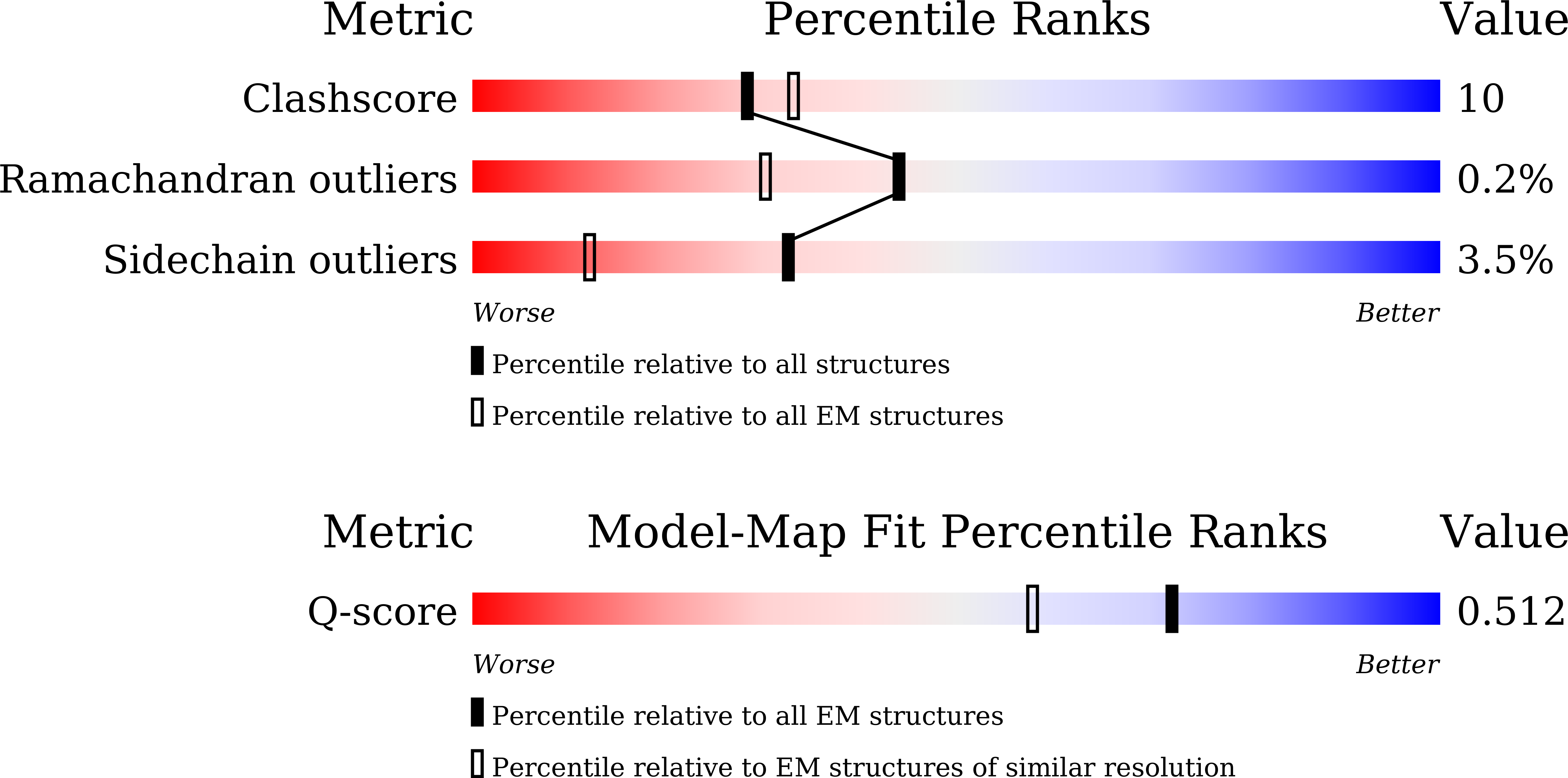
Macromolecular Entities
Polymer Type:polypeptide(L)
Molecule:CTP synthase
Gene (Uniprot):Ctps
Chain IDs:A, B, C
Chain Length:556
Number of Molecules:3
Biological Source:Drosophila melanogaster
Primary Citation
GTP orchestrates CTP synthase via an allosteric effector-cycling mechanism.
Proc.Natl.Acad.Sci.USA 123 e2620272123 e2620272123 (2026)
PMID: 42853685 DOI: 10.1073/pnas.2620272123

Abstact

Cytidine triphosphate (CTP), a fundamental building block of RNA, plays vital roles in diverse biological processes. CTP synthase (CTPS) is the only known enzyme for de novo synthesis of CTP. Efficient CTPS catalysis requires guanosine triphosphate (GTP) in a dose-dependent, nonconsumptive manner; however, the precise mechanism by which GTP drives CTP formation remains unclear. Here, we integrate a series of cryo-EM structures of Drosophila melanogaster CTPS captured from actively catalyzing samples with biochemical and mutagenesis analyses, yielding 34 distinct CTPS states at resolutions up to 2.0 A. We find that GTP binds to and dissociates from CTPS once per catalytic cycle, thereby enabling the production of a single CTP molecule. Initial GTP engagement requires formation of 4-phosphoryl-UTP in the AL domain, whereas full stabilization of GTP binding is promoted by occupancy of the GAT active site. Together, these two checkpoints couple GTP recruitment and stabilization to catalytic progress in the two domains, enabling the coordinated synthesis of one CTP molecule per GTP binding-dissociation cycle. Moreover, the GTP-recognition site is highly conserved across the three domains of life. These findings establish a comprehensive mechanistic framework for efficient CTPS catalysis and define "effector-cycling"-in which GTP undergoes obligatory binding and dissociation during each catalytic cycle to regulate an intermediate step in a multistep catalytic process-as a distinct mode of allosteric regulation.

Legend

Protein

Chemical

Disease

Primary Citation of related structures
Feedback Form
Name
Email
Institute
Feedback