

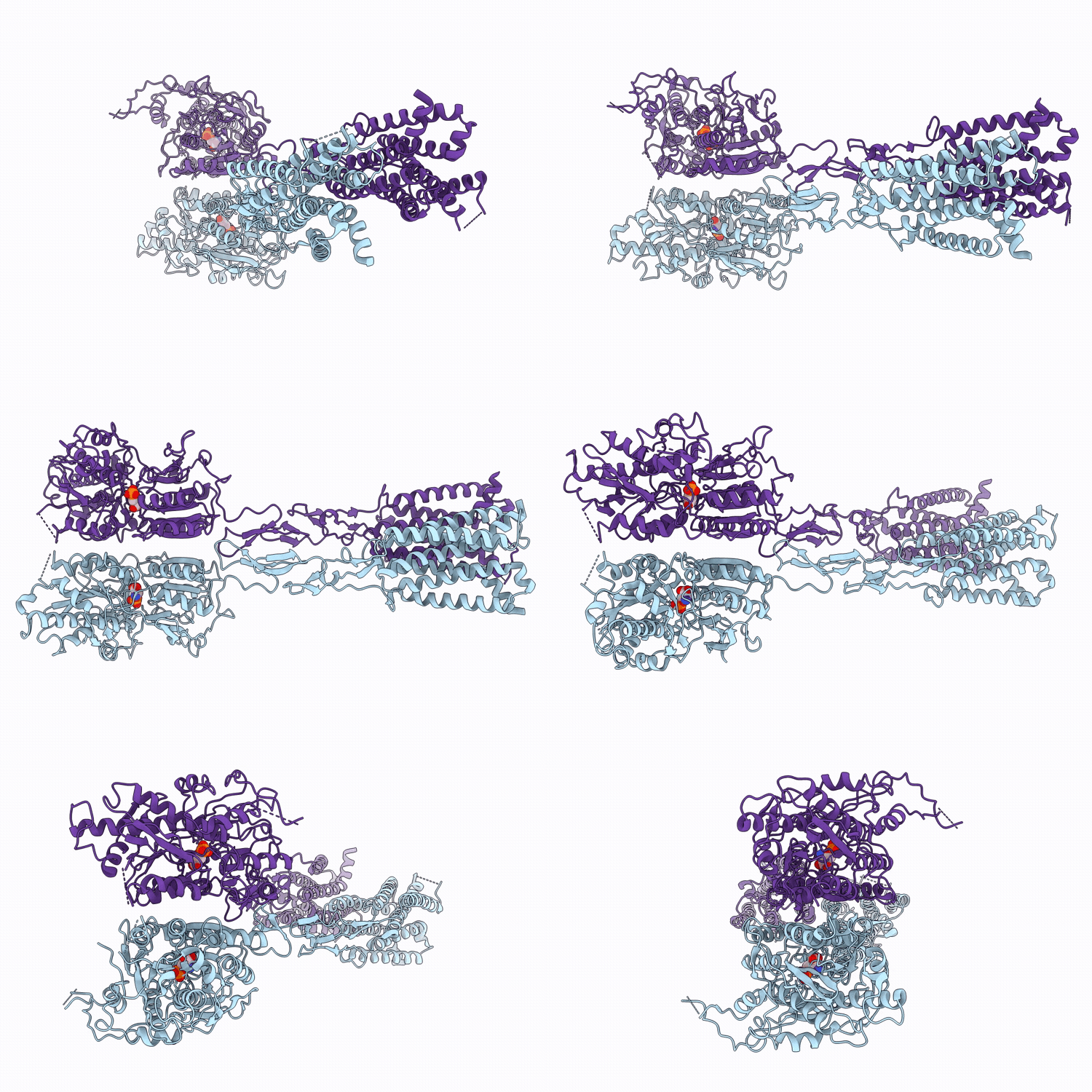
9UYO image
Deposition Date 2025-05-15
Release Date 2026-03-18
Last Version Date 2026-09-30
Entry Detail
PDB ID:
9UYO
Title:
Cryo-EM structure of a class C GPCR (Class 1)
Biological Source:
Source Organism(s):
Homo sapiens (Taxon ID: 9606)
Expression System(s):
Method Details:
Experimental Method:
Resolution:
3.39 Å
Aggregation State:
PARTICLE
Reconstruction Method:
SINGLE PARTICLE
Macromolecular Entities
Polymer Type:polypeptide(L)
Molecule:Metabotropic glutamate recept
Gene (Uniprot):GRM6
Chain IDs:A (auth: B), B (auth: A)
Chain Length:877
Number of Molecules:2
Biological Source:Homo sapiens
Ligand Molecules
Primary Citation
CryoEM structure of mGlu6 captures receptor activation prior to G protein coupling.
Nat Commun 17 ? ? (2026)
PMID: 41803130 DOI: 10.1038/s41467-026-70436-w

Abstact

The metabotropic glutamate receptor 6 (mGlu6) is essential for synaptic communication of rod photoreceptors, and mutations in mGlu6 lead to a blinding disorder. However, its structural organization remains unknown. Here, we present the structure of agonist-bound mGlu6, revealing an asymmetric dimer arrangement in the absence of a G protein. This indicates that agonist binding alone can induce the homodimeric receptor asymmetry in metabotropic glutamate receptors and structurally prime mGlu6 for activation by pre-organizing the transmembrane domain dimer interface for G protein binding. The structure also identifies noncanonical interactions between the cysteine-rich domain and extracellular loop 2, forming a unique interface that likely stabilizes the activation state. Mutational analyses of this interface reveal its role in maintaining rapid Galphao activation and surface targeting. The structure also permits mechanistic investigation of congenital stationary night blindness and reveals diverse effects of pathogenic mutations on surface trafficking, Galphao coupling, and activation dynamics, including unexpected gain-of-function. These results provide critical insight into the intermediate asymmetric structure of mGlu6 and offer a molecular framework for understanding the pathogenesis of inherited retinal disorders.

Legend

Protein

Chemical

Disease

Primary Citation of related structures
Feedback Form
Name
Email
Institute
Feedback