

9U9Q image
Deposition Date 2025-03-29
Release Date 2026-04-01
Last Version Date 2026-06-24
Entry Detail
PDB ID:
9U9Q
Keywords:
Title:
Tubulin-RB3-TTL in complex with C38
Biological Source:
Source Organism(s):
Rattus norvegicus (Taxon ID: 10116)
Gallus gallus (Taxon ID: 9031)
Sus scrofa (Taxon ID: 9823)
Expression System(s):
Method Details:
Experimental Method:
Resolution:
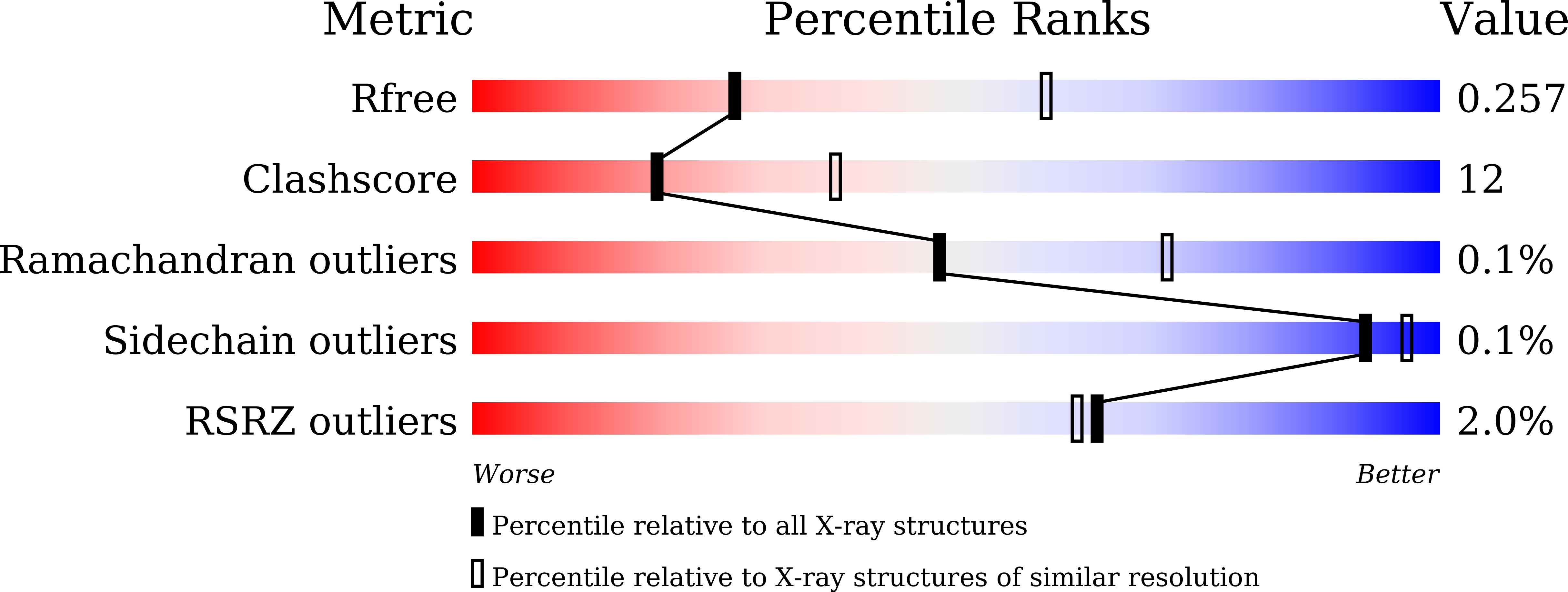
2.93 Å
R-Value Free:
0.26
R-Value Work:
0.21
R-Value Observed:
0.21
Space Group:
P 21 21 21
Macromolecular Entities
Structures with similar UniProt ID
Protein Blast
Polymer Type:polypeptide(L)
Molecule:Tubulin alpha-1B chain
Gene (Uniprot):TUBA1B
Chain IDs:A, C
Chain Length:451
Number of Molecules:2
Biological Source:Sus scrofa
Structures with similar UniProt ID
Protein Blast
Polymer Type:polypeptide(L)
Molecule:Tubulin beta chain
Chain IDs:B, D
Chain Length:431
Number of Molecules:2
Biological Source:Sus scrofa
Structures with similar UniProt ID
Protein Blast
Polymer Type:polypeptide(L)
Molecule:Stathmin-4
Gene (Uniprot):Stmn4
Chain IDs:E
Chain Length:189
Number of Molecules:1
Biological Source:Rattus norvegicus
Structures with similar UniProt ID
Protein Blast
Polymer Type:polypeptide(L)
Molecule:Tubulin--tyrosine ligase
Gene (Uniprot):TTL
Chain IDs:F
Chain Length:384
Number of Molecules:1
Biological Source:Gallus gallus
Primary Citation
Structure-based design and synthesis of 3-substituted-1,2,4-triazolo[1,5-a]pyrimidines as dual vinca/gatorbulin-site ligands for cancer treatment.
Eur.J.Med.Chem. 301 118245 118245 (2026)
PMID: 41106064 DOI: 10.1016/j.ejmech.2025.118245

Abstact

Our preliminary studies indicate that cevipabulin concurrently binds to both the vinca site and the gatorbulin site, and promotes tubulin degradation. To improve its antiproliferative activity and investigate the structure-activity relationships (SARs), thirty-eight cevipabulin derivatives were designed and synthesized based on the cevipabulin-tubulin cocrystal structure. Among them, compound 8g exerted optimal antiproliferative activity, with IC(50) values ranging from 0.016 to 0.035 muM against three tested tumor cell lines. The cocrystal structure of the 8g-tubulin complex revealed that it simultaneously occupies both the vinca site and the gatorbulin site, while maintaining a binding mode similar to that of cevipabulin. Furthermore, 8g promoted alphabeta-tubulin degradation and displayed good oral bioavailability. In an HT29 xenograft model, oral administration of 8g at doses of 20 and 40 mg/kg every 3 days resulted in potent in vivo antitumor activity, with tumor growth inhibition (TGI) rates of 41.0 % and 49.5 %, respectively. Moreover, 8g exhibited significantly reduced toxicity and fewer adverse effects compared to cevipabulin, supporting its potential as a promising therapeutic agent for cancer treatment.

Legend

Protein

Chemical

Disease

Primary Citation of related structures
Feedback Form
Name
Email
Institute
Feedback