

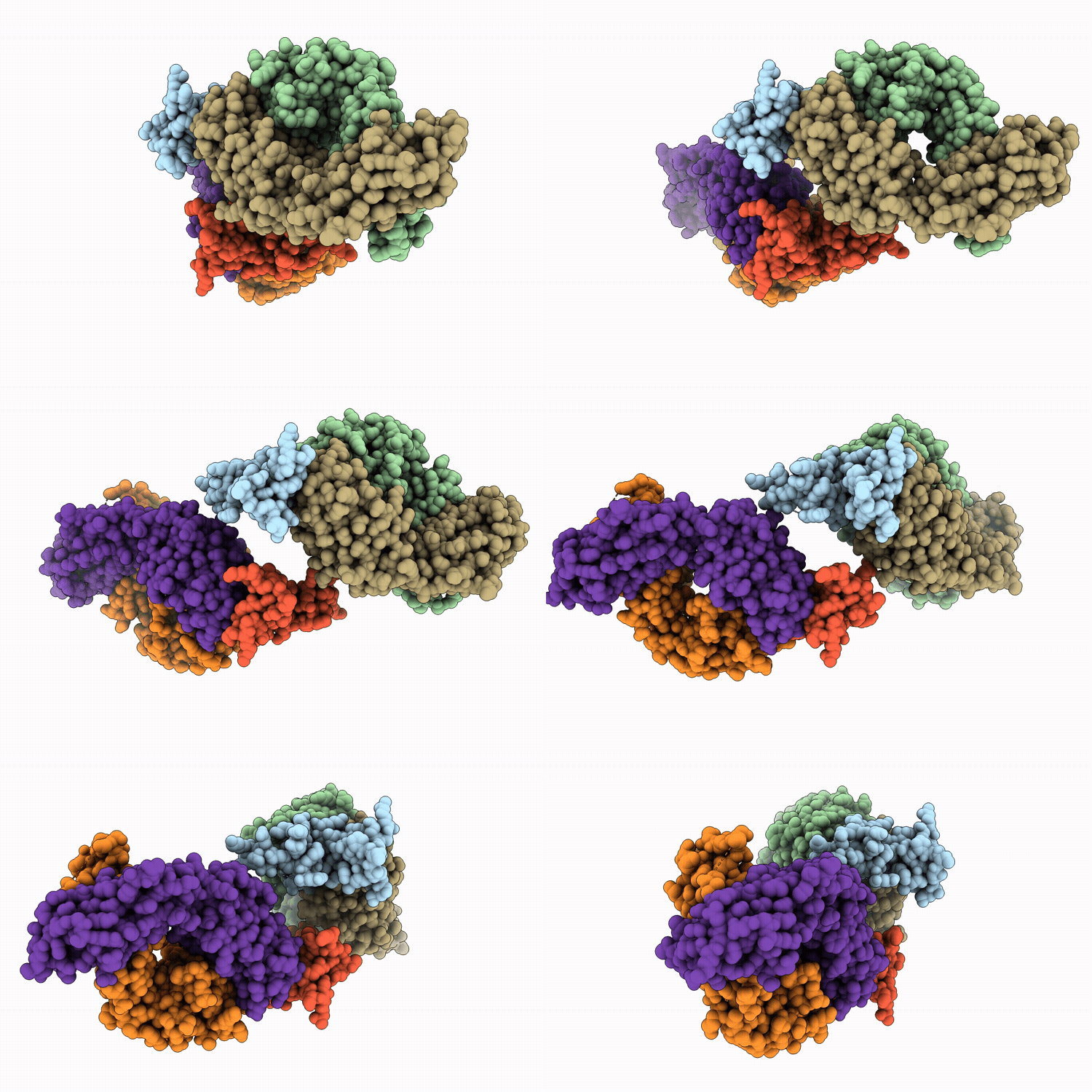
9TUW image
Deposition Date 2026-01-10
Release Date 2026-07-08
Last Version Date 2026-10-28
Entry Detail
PDB ID:
9TUW
Keywords:
Title:
PfRIPR EGF6 and 7 bound to monoclonal antibody RP.012
Biological Source:
Source Organism(s):
Expression System(s):
Method Details:
Experimental Method:
Resolution:
2.20 Å
R-Value Free:
0.25
R-Value Work:
0.24
R-Value Observed:
0.24
Space Group:
P 1
Macromolecular Entities
Structural Superimposition Protein Blast
Polymer Type:polypeptide(L)
Molecule:Immunoglobulin gamma-1 heavy
Gene (Uniprot):RIPR
Chain IDs:A, D
Chain Length:343
Number of Molecules:2
Biological Source:Homo sapiens, Plasmodium falciparum 3D7
Structural Superimposition Protein Blast
Polymer Type:polypeptide(L)
Molecule:RP.012 heavy chain
Chain IDs:B, E
Chain Length:241
Number of Molecules:2
Biological Source:Mus musculus
Structural Superimposition Protein Blast
Polymer Type:polypeptide(L)
Molecule:RP.012 light chain
Chain IDs:C, F
Chain Length:234
Number of Molecules:2
Biological Source:Mus musculus
Primary Citation
Dynamic hinge-motion of PfRIPR revealed by malaria invasion inhibitory antibodies.
Nat Commun 17 ? ? (2026)
PMID: 42864316 DOI: 10.1038/s41467-026-77069-z

Abstact

The PfPCRCR complex is essential for invasion of human erythrocytes by the deadliest malaria parasite, Plasmodium falciparum. Antibodies against each subunit of PfPCRCR prevent erythrocyte invasion and the PfRH5 component is currently the most advanced blood-stage malaria vaccine. Central within PfPCRCR is PfRIPR. This complex molecule contains a core and a flexible tail and allows PfPCRCR to bridge the parasite and erythrocyte during invasion. In this study, we generated a small panel of human monoclonal antibodies against PfRIPR. We structurally characterised four PfRIPR tail-binding antibodies in complex with PfRIPR fragments. We show that growth-inhibitory antibody RP.012 induces a kink in the PfRIPR tail while non-inhibitory antibodies do not. Furthermore, we show that these four antibodies modulate each other, either through antagonism or by acting synergistically. These studies have implications for the design of PfRIPR-based vaccine immunogens and indicate that the tail of PfRIPR undergoes essential conformational changes during erythrocyte invasion.

Legend

Protein

Chemical

Disease

Primary Citation of related structures
Feedback Form
Name
Email
Institute
Feedback