

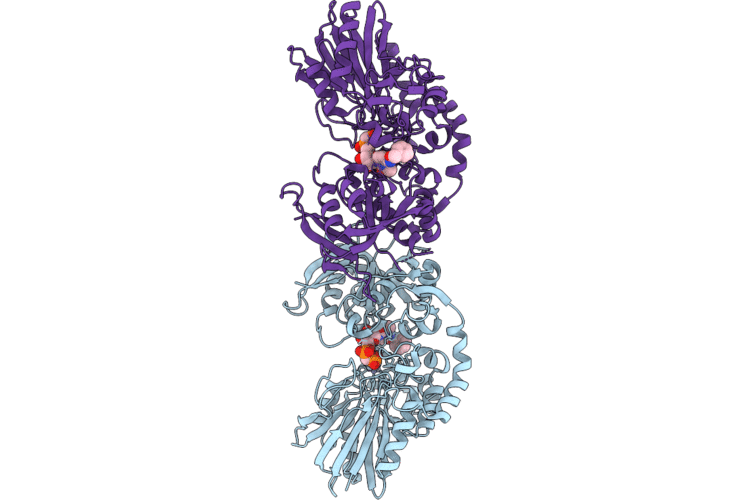
9SME image
Deposition Date 2025-09-07
Release Date 2026-08-12
Last Version Date 2026-08-12
Entry Detail
PDB ID:
9SME
Keywords:
Title:
Crystal structure of CD73 in complex with JMS04-14, a pyrimidine-based nucleoside bisphosphonate inhibitor, in the closed state and in crystal form III
Biological Source:
Source Organism(s):
Homo sapiens (Taxon ID: 9606)
Expression System(s):
Method Details:
Experimental Method:
Resolution:
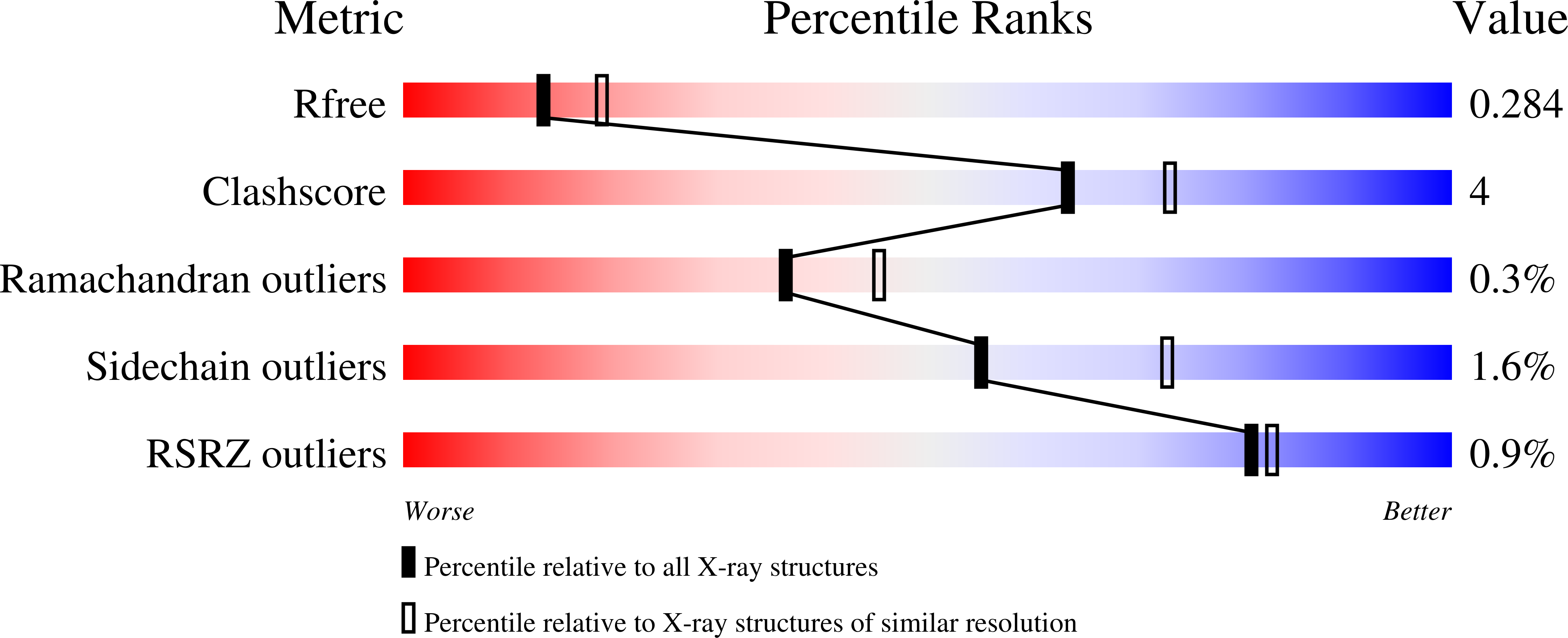
2.55 Å
R-Value Free:
0.28
R-Value Work:
0.25
R-Value Observed:
0.25
Space Group:
P 21 21 2
Macromolecular Entities
Polymer Type:polypeptide(L)
Molecule:5'-nucleotidase
Gene (Uniprot):NT5E
Chain IDs:A, B
Chain Length:538
Number of Molecules:2
Biological Source:Homo sapiens
Primary Citation
Fluorine-18-Labeled Nucleotide Analogs Targeting Ecto-5'-Nucleotidase (CD73) for Positron Emission Tomography Imaging of Solid Tumors.
Angew.Chem.Int.Ed.Engl. 65 e22758 e22758 (2026)
PMID: 41834421 DOI: 10.1002/anie.202522758

Abstact

Ecto-5'-nucleotidase (CD73) is a potential new drug target for cancer immunotherapy. Its overexpression is associated with various aggressive cancers, including triple-negative breast cancer (TNBC) and pancreatic cancer, making it a promising target for diagnostic imaging. Besides antibodies, small-molecule CD73 inhibitors have been developed and are currently in clinical trials. This study aimed to develop and evaluate fluorine-18 labeled high-affinity CD73 inhibitors as tracers for the non-invasive positron emission tomography (PET) imaging of CD73 expression in cancer. Two CD73 inhibitors were selected for radiolabeling based on their high potency (K(i) values of ca. 1 nM) and favorable pharmacokinetic properties, yielding [(18)F]PSB-19427 ([(18)F]1) and [(18)F]MRS-4648 ([(18)F]2). Ex vivo imaging studies on human breast cancer tissues indicated specific binding of both radiotracers. Subsequent in vivo studies proved [(18)F]1 to be superior due to its long elimination half-life and its accumulation in TNBC and pancreatic cancer tissues, suggesting its potential as a versatile PET tracer for imaging of various solid tumors. Compared to [(18)F]FDG, [(18)F]1 was superior in visualizing TNBC, offering potential advantages over [(18)F]FDG in terms of specificity and diagnostic accuracy. Thus, [(18)F]1 is a PET tracer with outstanding properties suitable for broad application in cancer diagnosis and personalized medicine.

Legend

Protein

Chemical

Disease

Primary Citation of related structures
Feedback Form
Name
Email
Institute
Feedback