

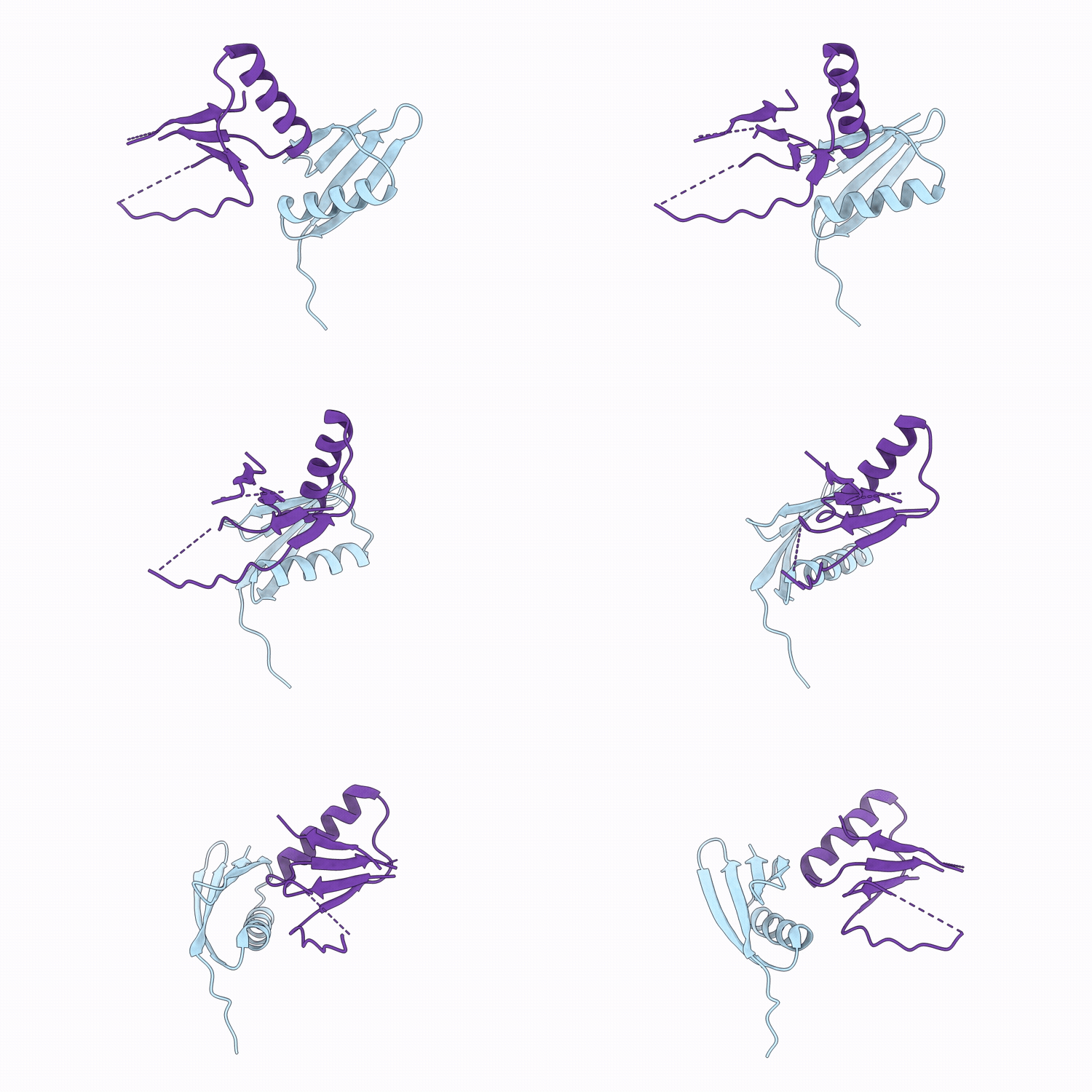
9RXK image
Deposition Date 2025-07-11
Release Date 2026-07-22
Last Version Date 2026-10-21
Entry Detail
PDB ID:
9RXK
Title:
Crystal structure of the Ustilago maydis virulence factor Pit2
Biological Source:
Source Organism(s):
Streptococcus (Taxon ID: 1301)
Mycosarcoma maydis (Taxon ID: 5270)
Expression System(s):
Method Details:
Experimental Method:
Resolution:
2.35 Å
R-Value Free:
0.27
R-Value Work:
0.23
R-Value Observed:
0.23
Space Group:
P 61 2 2
Macromolecular Entities
Polymer Type:polypeptide(L)
Molecule:Immunoglobulin G-binding prot
Gene (Uniprot):spg
Chain IDs:A
Chain Length:89
Number of Molecules:1
Biological Source:Streptococcus
Polymer Type:polypeptide(L)
Molecule:Secreted effector PIT2
Gene (Uniprot):PIT2
Chain IDs:B
Chain Length:99
Number of Molecules:1
Biological Source:Mycosarcoma maydis
Primary Citation
A co-evolved peptide-GPCR system senses host entry to drive fungal infection.
Nat Commun 17 ? ? (2026)
PMID: 42855465 DOI: 10.1038/s41467-026-78428-6

Abstact

A successful infection requires pathogens to recognize the specific host environment in order to reprogram their physiology accordingly. One major way in which eukaryotic cells sense their surroundings is via G-Protein Coupled Receptors (GPCRs), which share a seven-transmembrane architecture and G-protein-mediated downstream signaling. While mammalian GPCRs are well-characterized and represent important drug targets, their fungal counterparts remain poorly understood. Here we uncover a GPCR-based mechanism that allows the corn pathogen Ustilago maydis to sense whether it has entered plant tissue. During infection, the fungus secretes the protein Pit2, which is cleaved by host apoplastic cysteine proteases, releasing a peptide ligand 'hidden' within the protein core. This ligand activates the fungal GPCR Gpe1, thus promoting fungal proliferation after initial host penetration. We elucidate the crystal structure of Pit2 and model the complex formed by Gpe1 and the Pit2-derived peptide. Structure-guided mutational analysis supports that disrupting this interaction reduces fungal virulence. The Gpe1/Pit2 system is conserved in related fungal species, with co-evolutionary signatures apparently preserving receptor-ligand specificity. Furthermore, this system shows mechanistic similarities to mammalian receptors, suggesting an evolutionary link between fungal and mammalian GPCRs.

Legend

Protein

Chemical

Disease

Primary Citation of related structures
Feedback Form
Name
Email
Institute
Feedback