

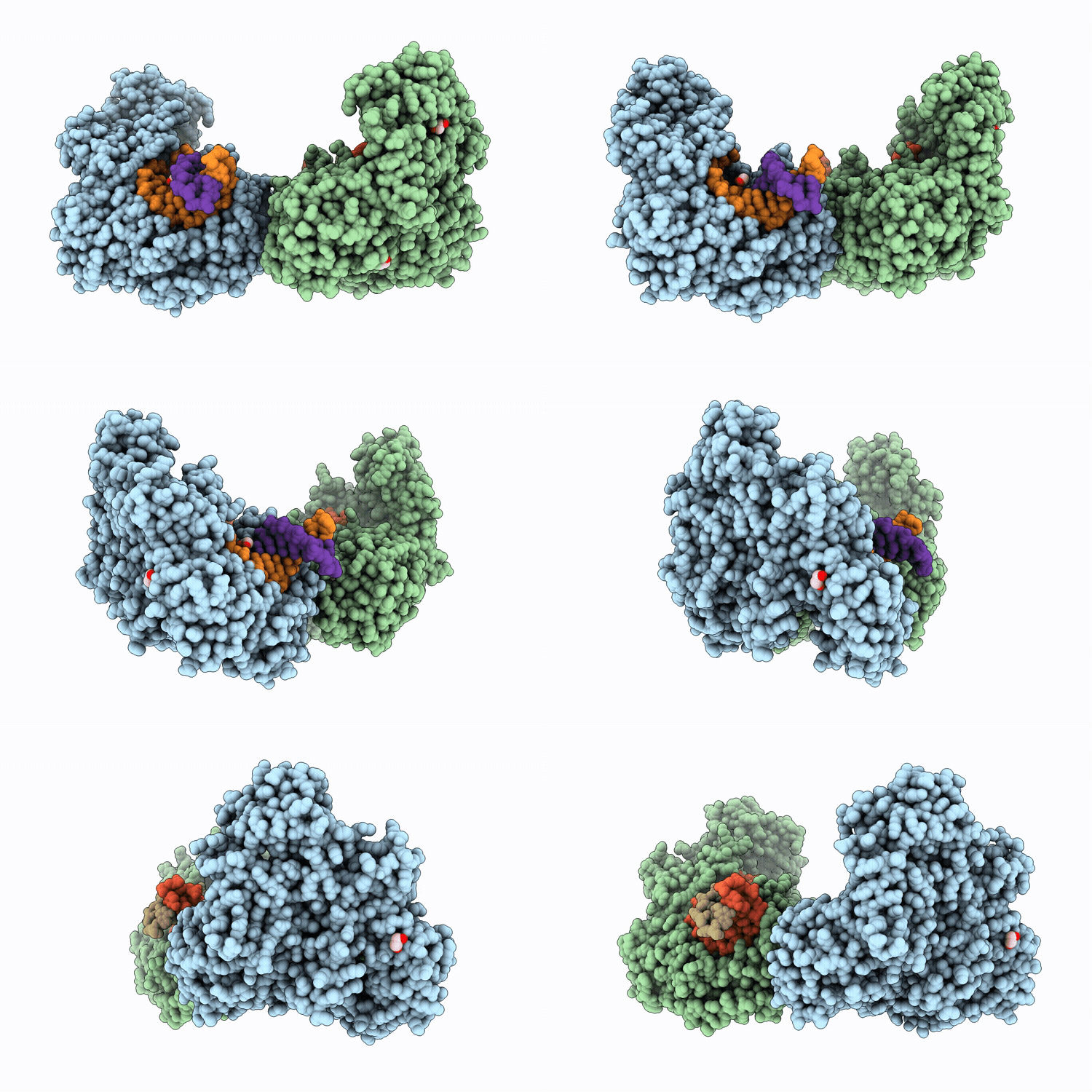
9R83 image
Deposition Date 2025-05-15
Release Date 2026-07-08
Last Version Date 2026-08-19
Entry Detail
PDB ID:
9R83
Keywords:
Title:
KOD-H4 DNA polymerase mutant in a ternary complex with HNA:DNA containing six HNA nucleotides and a 2',3'-dideoxycytidine at the 3'-end of the DNA primer complexed to a natural dATP in the active site
Biological Source:
Source Organism(s):
Expression System(s):
Method Details:
Experimental Method:
Resolution:
2.80 Å
R-Value Free:
0.25
R-Value Work:
0.21
R-Value Observed:
0.21
Space Group:
P 21 21 21
Macromolecular Entities
Polymer Type:polypeptide(L)
Molecule:DNA polymerase
Chain IDs:B (auth: A), C (auth: B)
Chain Length:774
Number of Molecules:2
Biological Source:Thermococcus kodakarensis KOD1
Polymer Type:polydeoxyribonucleotide
Molecule:DNA (5'-D(P*(6HA)P*(6HC)P*(6H
Chain IDs:E (auth: D), F (auth: E)
Chain Length:16
Number of Molecules:2
Biological Source:synthetic construct
Polymer Type:polydeoxyribonucleotide
Molecule:DNA (5'-D(*GP*AP*CP*CP*AP*CP*
Chain IDs:A (auth: F), D (auth: C)
Chain Length:12
Number of Molecules:2
Biological Source:synthetic construct
Primary Citation
Crystal structure of a closed ternary complex of a HNA Reverse Transcriptase in complex with a HNA/DNA duplex.
Plos One 21 e0351418 e0351418 (2026)
PMID: 42536700 DOI: 10.1371/journal.pone.0351418

Abstact

1,5-Anhydrohexitol nucleic acid (HNA) is a promising xeno nucleic acid (XNA) for applications such as aptamers and catalysts, due to its favourable physico-chemical properties. Realizing this potential requires efficient and high-fidelity polymerases capable of processing HNA. A key component are HNA reverse transcriptases that convert HNA into DNA, an essential step in standard SELEX workflows. Although HNA reverse transcriptases have been generated by directed evolution, structural insight is essential to guide further enzyme engineering. Here, we report the 2.8 A crystal structure of the engineered HNA reverse transcriptase KOD-H4, derived from the B-family DNA polymerase of Thermococcus kodakarensis, captured in a closed ternary complex with dATP, a 3'-terminated primer and a mixed HNA/DNA template. Compared to a previously reported open ternary KOD-H4 structure, the presented structure adopts a more closed conformation with increased finger and thumb domain closure and formation of a canonical Watson-Crick-Franklin base pair at the insertion site. Direct downstream nucleotides show more distorted base pairing and one HNA residue transits from the unusual 1C4 conformation it adopted in the open complex to the 4C1 hexitol sugar conformation. These findings demonstrate that KOD-H4 can form a closed, pre-catalytic complex resembling that of the wildtype enzyme with natural substrates, and reveal state-dependent conformational flexibility of HNA. Such flexibility should be considered in the design and optimization of enzymes that process HNA.

Legend

Protein

Chemical

Disease

Primary Citation of related structures
Feedback Form
Name
Email
Institute
Feedback