

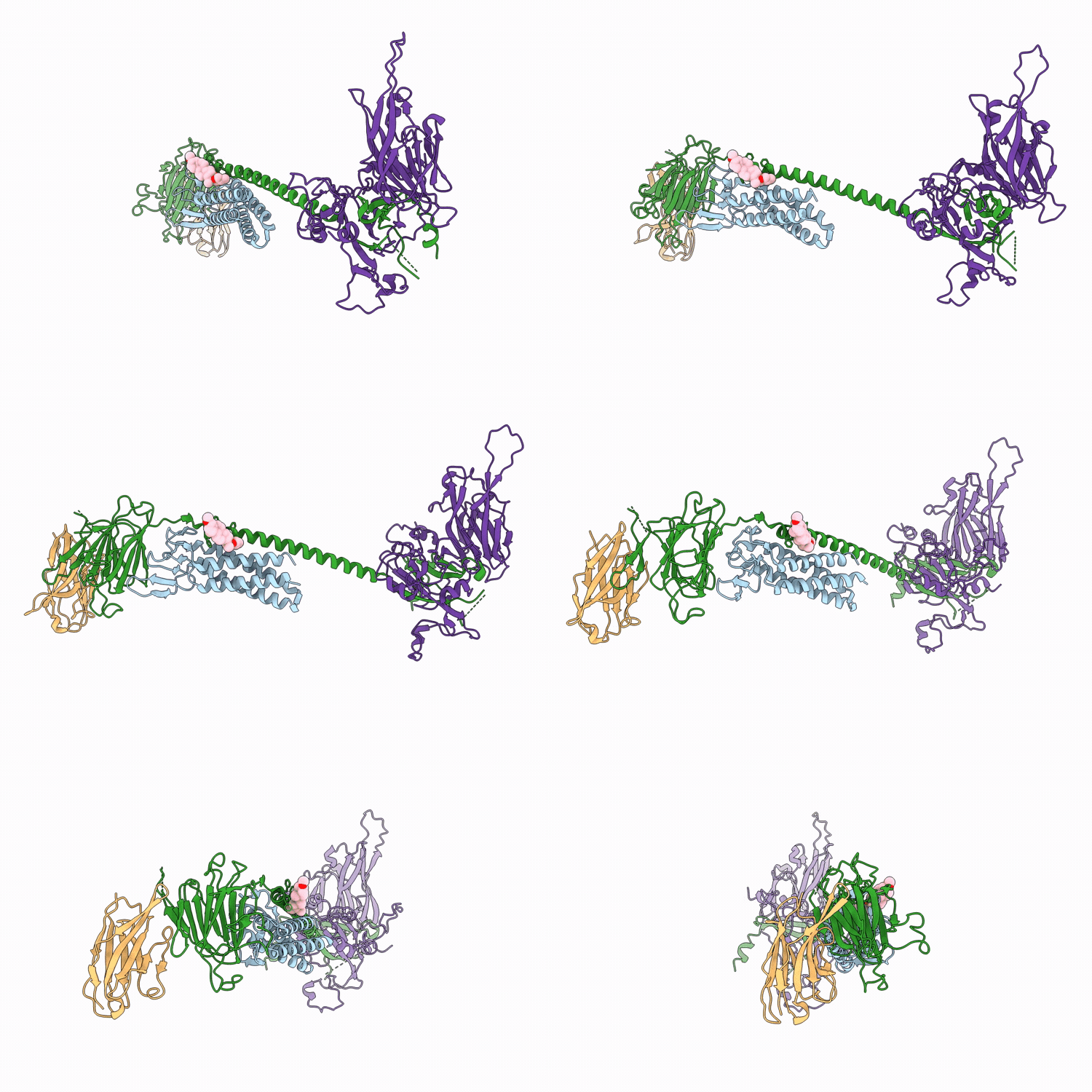
9QS6 image
Deposition Date 2025-04-04
Release Date 2026-05-27
Last Version Date 2026-06-10
Entry Detail
PDB ID:
9QS6
Title:
Cryo-EM structure of the helix-stabilized MMM ubiquitin ligase complex with nanobody 270 (Composite map)
Biological Source:
Source Organism(s):
Homo sapiens (Taxon ID: 9606)
Lama glama (Taxon ID: 9844)
Expression System(s):
Method Details:
Experimental Method:
Resolution:
3.30 Å
Aggregation State:
PARTICLE
Reconstruction Method:
SINGLE PARTICLE
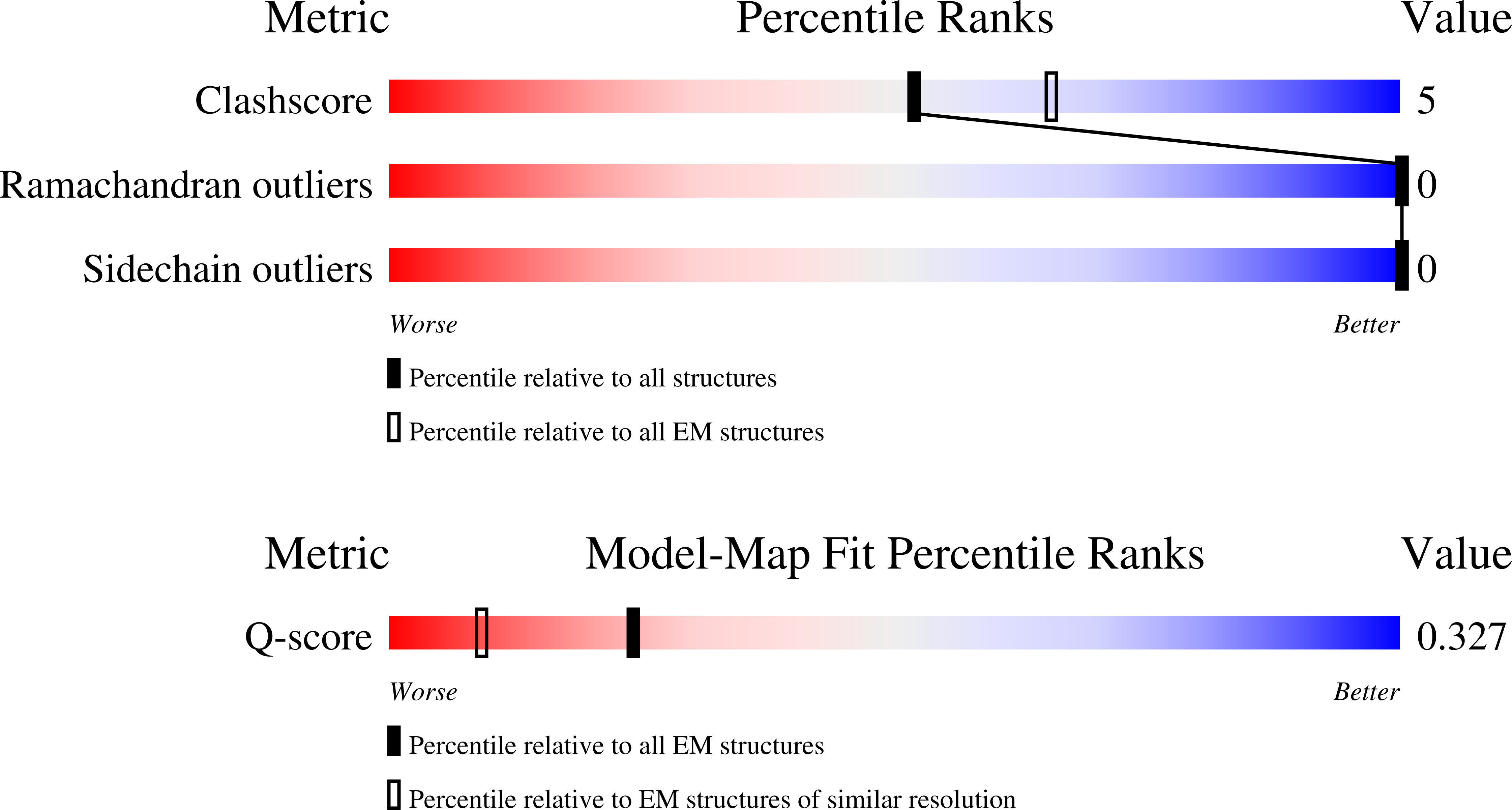
Macromolecular Entities
Structures with similar UniProt ID
Protein Blast
Polymer Type:polypeptide(L)
Molecule:Modulator of smoothened prote
Gene (Uniprot):MOSMO
Chain IDs:B (auth: A)
Chain Length:211
Number of Molecules:1
Biological Source:Homo sapiens
Structures with similar UniProt ID
Protein Blast
Polymer Type:polypeptide(L)
Molecule:Isoform 2 of Multiple epiderm
Gene (Uniprot):MEGF8
Mutagens:A2605E, K2606E, Q2607E, A2608E, L2609K, D2610K, Q2611K, Q2613E, Q2615E, R2616E, H2618R, L2619R, Q2620R, M2622E, T2623E
Chain IDs:D (auth: B)
Chain Length:477
Number of Molecules:1
Biological Source:Homo sapiens
Protein Blast
Polymer Type:polypeptide(L)
Molecule:Nanobody 270
Chain IDs:C
Chain Length:129
Number of Molecules:1
Biological Source:Lama glama
Structures with similar UniProt ID
Protein Blast
Polymer Type:polypeptide(L)
Molecule:Isoform 4 of E3 ubiquitin-pro
Gene (Uniprot):MGRN1
Mutagens:R317E
Chain IDs:A (auth: D)
Chain Length:539
Number of Molecules:1
Biological Source:Homo sapiens
Primary Citation

Abstact

Receptor-type E3 ubiquitin ligases enable extracellular signals to control ubiquitylation in the cytoplasm, playing widespread roles in development, metabolism, and immunity. Using cryoelectron microscopy, integrated with biophysical and functional studies, we visualized a human E3 complex composed of two transmembrane proteins, MEGF8 and MOSMO, and the intracellular RING-family protein MGRN1. This MEGF8-MOSMO-MGRN1 (MMM) complex attenuates Hedgehog signaling by ubiquitylating Smoothened (SMO), a G-protein-coupled receptor (GPCR) that transduces morphogen signals. A long helix in the MMM complex engages SMO using an intramembrane degron and extends into the cytoplasm to suspend an activated and precisely oriented RING domain below the plasma membrane. This architecture enables ubiquitylation of the cytoplasmic surface of SMO, reducing SMO abundance at primary cilia. Our structure provides insights into MEGF8 mutations, which cause multi-organ birth defects, and defines a paradigm for how transmembrane E3 ligases control the cell surface abundance of GPCRs and other signaling receptors.

Legend

Protein

Chemical

Disease

Primary Citation of related structures
Feedback Form
Name
Email
Institute
Feedback