

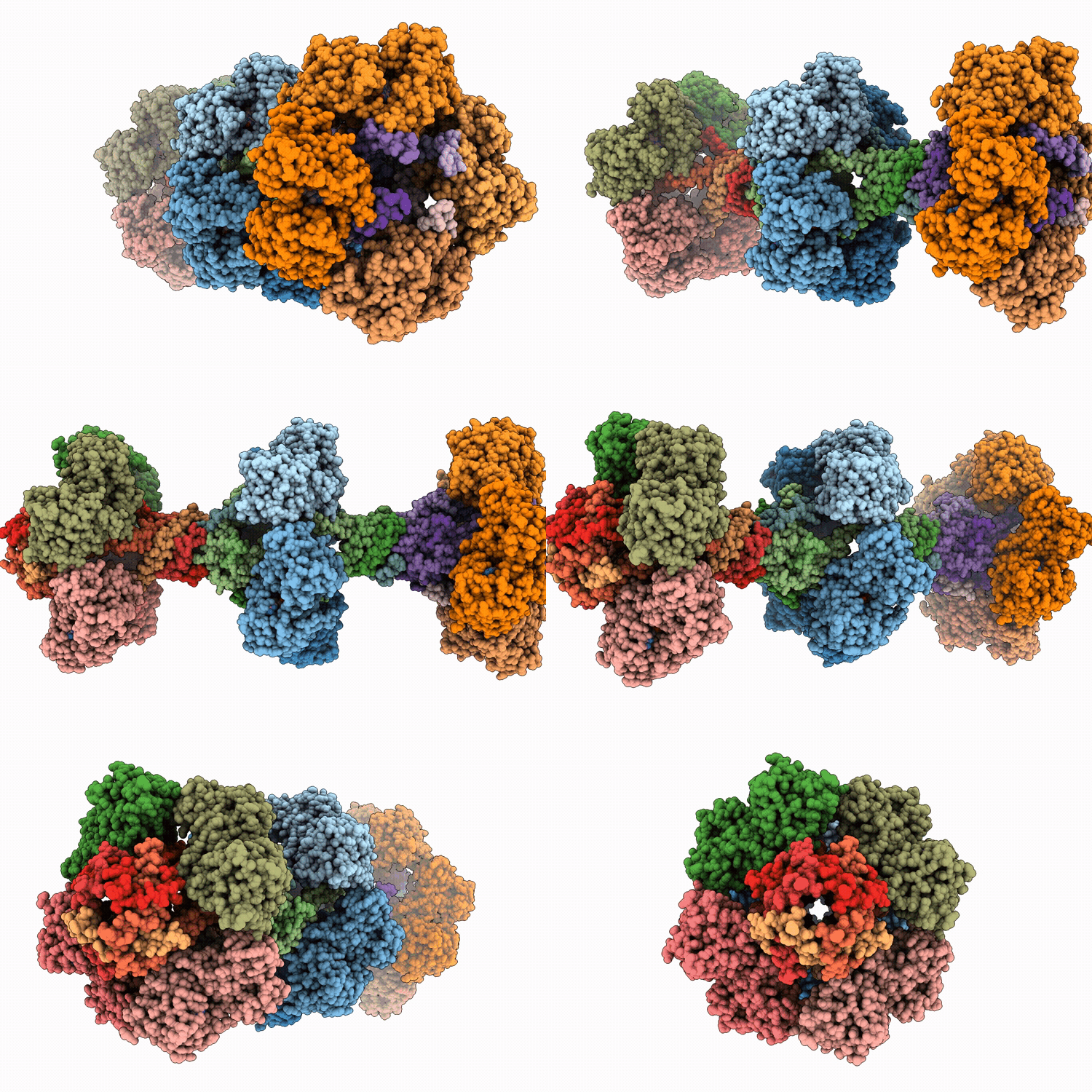
9PXM image
Deposition Date 2025-08-05
Release Date 2026-07-22
Last Version Date 2026-09-09
Entry Detail
PDB ID:
9PXM
Keywords:
Title:
CryoEM structure of Ndh-Ncp filament from Bacillus subtilis
Biological Source:
Source Organism(s):
Expression System(s):
Method Details:
Experimental Method:
Resolution:
3.09 Å
Aggregation State:
FILAMENT
Reconstruction Method:
HELICAL
Macromolecular Entities
Polymer Type:polypeptide(L)
Molecule:NADH dehydrogenase-like prote
Gene (Uniprot):yjlD
Chain IDs:A, B, C, D, I, J, K, L, Q, R, S, T
Chain Length:392
Number of Molecules:12
Biological Source:Bacillus subtilis subsp. subtilis str. 168
Polymer Type:polypeptide(L)
Molecule:NDH-2 membrane coupling prote
Gene (Uniprot):yjlC
Chain IDs:E, F, G, H, M, N, O, P, U, V, W, X
Chain Length:176
Number of Molecules:12
Biological Source:Bacillus subtilis subsp. subtilis str. 168
Ligand Molecules
Primary Citation
Quinone-transporting filaments expand bioenergetic capacity in Gram-positive Bacillota.
Nat Microbiol 11 2543 2561 (2026)
PMID: 42608535 DOI: 10.1038/s41564-026-02450-z

Abstact

Cellular respiration depends on transferring electrons to hydrophobic quinones in membrane bilayers, meaning bioenergetic capacity is constrained by available membrane surface area. While Gram-negative bacteria expand this capacity through internal membrane invaginations and eukaryotes use membrane-bound organelles, whether Gram-positive bacteria have alternative capacity-generating mechanisms is unknown. Here we show that Bacillus subtilis forms a quinone-transporting pseudomembrane composed of filaments of the NADH dehydrogenase Ndh and the quinone-transporting protein Ncp. Cryo-EM, lipidomics and molecular dynamics reveal that Ndh and Ncp co-assemble with lipids into a 4:4 stoichiometric complex with a solvent-excluded hydrophobic lumen containing phospholipids, which sequesters quinones. These complexes further assemble into filaments, linking chambers into a continuous conduit that amplifies quinone reduction. Phylogenetic analysis suggests that this capacity is widespread in Bacillota. Quinone-transporting filaments thus reveal a strategy to expand the quinone pool and bioenergetic capacity while occupying minimal membrane space.

Legend

Protein

Chemical

Disease

Primary Citation of related structures
Feedback Form
Name
Email
Institute
Feedback