

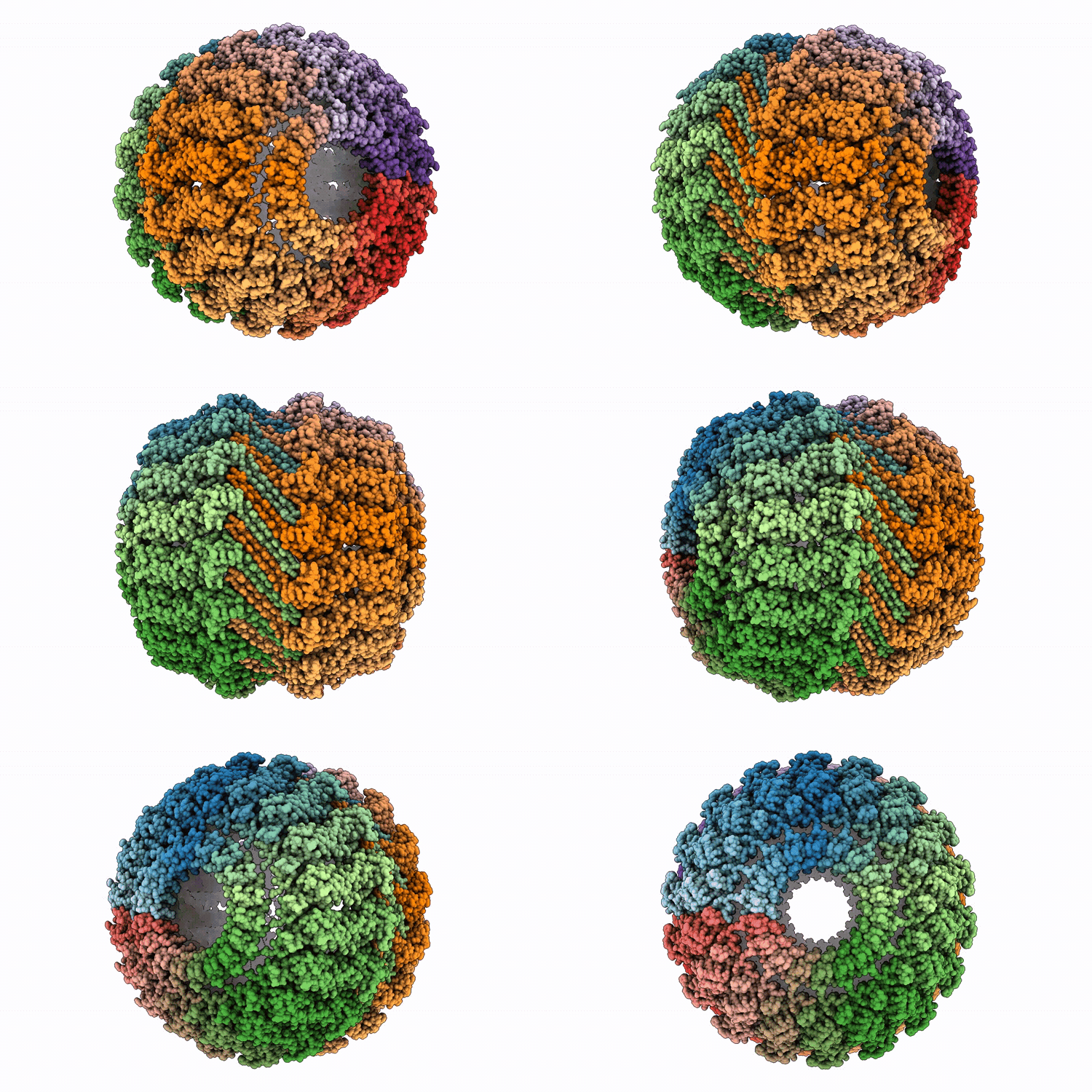
9O7M image
Deposition Date 2025-04-15
Release Date 2026-07-08
Last Version Date 2026-08-19
Entry Detail
PDB ID:
9O7M
Keywords:
Title:
Cryo-EM Structure of YfdQ Reveals a Widespread Novel Family of Bacteriophage-Associated Proteins with Shell-Like Assemblies
Biological Source:
Source Organism(s):
Method Details:
Experimental Method:
Resolution:
3.90 Å
Aggregation State:
PARTICLE
Reconstruction Method:
SINGLE PARTICLE
Macromolecular Entities
Structural Superimposition Protein Blast
Polymer Type:polypeptide(L)
Molecule:YfdQ Protein
Chain IDs:A (auth: C), B (auth: D), C (auth: E), D (auth: F), E (auth: G), F (auth: H), G (auth: I), H (auth: J), I (auth: K), J (auth: L), K (auth: M), L (auth: N), M (auth: O), N (auth: P), O (auth: Q), P (auth: R), Q (auth: S), R (auth: T), S (auth: U), T (auth: V), U (auth: W), V (auth: X), W (auth: Y), X (auth: Z), Y (auth: a), Z (auth: b), AA (auth: c), BA (auth: d), CA (auth: e), DA (auth: f), EA (auth: g), FA (auth: h), GA (auth: i), HA (auth: j), IA (auth: k), JA (auth: l)
Chain Length:274
Number of Molecules:36
Biological Source:Caudoviricetes
Ligand Molecules
Primary Citation
Cryo-EM structure of YfdQ reveals a widespread family of bacteriophage-associated proteins with shell-like assemblies.
Structure 34 1159 ? (2026)
PMID: 42309054 DOI: 10.1016/j.str.2026.05.009

Abstact

Bacteriophages are key players in microbial ecosystems with strong biotechnological potential, yet many phage-encoded proteins remain uncharacterized. We present the structure of the YfdQ complex from the Xanthomonas citri PhiXacm4-11 phage, a conserved DUF2303 protein encoded by double-stranded DNA bacteriophages of the Caudoviricetes class. Using cryo-electron microscopy, we report that native YfdQ assembles into a shell-like structure with D18 symmetry forming a approximately 1.1 MegaDalton complex, a hollow interior and a unique equatorial beta strand stitching oligomerization interface that holds together the two hemispheres. YfdQ homologs are widely distributed among phages infecting diverse bacterial hosts, suggesting a conserved biological role. YfdQ are found in prophages and cryptic phages. Our results suggest that heterologous expression of YfdQ in X. citri and in Escherichia coli allows the obtention of structurally heterogeneous YfdQ complexes, suggesting that its proper assembly into the shell-like structure may depend on still unidentified viral factors.

Legend

Protein

Chemical

Disease

Primary Citation of related structures
Feedback Form
Name
Email
Institute
Feedback