

9NPM image
Deposition Date 2025-03-11
Release Date 2026-08-19
Last Version Date 2026-11-18
Entry Detail
PDB ID:
9NPM
Title:
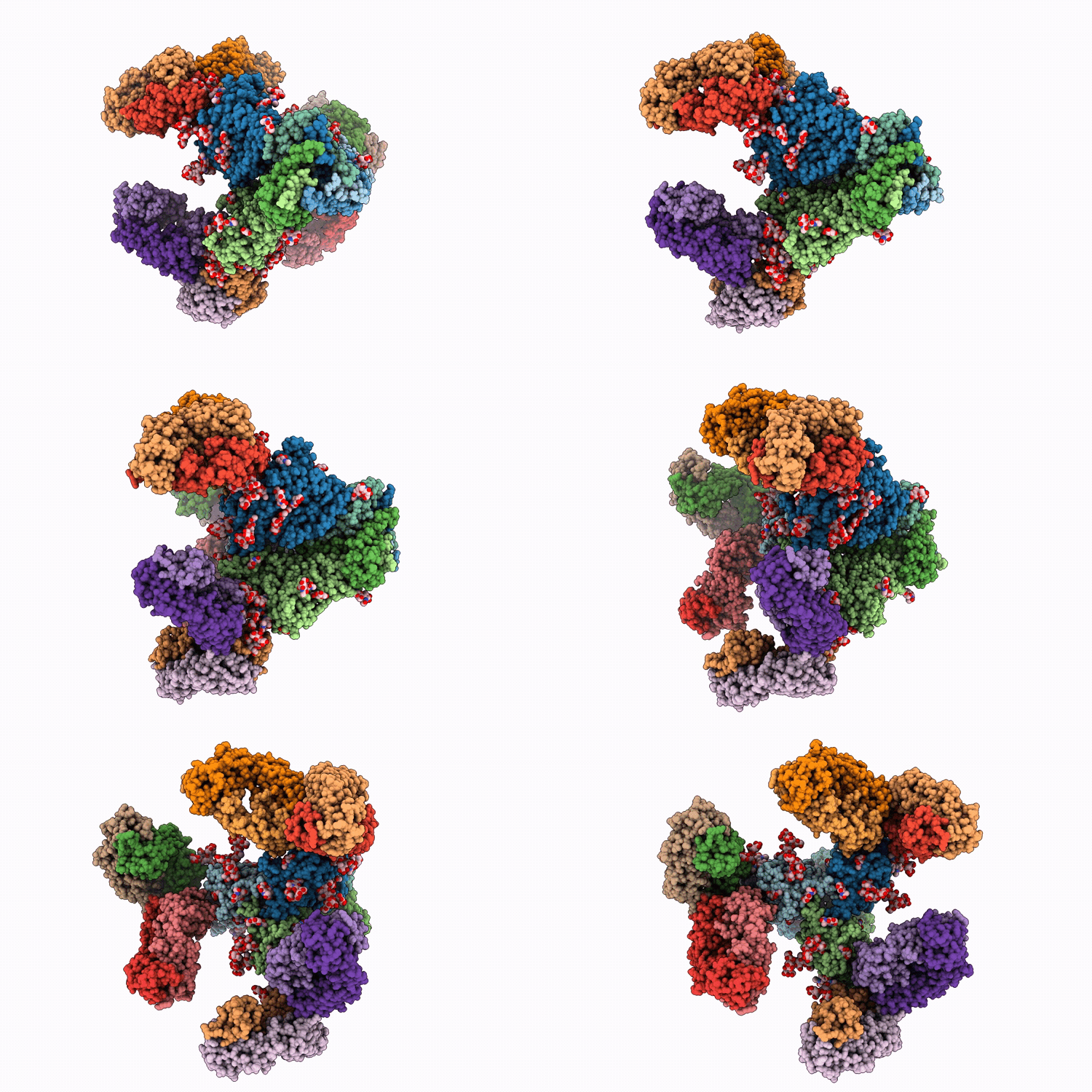
Composite map of three pairs of dimeric VRC36 Fabs bound to HIV-1 BG505.T332N DS-SOSIP.664 Env trimer
Biological Source:
Source Organism(s):
Expression System(s):
Method Details:
Experimental Method:
Resolution:
3.59 Å
Aggregation State:
PARTICLE
Reconstruction Method:
SINGLE PARTICLE
Macromolecular Entities
Polymer Type:polypeptide(L)
Molecule:HIV-1 BG505.T332N DS-SOSIP.66
Chain IDs:A (auth: C), G (auth: E), M (auth: A)
Chain Length:473
Number of Molecules:3
Biological Source:Human immunodeficiency virus 1
Polymer Type:polypeptide(L)
Molecule:HIV-1 BG505.T332N DS-SOSIP.66
Gene (Uniprot):env
Chain IDs:B (auth: D), H (auth: F), N (auth: B)
Chain Length:153
Number of Molecules:3
Biological Source:Human immunodeficiency virus 1
Polymer Type:polypeptide(L)
Molecule:VRC36 Fab heavy chain
Chain IDs:C (auth: K), E (auth: M), I (auth: O), K (auth: Q), O (auth: G), Q (auth: I)
Chain Length:223
Number of Molecules:6
Biological Source:Homo sapiens
Polymer Type:polypeptide(L)
Molecule:VRC36 Fab light chain
Chain IDs:D (auth: L), F (auth: N), J (auth: P), L (auth: R), P (auth: H), R (auth: J)
Chain Length:214
Number of Molecules:6
Biological Source:Homo sapiens
Ligand Molecules
Primary Citation

Abstact

Viral entry glycoproteins are often shielded from immune recognition by dense N-linked glycans that limit antibody access to protein epitopes. While glycan-reactive antibodies with unusual architectures have been described, how canonical Y-shaped antibodies engage these glycan-rich surfaces remains poorly defined. Here, we characterize two human antibodies, VRC35 and VRC36, isolated from an HIV-1-infected donor, that recognize diverse glycosylated viral glycoproteins. Cryo-electron microscopy structural analyses of these antibodies in complex with viral entry glycoproteins, including HIV-1 envelope, influenza hemagglutinin, SARS-CoV-2 spike, and the Lassa virus glycoprotein complex, reveal adaptive Fab stoichiometries ranging from single-Fab binding to dimeric and higher-order assemblies are mediated by intra- and inter-IgG interactions that depend on local glycan organization. Dense glycan clustering on HIV-1 and influenza glycoproteins supports multivalent Fab assemblies and correlates with neutralization activity, whereas sparse glycan environments on SARS-CoV-2 and Lassa virus favor weak or heterogeneous engagement without neutralization. Structural and mutational analyses further demonstrate that homotypic Fab-Fab interactions stabilize multivalent engagement and contribute to neutralizing activity. Together, these findings define a structural framework in which viral glycan organization constrains antibody valency and engagement, while somatic hypermutation contributes to the acquisition of homotypic Fab-Fab interactions that facilitate multivalent recognition of viral glycan shields.

Legend

Protein

Chemical

Disease

Primary Citation of related structures
Feedback Form
Name
Email
Institute
Feedback