

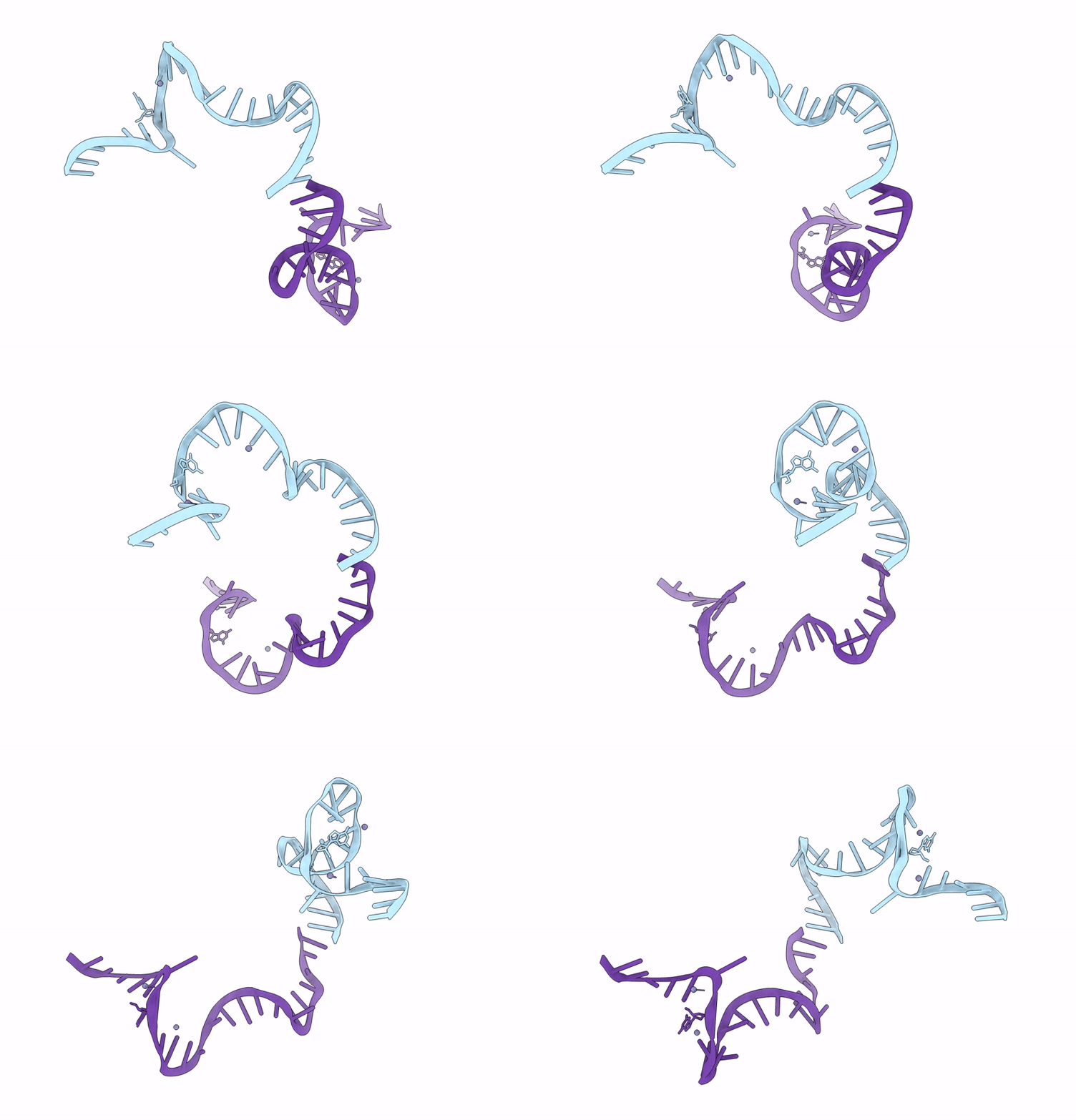
9K8P image
Deposition Date 2024-10-24
Release Date 2025-10-29
Last Version Date 2026-03-11
Entry Detail
PDB ID:
9K8P
Keywords:
Title:
Crystal structure of a short zinc-dependent DNAzyme minGAA, dimeric form
Biological Source:
Source Organism(s):
Method Details:
Experimental Method:
Resolution:
2.85 Å
R-Value Free:
0.32
R-Value Work:
0.24
R-Value Observed:
0.24
Space Group:
C 1 2 1

Macromolecular Entities
Polymer Type:polydeoxyribonucleotide/polyribonucleotide hybrid
Molecule:DNAzyme minGAA
Chain IDs:A, B
Chain Length:26
Number of Molecules:2
Biological Source:synthetic construct
Ligand Molecules
Primary Citation
A minimal RNA-cleaving DNAzyme and its catalytic mechanism.
Nucleic Acids Res. 54 ? ? (2026)
PMID: 41538318 DOI: 10.1093/nar/gkaf1502

Abstact

Although natural sources of enzymes are limited to protein and RNA, some artificial DNAs exhibit catalytic activities. Representative functions of such DNAs, i.e. DNAzymes, are cleavage and ligation of nucleic acids. Here we developed a minimal DNAzyme with an RNA-cleaving activity by in vitro selection and secondary structure-based design. Its catalytic and substrate cores are only two and three nucleotides, respectively. This DNAzyme showed strict Zn2+ dependence at optimal pH 7.0-7.5. To elucidate its catalytic mechanism, we determined its three-dimensional structure by X-ray crystallography and nuclear magnetic resonance (NMR) spectroscopy. The results consistently showed a B-DNA-like structure with base pairing and stacking throughout the molecule, unlike the kinked structures of larger DNAzymes. Notably, an A-base in the catalytic loop and a G-base in the substrate loop formed a non-Watson-Crick base pair. The catalytic Zn2+ coordinates to N7 of that G-base, enabling the Zn2+-hydrated water molecules to contacts O2' and O5' at the cleavage site. Considering that Zn(OH)+ and Zn2+ co-exist at the enzyme's optimal pH, we propose a catalytic mechanism whereby these ions act as the base withdrawing H+ from O2' and the acid donating H+ to O5', generating the cleaved ends with 2',3'-cyclic phosphate and OH groups.

Legend

Protein

Chemical

Disease

Primary Citation of related structures
Feedback Form
Name
Email
Institute
Feedback