

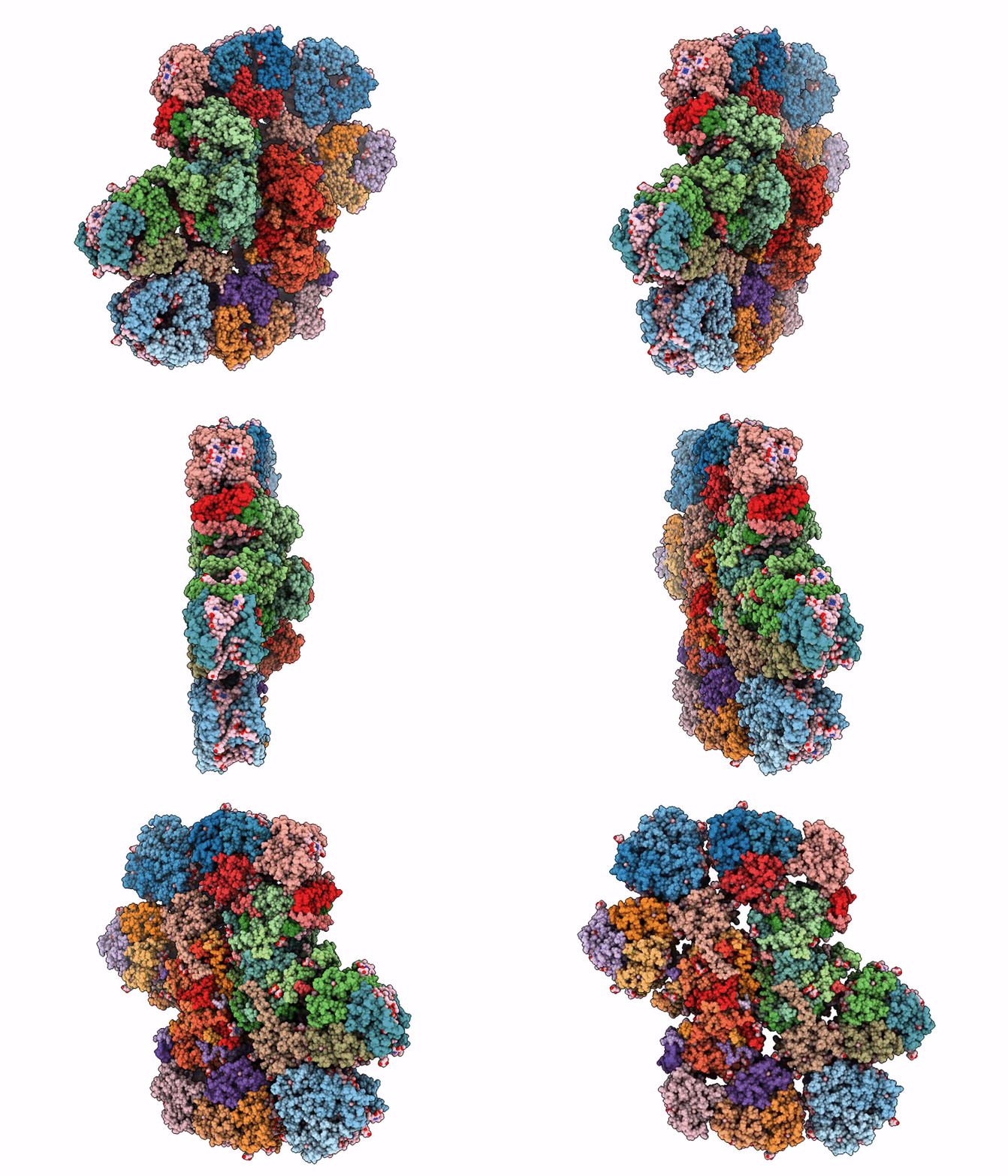
9K7V image
Deposition Date 2024-10-24
Release Date 2026-02-25
Last Version Date 2026-10-07
Entry Detail
PDB ID:
9K7V
Keywords:
Title:
Structural insights into photosystem II supercomplex of a a siphonous green algae Bryopsis corticulans from intertidal zone
Biological Source:
Source Organism(s):
Method Details:
Experimental Method:
Resolution:
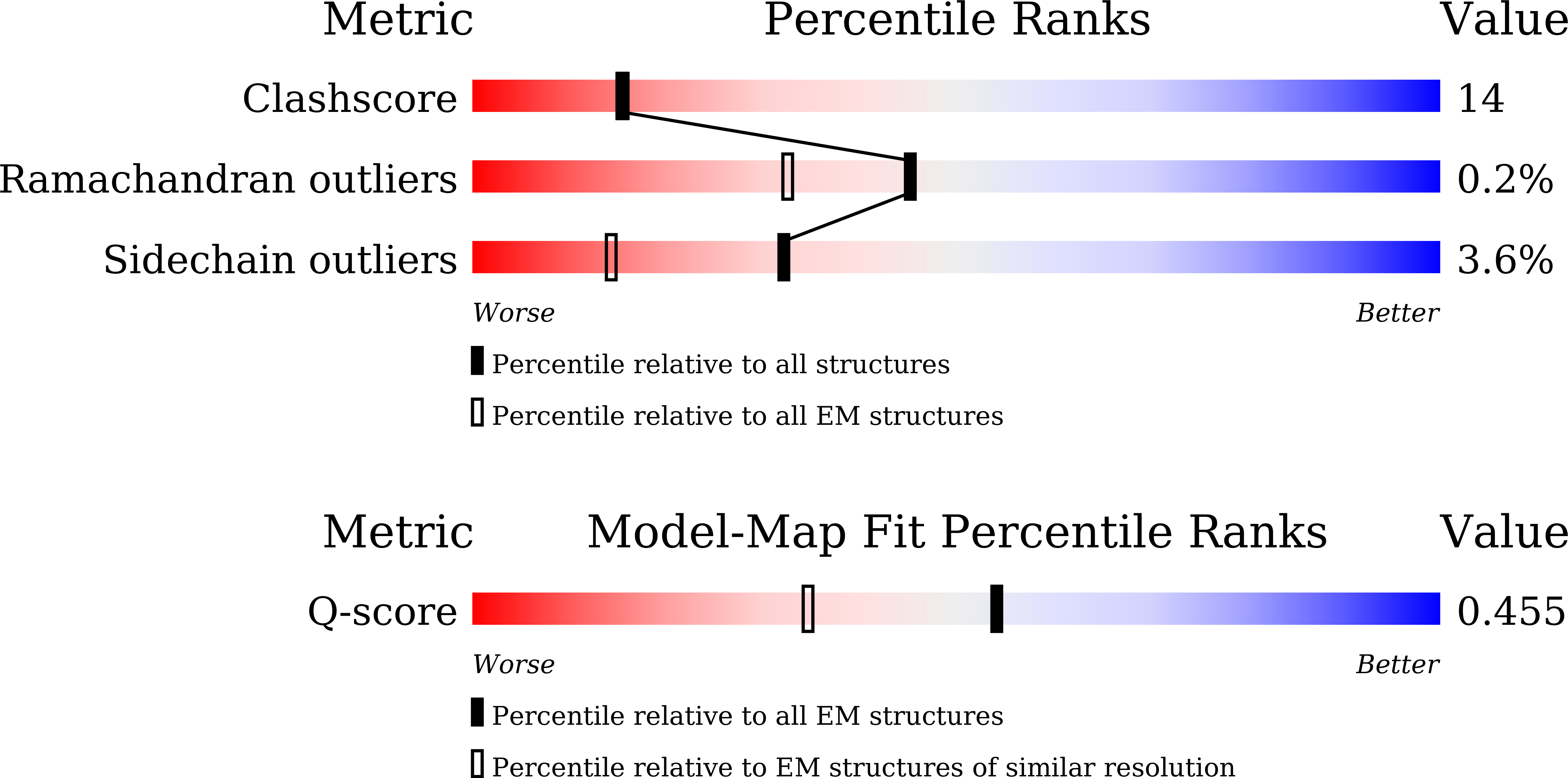
3.07 Å
Aggregation State:
PARTICLE
Reconstruction Method:
SINGLE PARTICLE
Macromolecular Entities
Polymer Type:polypeptide(L)
Molecule:Lhcb1
Chain IDs:J (auth: 1), IA (auth: 4)
Chain Length:212
Number of Molecules:2
Biological Source:Bryopsis corticulans
Polymer Type:polypeptide(L)
Molecule:Lhcb2
Chain IDs:K (auth: 2), JA (auth: 5)
Chain Length:256
Number of Molecules:2
Biological Source:Bryopsis corticulans
Polymer Type:polypeptide(L)
Molecule:Lhcb3
Chain IDs:L (auth: 3), R (auth: 9), KA (auth: 6), PA (auth: u), SA (auth: p), BB (auth: 7)
Chain Length:254
Number of Molecules:6
Biological Source:Bryopsis corticulans
Polymer Type:polypeptide(L)
Molecule:PsbA
Chain IDs:W (auth: A), WA (auth: a)
Chain Length:327
Number of Molecules:2
Biological Source:Bryopsis corticulans
Polymer Type:polypeptide(L)
Molecule:Photosystem II CP47 reaction
Gene (Uniprot):psbB
Chain IDs:V (auth: B), VA (auth: b)
Chain Length:508
Number of Molecules:2
Biological Source:Bryopsis corticulans
Polymer Type:polypeptide(L)
Molecule:Photosystem II CP43 reaction
Gene (Uniprot):psbC
Chain IDs:X (auth: C), XA (auth: c)
Chain Length:461
Number of Molecules:2
Biological Source:Bryopsis corticulans
Polymer Type:polypeptide(L)
Molecule:Photosystem II D2 protein
Gene (Uniprot):psbD
Chain IDs:Y (auth: D), YA (auth: d)
Chain Length:352
Number of Molecules:2
Biological Source:Bryopsis corticulans
Polymer Type:polypeptide(L)
Molecule:Cytochrome b559 subunit alpha
Gene (Uniprot):psbE
Chain IDs:B (auth: E), BA (auth: e)
Chain Length:82
Number of Molecules:2
Biological Source:Bryopsis corticulans
Polymer Type:polypeptide(L)
Molecule:Cytochrome b559 subunit beta
Gene (Uniprot):psbF
Chain IDs:I (auth: F), HA (auth: f)
Chain Length:42
Number of Molecules:2
Biological Source:Bryopsis corticulans
Polymer Type:polypeptide(L)
Molecule:LhcbG
Chain IDs:Q (auth: G), S (auth: N), T (auth: Y), U (auth: 8), OA (auth: g), QA (auth: n), RA (auth: y), TA (auth: q)
Chain Length:280
Number of Molecules:8
Biological Source:Bryopsis corticulans
Polymer Type:polypeptide(L)
Molecule:Photosystem II reaction cente
Gene (Uniprot):psbH
Chain IDs:C (auth: H), CA (auth: h)
Chain Length:75
Number of Molecules:2
Biological Source:Bryopsis corticulans
Polymer Type:polypeptide(L)
Molecule:Photosystem II reaction cente
Gene (Uniprot):psbI
Chain IDs:D (auth: I), DA (auth: i)
Chain Length:36
Number of Molecules:2
Biological Source:Bryopsis corticulans
Polymer Type:polypeptide(L)
Molecule:Photosystem II reaction cente
Gene (Uniprot):psbK
Chain IDs:E (auth: K), EA (auth: k)
Chain Length:43
Number of Molecules:2
Biological Source:Bryopsis corticulans
Polymer Type:polypeptide(L)
Molecule:Photosystem II reaction cente
Gene (Uniprot):psbL
Chain IDs:F (auth: L), FA (auth: l)
Chain Length:38
Number of Molecules:2
Biological Source:Bryopsis corticulans
Polymer Type:polypeptide(L)
Molecule:Photosystem II reaction cente
Gene (Uniprot):psbM
Chain IDs:G (auth: M), GA (auth: m)
Chain Length:33
Number of Molecules:2
Biological Source:Bryopsis corticulans
Polymer Type:polypeptide(L)
Molecule:PsbR
Chain IDs:H (auth: R), AB (auth: r)
Chain Length:267
Number of Molecules:2
Biological Source:Bryopsis corticulans
Polymer Type:polypeptide(L)
Molecule:LhcbS
Chain IDs:M (auth: S), ZA (auth: s)
Chain Length:308
Number of Molecules:2
Biological Source:Bryopsis corticulans
Polymer Type:polypeptide(L)
Molecule:Photosystem II reaction cente
Gene (Uniprot):psbT
Chain IDs:P (auth: T), NA (auth: t)
Chain Length:31
Number of Molecules:2
Biological Source:Bryopsis corticulans
Polymer Type:polypeptide(L)
Molecule:Photosystem II reaction cente
Gene (Uniprot):ycf12
Chain IDs:O (auth: V), MA (auth: v)
Chain Length:33
Number of Molecules:2
Biological Source:Bryopsis corticulans
Polymer Type:polypeptide(L)
Molecule:PsbW
Chain IDs:Z (auth: W), UA (auth: w)
Chain Length:118
Number of Molecules:2
Biological Source:Bryopsis corticulans
Polymer Type:polypeptide(L)
Molecule:PsbX
Chain IDs:N (auth: X), LA (auth: x)
Chain Length:109
Number of Molecules:2
Biological Source:Bryopsis corticulans
Polymer Type:polypeptide(L)
Molecule:Photosystem II reaction cente
Gene (Uniprot):psbZ
Chain IDs:A (auth: Z), AA (auth: z)
Chain Length:62
Number of Molecules:2
Biological Source:Bryopsis corticulans
Primary Citation
Cryo-EM structural analyses of chlorophyll b-enriched PSI-LHC and PSII-LHC supercomplexes of the siphonous green alga Bryopsis corticulans.
Plant Commun. 7 101738 101738 (2026)
PMID: 41578646 DOI: 10.1016/j.xplc.2026.101738

Abstact

The light-harvesting complexes of photosystem I (PSI) and PSII (LHCI and LHCII) in Bryopsis corticulans (B. corticulans) are homologous to those in Chlamydomonas reinhardtii and land plants but exhibit a distinct chlorophyll (Chl) and carotenoid composition. Here, we report cryo-electron microscopy structures of the PSI-LHCI(10)-LHCII(9) supercomplex, comprising three LHCII trimers, and the C(2)S(2)M(2)N(2)-type PSII-LHCII supercomplex from B. corticulans. In the PSI supercomplex, ten LHCI subunits assemble into two belts and one heterodimer, coordinating a total of 86 Chl a and 65 Chl b molecules (Chl a/b ratio of 1.3, compared with 3.4 in C. reinhardtii), as well as 18 siphonaxanthin, 2 siphonein, and 13 alpha-carotene molecules. Of the three LHCII trimers bound to the PSI-LHCI supercomplex, two are anchored to the PSI core primarily via phosphorylated subunits, whereas the third, non-phosphorylated trimer is stabilized through interactions with Lhca-d and the adjacent LHCII trimer. In the C(2)S(2)M(2)N(2)-type PSII-LHCII supercomplex, the N-LHCII is positioned closer to the PSII core than in C. reinhardtii, likely owing to loss of the linker motif in the N-terminal region of B. corticulans CP29. Structure-based energy transfer analysis suggests that this spatial rearrangement enhances the efficiency of excitation energy transfer from N-LHCII to the PSII core. Collectively, these findings reveal structural adaptations that underlie the acclimation strategies of siphonous green algae inhabiting intertidal environments.

Legend

Protein

Chemical

Disease

Primary Citation of related structures
Feedback Form
Name
Email
Institute
Feedback