

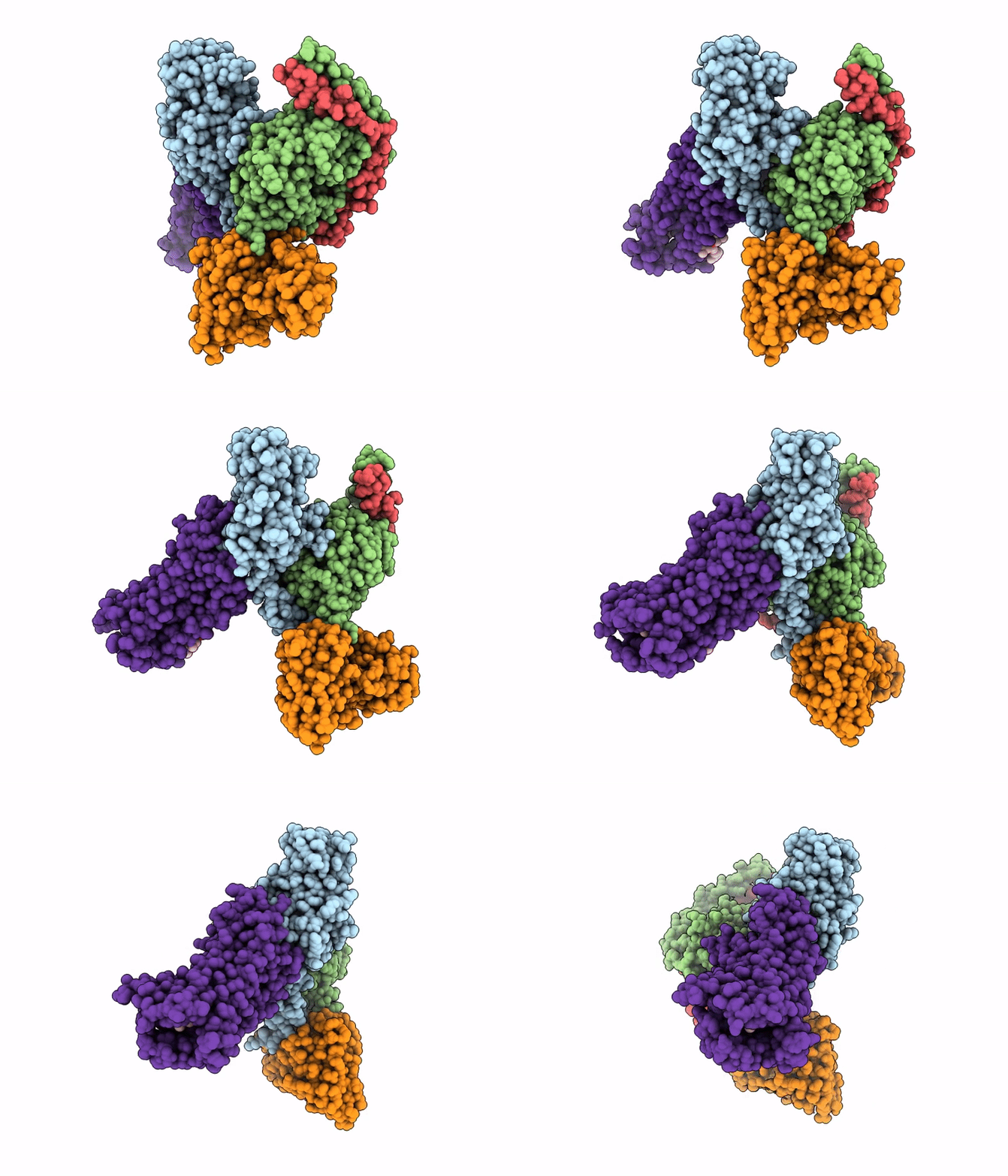
8Y71 image
Deposition Date 2024-02-03
Release Date 2026-01-07
Last Version Date 2026-03-11
Entry Detail
PDB ID:
8Y71
Title:
positive allosteric modulator(BMS986187)-bound delta-opioid receptor-Gi complex
Biological Source:
Source Organism(s):
Homo sapiens (Taxon ID: 9606)
Rattus norvegicus (Taxon ID: 10116)
Bos taurus (Taxon ID: 9913)
synthetic construct (Taxon ID: 32630)
Expression System(s):
Method Details:
Experimental Method:
Resolution:
2.97 Å
Aggregation State:
PARTICLE
Reconstruction Method:
SINGLE PARTICLE
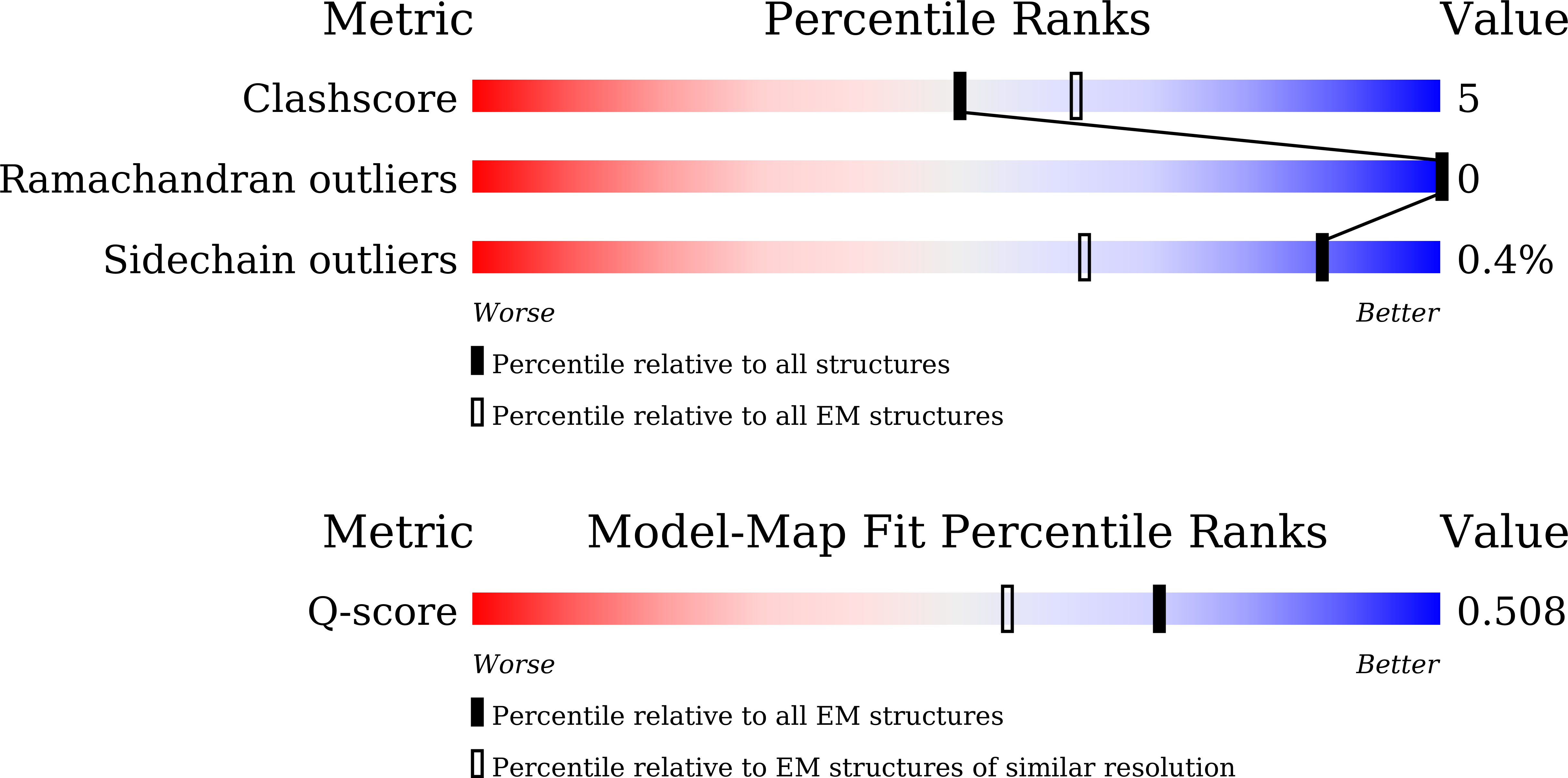
Macromolecular Entities
Structures with similar UniProt ID
Protein Blast
Polymer Type:polypeptide(L)
Molecule:Guanine nucleotide-binding pr
Gene (Uniprot):GNAI1
Mutagens:G203A, A326S
Chain IDs:A
Chain Length:354
Number of Molecules:1
Biological Source:Homo sapiens
Structures with similar UniProt ID
Protein Blast
Polymer Type:polypeptide(L)
Molecule:Guanine nucleotide-binding pr
Gene (Uniprot):Gnb1
Chain IDs:B
Chain Length:371
Number of Molecules:1
Biological Source:Rattus norvegicus
Structures with similar UniProt ID
Protein Blast
Polymer Type:polypeptide(L)
Molecule:Guanine nucleotide-binding pr
Gene (Uniprot):GNG2
Chain IDs:C
Chain Length:68
Number of Molecules:1
Biological Source:Bos taurus
Protein Blast
Polymer Type:polypeptide(L)
Molecule:scFv16
Chain IDs:D (auth: E)
Chain Length:248
Number of Molecules:1
Biological Source:synthetic construct
Structures with similar UniProt ID
Protein Blast
Polymer Type:polypeptide(L)
Molecule:Delta-type opioid receptor
Gene (Uniprot):OPRD1
Chain IDs:E (auth: R)
Chain Length:523
Number of Molecules:1
Biological Source:Homo sapiens
Ligand Molecules
Primary Citation
Structure-based design of an opioid receptor modulator for enhanced morphine analgesia.
Sci Adv 12 eaea9832 eaea9832 (2026)
PMID: 41671375 DOI: 10.1126/sciadv.aea9832

Abstact

The alarming rates of deaths due to opioid overdose present an urgent need for safer opioid analgesics. Positive allosteric modulators (PAMs) of opioid receptors (ORs) offer a promising approach to enhance opioid efficacy while reducing risks of overdose. In this study, we unveil the selective mechanism of PAM modulation of the OR family through structure elucidation of the delta-opioid receptor and mu-opioid receptor (muOR) bound to orthosteric agonists and PAMs BMS986187 (BMS187) and BMS986122 (BMS122). In addition, we uncovered an unexpected but conserved allosteric site across the transmembrane helices TM2 to TM4 of ORs, occupied by BMS187 but not BMS122. Leveraging these structural insights, we designed 9-(5-(4-chlorophenyl)furan-2-yl)-3,3,6,6-tetramethyl-3,4,5,6,7,9-hexahydro-1H-xanthene-1,8(2H)-dione (MPAM-15), whose alphabeta cooperativity factor is 33-fold higher than BMS122 and threefold higher than BMS187, indicating markedly stronger positive allosterism. Animal studies demonstrate that MPAM-15 shows excellent brain penetration and enhances morphine-induced antinociception without exacerbating respiratory depression or constipation. Molecular dynamics simulations revealed that MPAM-15 promotes and stabilizes the conformational equilibrium of muOR toward the canonical active state, providing a mechanistic basis for its enhanced allosteric potency. These discoveries substantially advance our understanding of OR allosteric mechanism and pave the way for the structure-based development of allosteric opioid analgesics.

Legend

Protein

Chemical

Disease

Primary Citation of related structures
Feedback Form
Name
Email
Institute
Feedback