

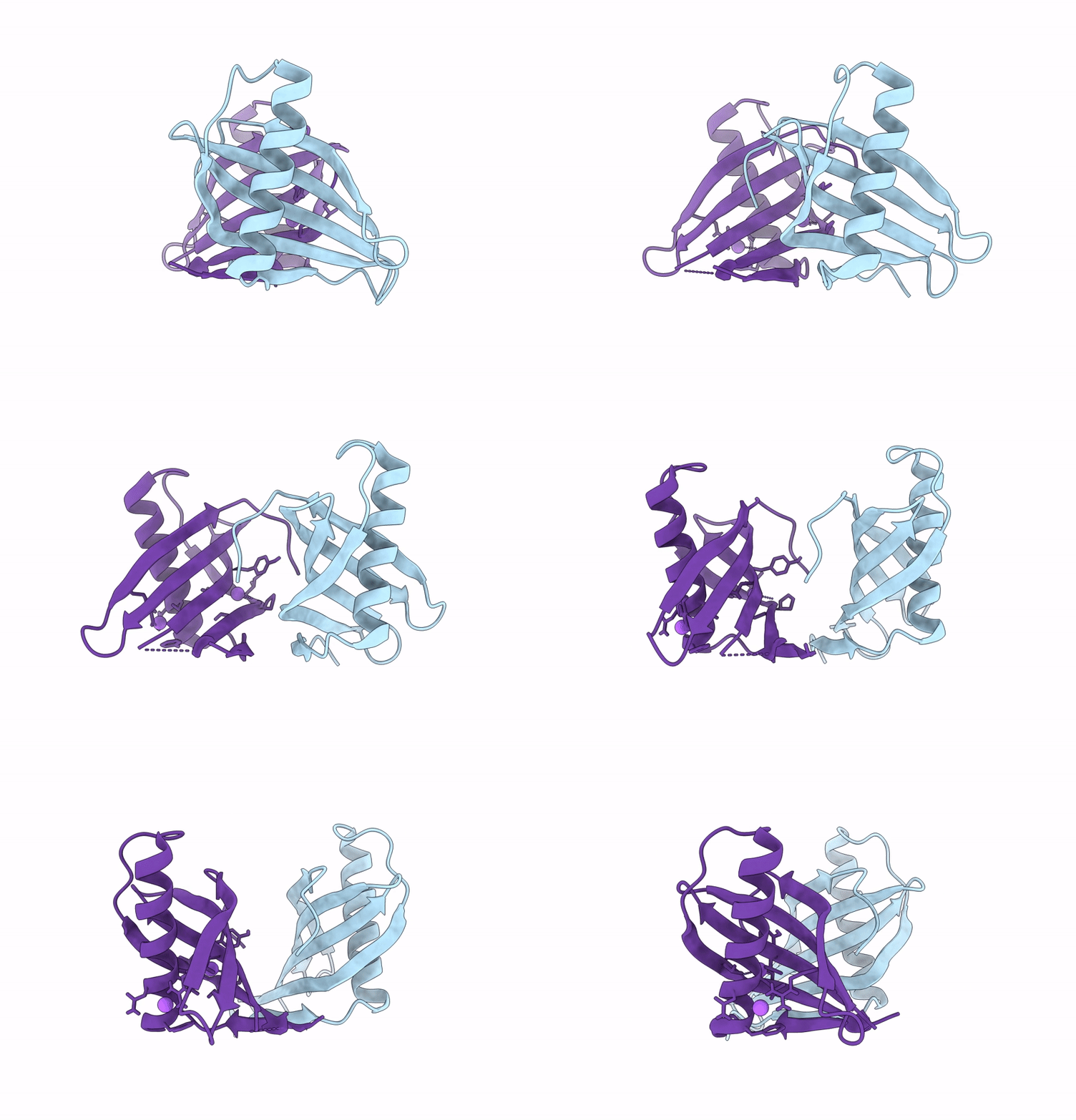
8TM8 image
Deposition Date 2023-07-28
Release Date 2024-12-18
Last Version Date 2026-07-22
Entry Detail
PDB ID:
8TM8
Keywords:
Title:
Monomer structure of monellin loop1 mutant (YENKG)
Biological Source:
Source Organism(s):
Expression System(s):
Method Details:
Experimental Method:
Resolution:
2.26 Å
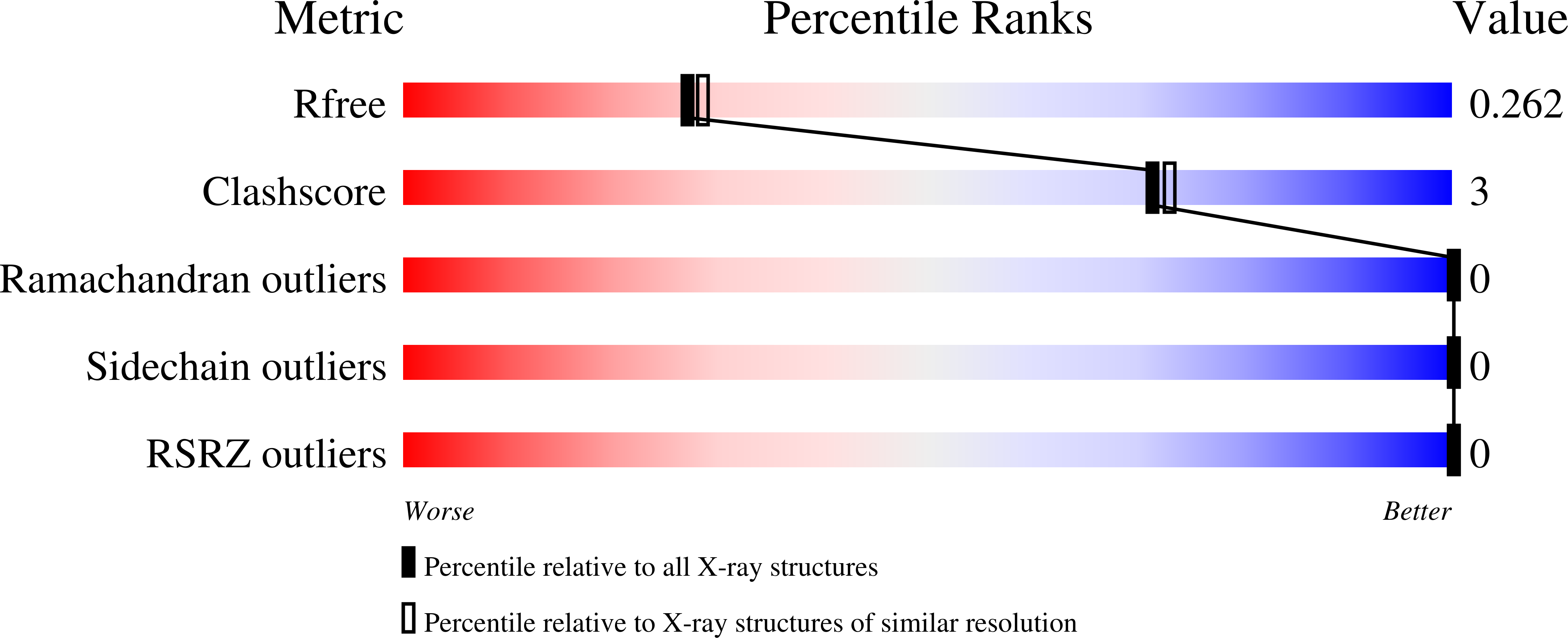
R-Value Free:
0.26
R-Value Work:
0.19
R-Value Observed:
0.19
Space Group:
P 1 21 1
Macromolecular Entities
Structural Superimposition Protein Blast
Polymer Type:polypeptide(L)
Molecule:Monellin chain B,Monellin cha
Chain IDs:A, B
Chain Length:91
Number of Molecules:2
Biological Source:Dioscoreophyllum cumminsii
Ligand Molecules
Primary Citation
On proline isomerization and 3D-domain-swapping.
Biochem.Biophys.Res.Commun. 821 153872 153872 (2026)
PMID: 42102672 DOI: 10.1016/j.bbrc.2026.153872

Abstact

3D-domain-swapping is the exchange of identical "domains" between two protein monomers, which leads to homodimerization. This domain exchange can be facilitated by a single hinge-loop extending out. Hinge-loop prolines have been associated with domain-swapping, but their role remains unclear. Previously, we had engineered three domain-swapping variants of the monomeric monellin by replacing the wild-type hinge-loop sequence (L1:YENEGFREIKG) with QEVKG, YEIKG or QVVAG. The central residues of these sequences are hydrophobic (V/I), and lie at the apex of a tight solvent-exposed hinge-loop (L1Delta6) connecting two beta-strands (beta2-beta3). The hydrophobic residue-solvent interaction likely impedes the closure of L1Delta6 and the formation of intra-chain beta2-beta3 contacts. This promotes domain-swapping. Here, we replaced the apex residue with the borderline-hydrophobic proline and found that it reduced domain-swapping in all three variants, with significant domain-swapping observed only in the most hydrophobic QVPAG construct. We then structurally characterized three monomeric (QEPKG, YEPKG, and QVPAG) and one domain-swapped dimeric (QVPAG) variants of monellin using X-ray crystallography. Interestingly, we find that the dimer has a trans-proline isomer, whereas all three monomers have a cis-proline. Thus, introducing proline into a solvent-exposed tight beta-turn may be a robust method for designing cis-proline. Conversely, mutating such a naturally-occurring cis-proline to a hydrophobic amino acid may induce domain-swapping. The trans-proline in a hydrophobic hinge-loop (e.g. QVPAG), can provide rigidity to the domain-swapped dimer enabling the precise design of domain-swapping-driven protein assemblies. Overall, our mutational-design strategy is a step towards clarifying the role of prolines in 3D-domain-swapping and the rational design of proline isomerization.

Legend

Protein

Chemical

Disease

Primary Citation of related structures
Feedback Form
Name
Email
Institute
Feedback