

43OF image
Deposition Date 2026-07-10
Release Date 2026-10-28
Last Version Date 2026-10-28
Entry Detail
PDB ID:
43OF
Keywords:
Title:
Cryo-EM structure of a virus helcal scaffolds
Biological Source:
Expression System(s):
Method Details:
Experimental Method:
Resolution:
3.54 Å
Aggregation State:
PARTICLE
Reconstruction Method:
SINGLE PARTICLE
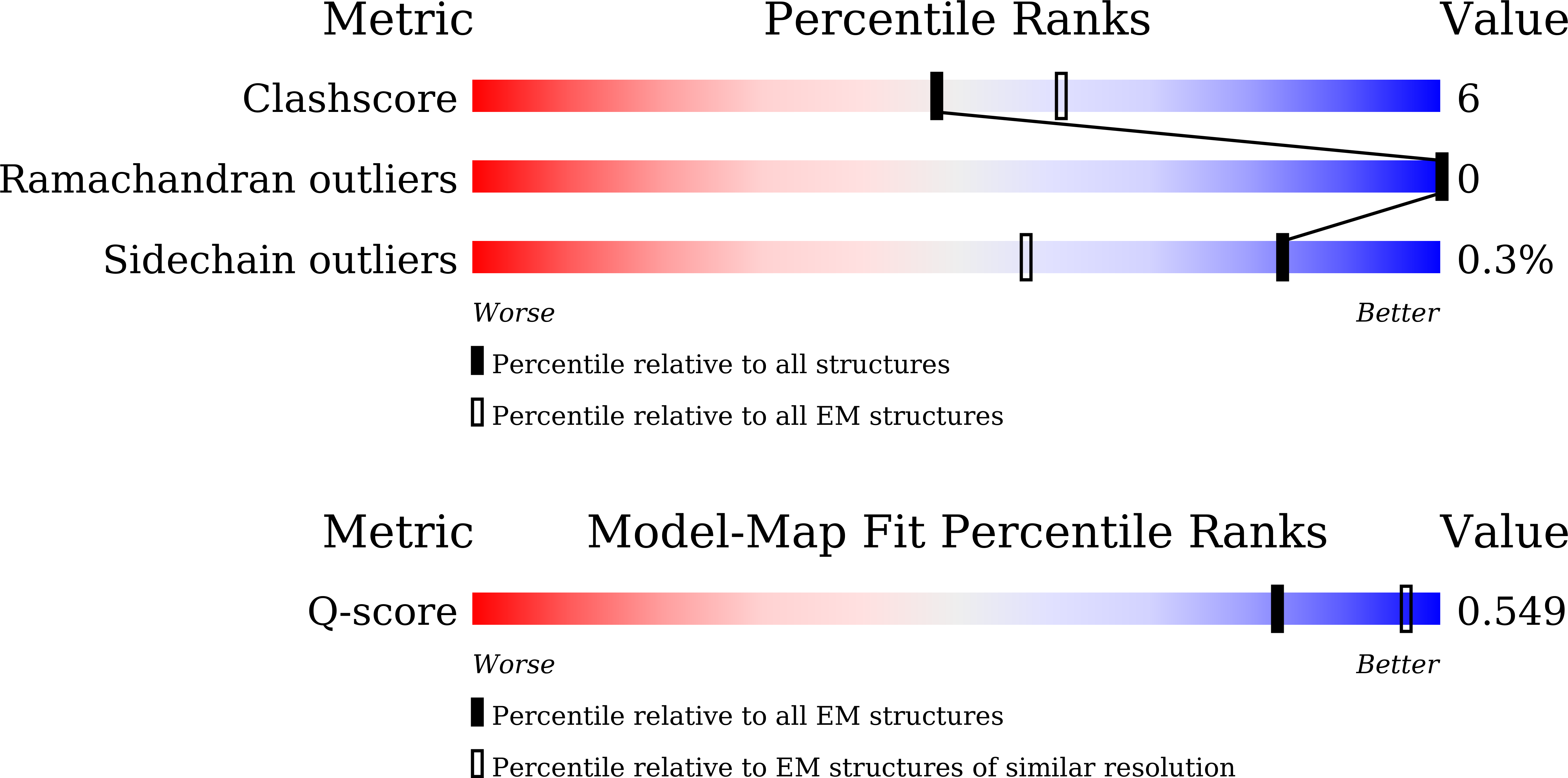
Macromolecular Entities
Polymer Type:polypeptide(L)
Molecule:Non-structural protein 3
Chain IDs:A, B, C, D, E, F, G, H, I, J, K, L, M, N, O, P, Q, R, S, T, U, V, W, X, Y, Z, AA (auth: a), BA (auth: b), CA (auth: c), DA (auth: d), EA (auth: e), FA (auth: f), GA (auth: g), HA (auth: h), IA (auth: i), JA (auth: j), KA (auth: k), LA (auth: l), MA (auth: m), NA (auth: n), OA (auth: o), PA (auth: p), QA (auth: q), RA (auth: r), SA (auth: s)
Chain Length:137
Number of Molecules:45
Biological Source:Venezuelan equine encephalitis virus (strain Trinidad donkey)
Ligand Molecules
Primary Citation
Cryo-EM reveals a C15 annular stacking assembly of the VEEV nsP3 Alphavirus Unique Domain.
Biochem.Biophys.Res.Commun. 839 154736 154736 (2026)
PMID: 42887385 DOI: 10.1016/j.bbrc.2026.154736

Abstact

Alphaviruses are arthropod-borne pathogens that cause significant human disease, including severe arthritis and encephalitis. Among the four nonstructural proteins (nsP1-nsP4) that form the viral replication complex (RC), nsP3 is the least functionally characterized. Recent studies have shown that CHIKV-nsP3 forms a right-handed helical scaffold, while Venezuelan equine encephalitis virus (VEEV) nsP3 forms gel-like biomolecular condensates mediated by its Alphavirus Unique Domain (AUD). In this study, we used cryo-electron microscopy to reveal a closed annular stacking assembly of VEEV-nsP3, composed of C15-symmetric rings that stack axially without helical offset-fundamentally differing from the helical arrangement of CHIKV. Structural comparisons demonstrate that this divergence arises from the loss of three key hydrogen bond networks, particularly an axial hydrogen bond that drives helical propagation in CHIKV but is uniquely absent in VEEV. Furthermore, we propose that the proteolytic cleavage at the nsP2/nsP3 junction regulates the annular to tubular transition. Our work provides insights into the structural diversity and dynamic regulation of alphavirus RC crown formation, with implications for understanding replication complex assembly across this viral lineage.

Legend

Protein

Chemical

Disease

Primary Citation of related structures
Feedback Form
Name
Email
Institute
Feedback