

39AS image
Deposition Date 2026-09-27
Release Date 2026-10-28
Last Version Date 2026-10-28
Entry Detail
PDB ID:
39AS
Keywords:
Title:
Crystal structure of LUCI-tag, bound to adagrasib
Biological Source:
Source Organism(s):
Expression System(s):
Method Details:
Experimental Method:
Resolution:
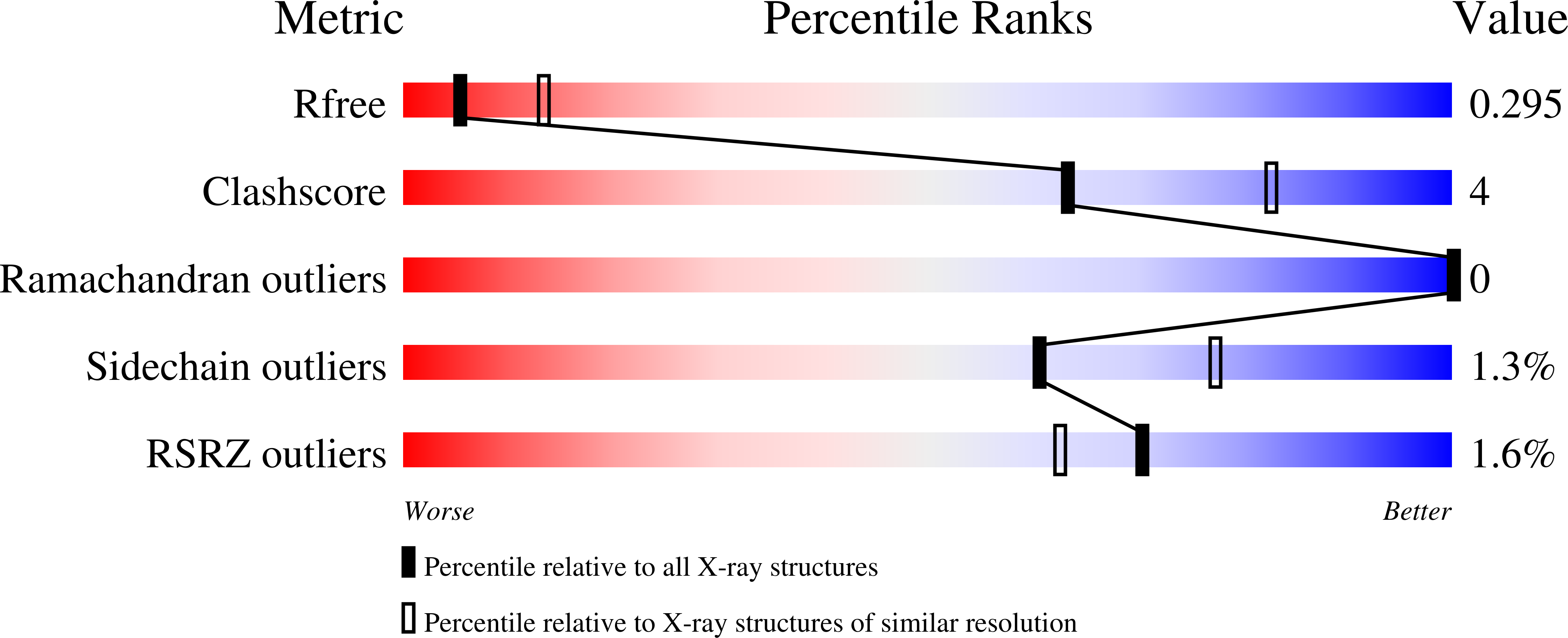
2.94 Å
R-Value Free:
0.29
R-Value Work:
0.26
R-Value Observed:
0.26
Space Group:
C 1 2 1
Macromolecular Entities
Structural Superimposition Protein Blast
Polymer Type:polypeptide(L)
Molecule:LUCI-tag
Chain IDs:A, B (auth: D), C (auth: G), D (auth: J)
Chain Length:169
Number of Molecules:4
Biological Source:synthetic construct
Primary Citation
Deep-learning-based design of an orthogonal self-labeling protein from K-Ras(G12C).
Biorxiv ? ? ? (2026)
PMID: 42856208 DOI: 10.64898/2026.09.27.754867

Abstact

Self-labeling protein (SLP) tags enable versatile labeling of proteins in live cells, yet only two SLPs are commonly used, limiting multiplexing. Here, we repurposed the oncoprotein K-Ras(G12C) and its covalent inhibitors to create a third, orthogonal SLP system. We used a deep-learning-based approach to radically redesign the sequence of K-Ras(G12C) while preserving its covalent-inhibitor binding pocket. Our top design, LUCI-tag, is a 19 kDa, monomeric, thermostable SLP that rapidly and covalently reacts with commercially available K-Ras(G12C) inhibitors bearing diverse payloads. Unlike existing SLPs, LUCI-tag exhibited payload-agnostic labeling kinetics, outperforming HaloTag7 and SNAP-tag for a negatively charged payload. X-ray crystal structures of drug-bound and drug-free LUCI-tag showed the design was structurally accurate and contained a preorganized inhibitor-binding pocket that could explain its rapid labeling kinetics. Proteomics and cell-signaling experiments confirmed LUCI-tag is biologically inert. LUCI-tag enabled rapid, wash-free, live-cell imaging and simultaneous three-color multiplexed experiments with HaloTag7 and SNAP-tag. This work establishes LUCI-tag as an immediately useful orthogonal SLP and demonstrates that covalent drug-target pairs can be repurposed into a broadly applicable platform for protein labeling.

Legend

Protein

Chemical

Disease

Primary Citation of related structures
Feedback Form
Name
Email
Institute
Feedback