

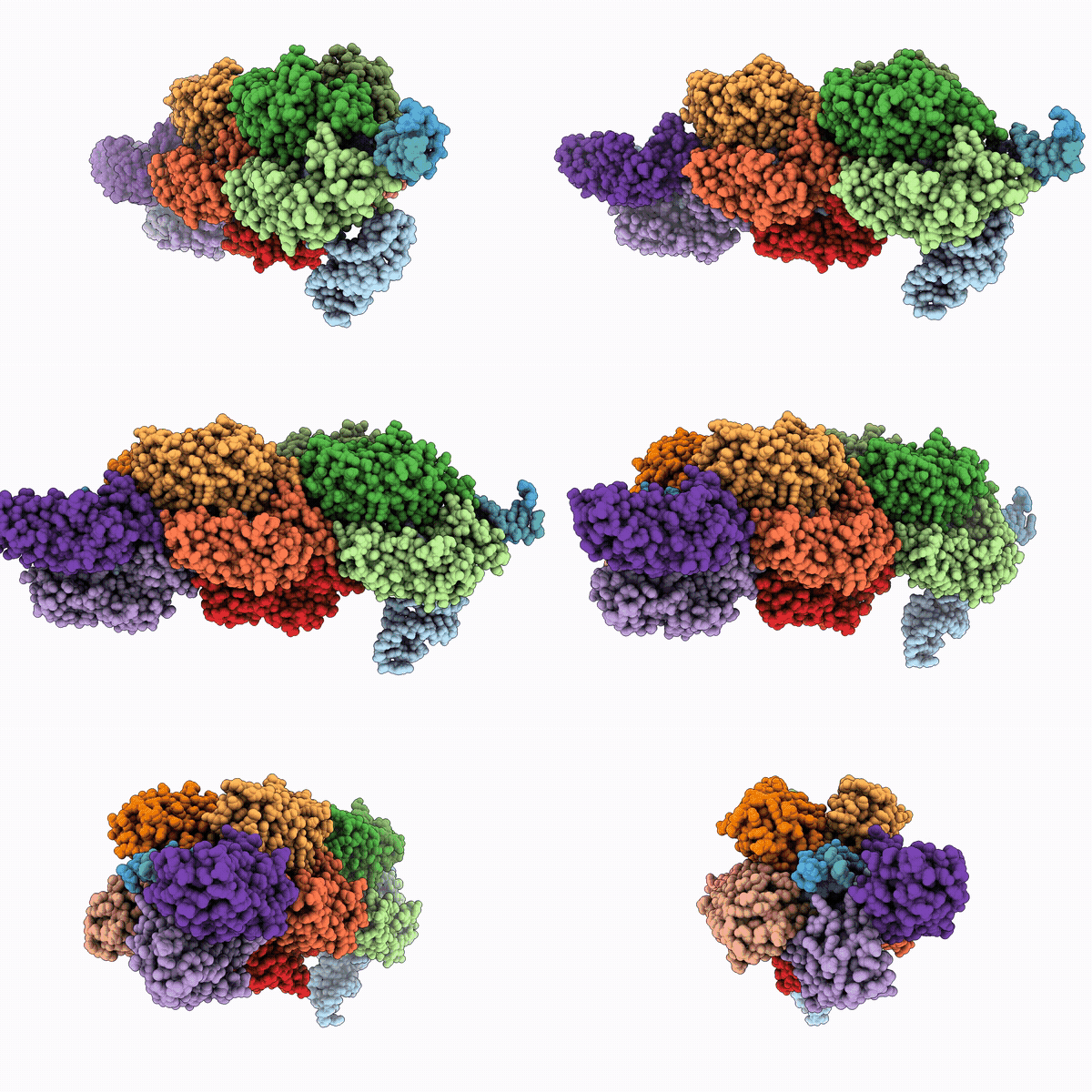
35SY image
Deposition Date 2026-05-15
Release Date 2026-09-16
Last Version Date 2026-09-30
Entry Detail
PDB ID:
35SY
Title:
VIPR Ternary Complex with a pre-unwound dsDNA substrate, 11 subunits
Biological Source:
Source Organism(s):
Expression System(s):
Method Details:
Experimental Method:
Resolution:
3.17 Å
Aggregation State:
PARTICLE
Reconstruction Method:
SINGLE PARTICLE
Macromolecular Entities
Polymer Type:polyribonucleotide
Molecule:RNA (88-MER)
Chain IDs:M (auth: A)
Chain Length:94
Number of Molecules:1
Biological Source:Suspvirus SUSP1
Polymer Type:polydeoxyribonucleotide
Molecule:Target DNA strand
Chain IDs:L (auth: B)
Chain Length:63
Number of Molecules:1
Biological Source:synthetic construct
Polymer Type:polydeoxyribonucleotide
Molecule:DNA (45-MER)
Chain IDs:N (auth: C)
Chain Length:63
Number of Molecules:1
Biological Source:synthetic construct
Structural Superimposition Protein Blast
Polymer Type:polypeptide(L)
Molecule:SUSP1 Vipr Protein
Chain IDs:A (auth: D), B (auth: E), C (auth: F), D (auth: G), E (auth: H), F (auth: I), G (auth: J), H (auth: K), I (auth: L), J (auth: M), K (auth: N)
Chain Length:202
Number of Molecules:11
Biological Source:Suspvirus SUSP1
Ligand Molecules
Primary Citation
VIPR RNA-guided DNA recognition by noncontiguous geometric triplex formation.
Science 393 1236 1240 (2026)
PMID: 42752121 DOI: 10.1126/science.aei3472

Abstact

Viral interference programmable repeat (VIPR) systems use a noncontiguous code for RNA-guided transcriptional silencing. How the Vipr protein and a VIPR RNA (vrRNA) comprising alternating GGY and NN segments achieve precise DNA targeting is unknown. Here, we present 21 cryo-electron microscopy structures that help explain the mechanism of target engagement. Vipr protomers oligomerize along the vrRNA to form a right-handed helical filament, sequestering each GGY motif and positioning the adjacent NN bases for target base pairing. DNA binding, in which every third nucleotide is skipped, results in a gapped vrRNA-DNA hybrid helix that encircles the nontarget DNA strand to form a geometric triplex. These findings suggest that triplex-mediated target-strand handoff could enable noncontiguous and programmable RNA-guided DNA recognition in VIPR systems.

Legend

Protein

Chemical

Disease

Primary Citation of related structures
Feedback Form
Name
Email
Institute
Feedback