

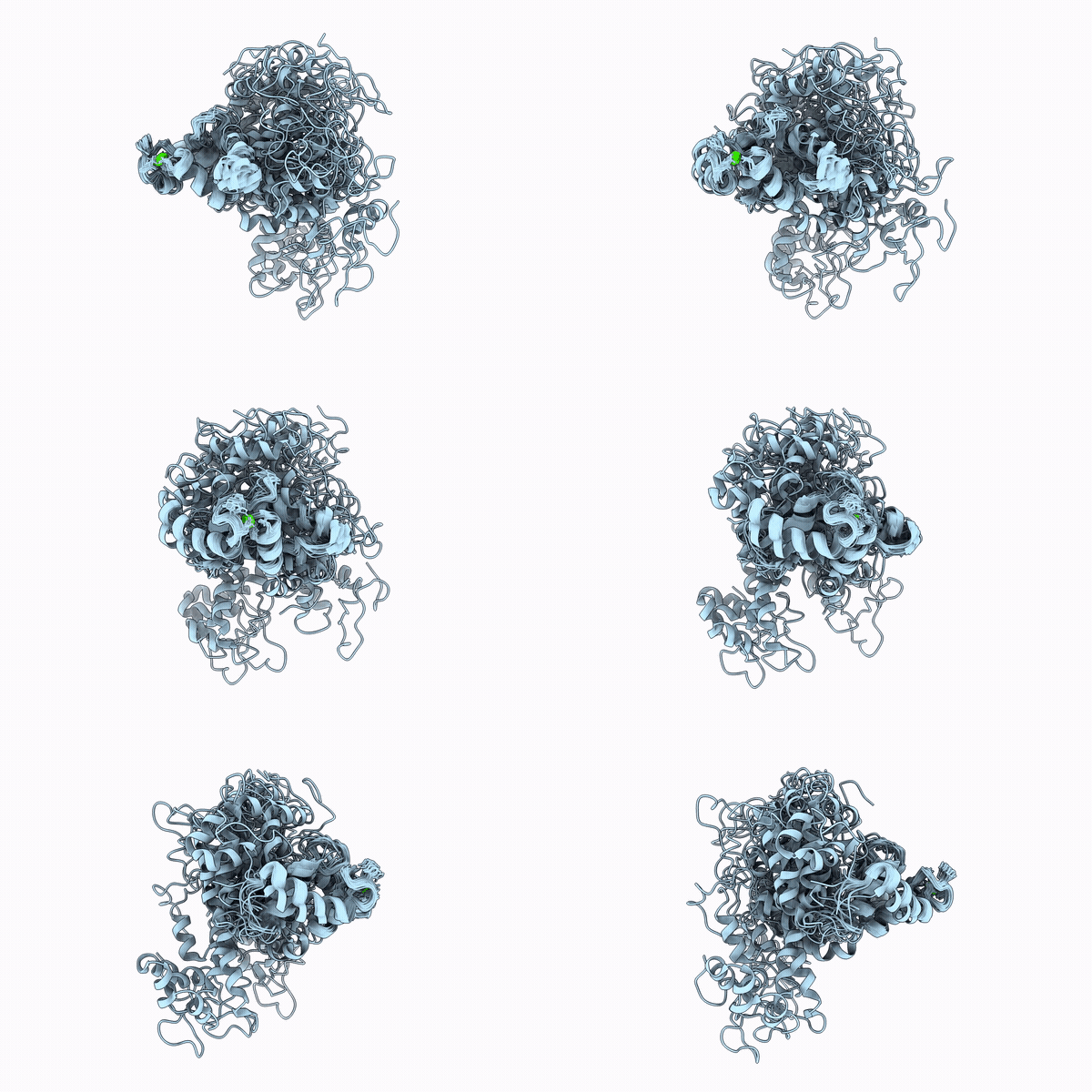
31DM image
Deposition Date 2026-05-27
Release Date 2026-10-21
Last Version Date 2026-11-04
Entry Detail
PDB ID:
31DM
Title:
Holo form of calmodulin-like domain of human alpha-actinin-4
Biological Source:
Source Organism(s):
Homo sapiens (Taxon ID: 9606)
Expression System(s):
Method Details:
Experimental Method:
Conformers Calculated:
20
Conformers Submitted:
20
Selection Criteria:
all calculated structures submitted
Macromolecular Entities
Polymer Type:polypeptide(L)
Molecule:Alpha-actinin-4
Gene (Uniprot):ACTN4
Chain IDs:A
Chain Length:153
Number of Molecules:1
Biological Source:Homo sapiens
Ligand Molecules
Primary Citation
Distinct Ca 2+ -binding thermodynamics reveal a paralogue-specific structural response in the calmodulin-like domain of alpha-actinin-4.
Int.J.Biol.Macromol. 384 154866 154866 (2026)
PMID: 42874945 DOI: 10.1016/j.ijbiomac.2026.154866

Abstact

The actin cytoskeleton, a complex and dynamic network, is precisely organized into structurally and functionally diverse assemblies by actin-binding proteins. A major group of actin crosslinking proteins are alpha-actinins. The non-muscle forms, alpha-actinin-1 and -4, are ubiquitous proteins whose actin crosslinking activity is regulated by Ca(2+) ions. The molecular mechanism of regulation is unknown, but it has been suggested to be driven by structural changes triggered by the binding of Ca(2+) ions to their calmodulin-like domain (CaMD). While the structure and Ca(2+)-binding properties of human alpha-actinin-1 CaMD have already been investigated, no such data were available for the alpha-actinin-4 CaMD. To address this, we used structurally informed mutagenesis and isothermal titration calorimetry (ITC) to confirm a homologous single Ca(2+)-binding site in the N-terminal lobe of the alpha-actinin-4 CaMD. In stark contrast to the alpha-actinin-1 CaMD, where binding is endothermic, binding to the alpha-actinin-4 CaMD is exothermic and displays a 6-fold lower affinity towards Ca(2+). These distinct thermodynamic signatures suggest a paralogue-specific conformational change. Indeed, protein NMR spectroscopy revealed a unique Ca(2+)-induced conformational change of the C-terminal lobe, providing new insights into the molecular mechanisms that modulate alpha-actinin-mediated actin crosslinking.

Legend

Protein

Chemical

Disease

Primary Citation of related structures
Feedback Form
Name
Email
Institute
Feedback