

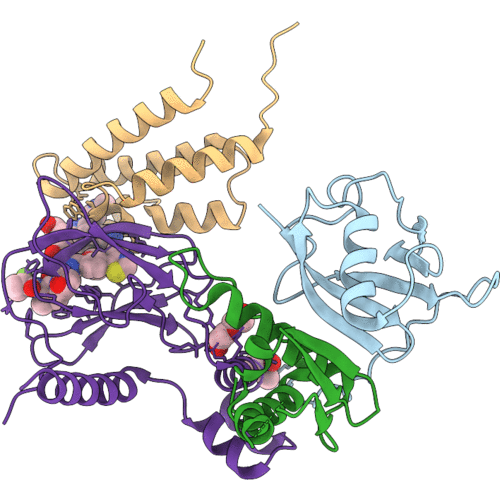
29HO image
Deposition Date 2026-03-12
Release Date 2026-09-09
Last Version Date 2026-10-07
Entry Detail
PDB ID:
29HO
Keywords:
Title:
Ternary complex of VCB, Baz2B-BD with compound 8
Biological Source:
Source Organism(s):
Homo sapiens (Taxon ID: 9606)
Expression System(s):
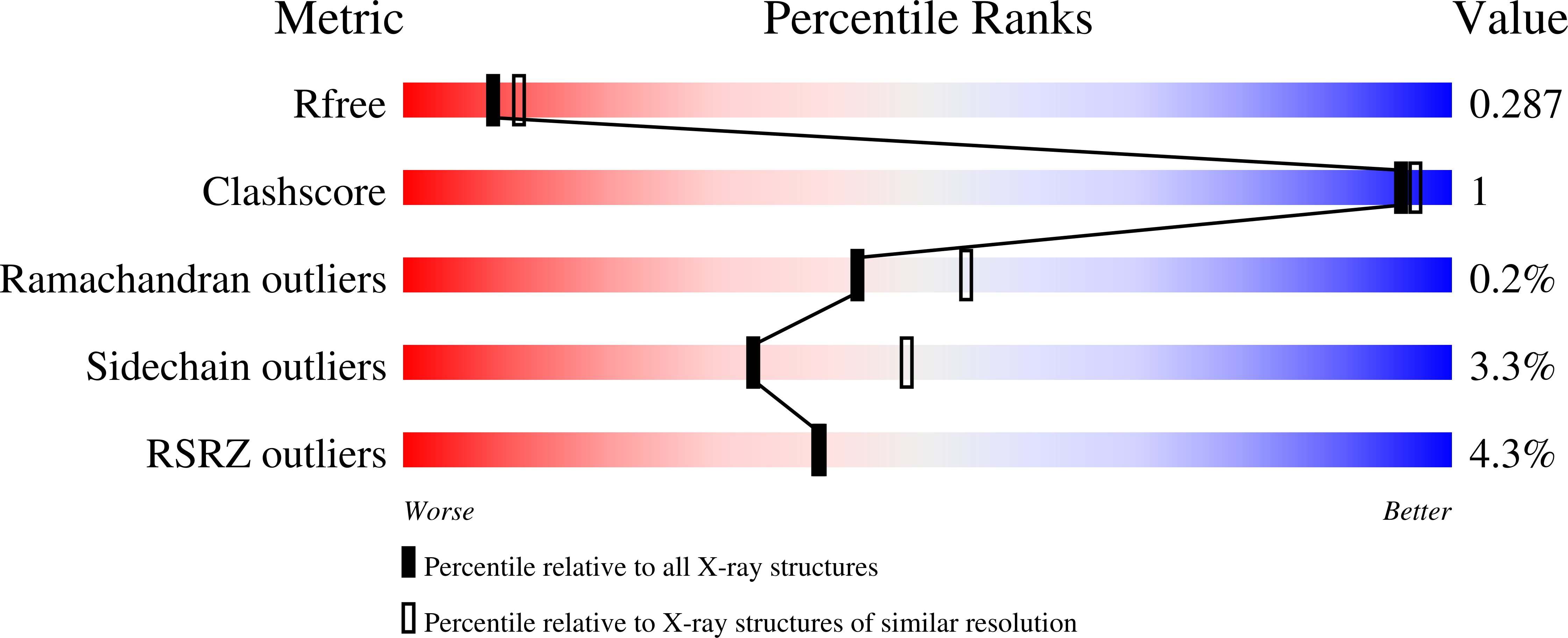
Method Details:
Experimental Method:
Resolution:
2.45 Å
R-Value Free:
0.27
R-Value Work:
0.23
Space Group:
P 21 21 21
Macromolecular Entities
Polymer Type:polypeptide(L)
Molecule:Elongin-B
Gene (Uniprot):ELOB
Chain IDs:A (auth: B)
Chain Length:104
Number of Molecules:1
Biological Source:Homo sapiens
Polymer Type:polypeptide(L)
Molecule:Elongin-C
Gene (Uniprot):ELOC
Chain IDs:B (auth: C)
Chain Length:97
Number of Molecules:1
Biological Source:Homo sapiens
Polymer Type:polypeptide(L)
Molecule:Bromodomain adjacent to zinc
Gene (Uniprot):BAZ2B
Chain IDs:C (auth: D)
Chain Length:117
Number of Molecules:1
Biological Source:Homo sapiens
Polymer Type:polypeptide(L)
Molecule:Isoform 1 of von Hippel-Linda
Gene (Uniprot):VHL
Chain IDs:D (auth: V)
Chain Length:162
Number of Molecules:1
Biological Source:Homo sapiens
Modified Residue
Compound ID Chain ID Parent Comp ID Details 2D Image
CAS A, D CYS modified residue
Primary Citation
Chemical tools for BAZ2A/B biology: discovery of dual and BAZ2B-selective PROTAC degraders.
Rsc Med Chem 17 4430 4444 (2026)
PMID: 42626597 DOI: 10.1039/d6md00244g

Abstact

Bromodomain adjacent to zinc finger 2A and 2B (BAZ2A/B) are regulatory subunits of imitation switch (ISWI) chromatin remodelling complexes. Despite their implication in diverse pathologies, BAZ2A/B remain poorly understood, largely due to the lack of chemical probes capable of discriminating between these homologues or targeting their multiple domains. To address this challenge, we recently disclosed two first-in-class PROTACs: dBAZ2, which degrades both BAZ2A and BAZ2B, and the BAZ2B-selective degrader dBAZ2B. Here, we describe the medicinal chemistry campaign that led to their discovery. In addition, we report here an optimized synthesis of the BAZ2A/B bromodomain (BRD) ligand BAZ2-ICR enabling two different attachment points for linker incorporation and demonstrate that BAZ2A/B degradation is more readily achieved through recruitment of VHL than CRBN. We also identify a third degrader, 8, which employs an alternative linkage vector to BAZ2-ICR compared to dBAZ2 and dBAZ2B, adding to the structural diversity of BAZ2 PROTACs. Cooperativity assays and the BAZ2B-BRD:8:VHL-EloC-EloB co-crystal structure reflect the ability of 8 to degrade both BAZ2A and BAZ2B. In contrast, dBAZ2B achieves selectivity through preferential ternary complex formation with BAZ2B. Finally, we demonstrate the utility of dBAZ2/dBAZ2B as chemical probes: dBAZ2 induces expression of BAZ2A-regulated genes more strongly than dBAZ2B or BAZ2-ICR, and the BAZ2B selectivity of dBAZ2B is maintained across multiple cell lines. Collectively, this work delivers new chemical tools to interrogate BAZ2A/B biology and establishes a platform for developing heterobifunctional molecules targeting these understudied yet disease-relevant proteins.

Legend

Protein

Chemical

Disease

Primary Citation of related structures
Feedback Form
Name
Email
Institute
Feedback