

27ZK image
Deposition Date 2026-06-18
Release Date 2026-10-28
Last Version Date 2026-10-28
Entry Detail
PDB ID:
27ZK
Keywords:
Title:
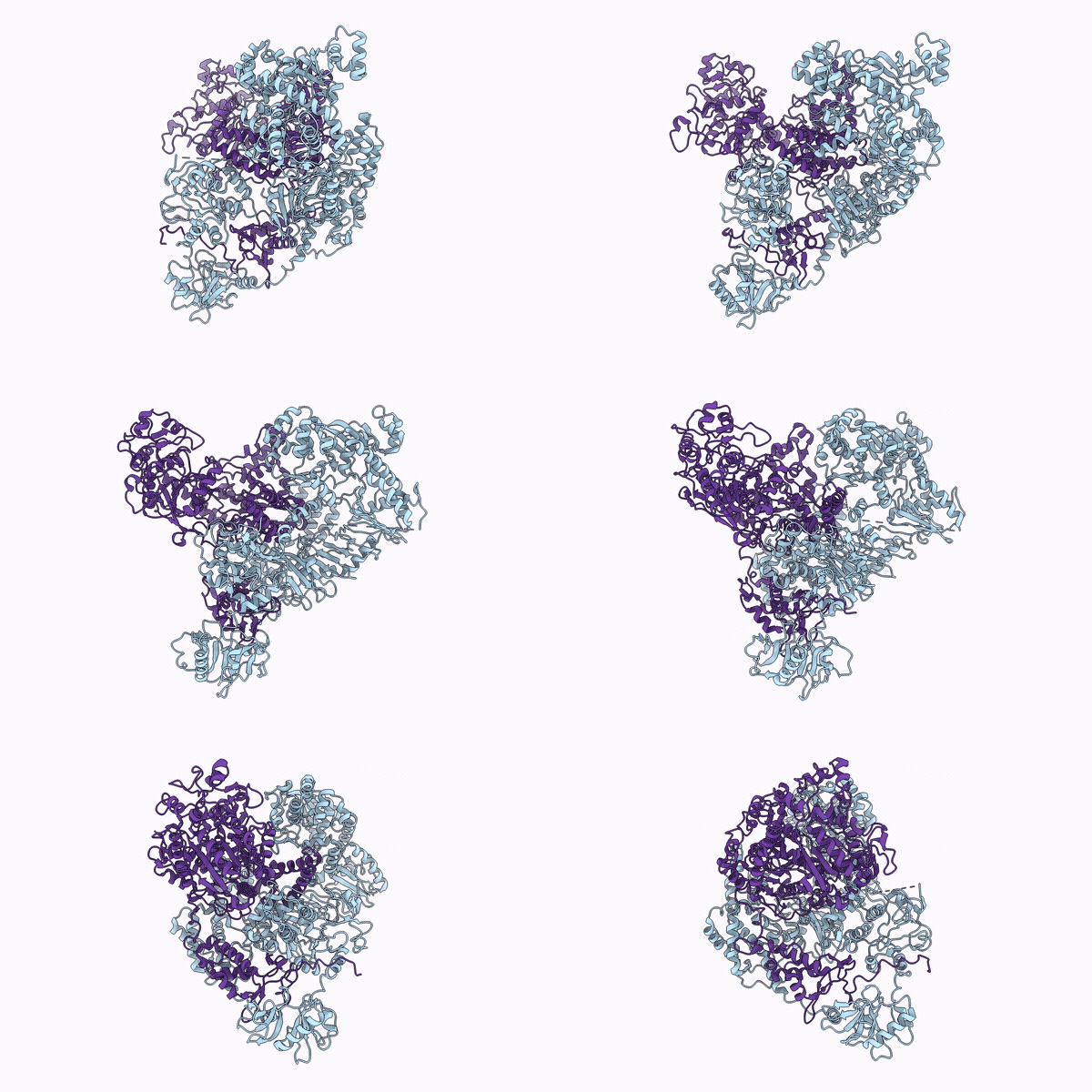
Atomic structure of the ASFV virus early transcription factor in ER state
Biological Source:
Source Organism(s):
Expression System(s):
Method Details:
Experimental Method:
Resolution:
4.00 Å
Aggregation State:
3D ARRAY
Reconstruction Method:
SINGLE PARTICLE
Macromolecular Entities
Polymer Type:polypeptide(L)
Molecule:Early transcription factor la
Gene (Uniprot):G1340L
Chain IDs:A
Chain Length:1377
Number of Molecules:1
Biological Source:African swine fever virus BA71V
Polymer Type:polypeptide(L)
Molecule:Early transcription factor la
Gene (Uniprot):D1133L
Chain IDs:B
Chain Length:1141
Number of Molecules:1
Biological Source:African swine fever virus BA71V
Ligand Molecules
Primary Citation
Structural insights into the early transcription factors of the African swine fever virus.
Int.J.Biol.Macromol. 384 154747 154747 (2026)
PMID: 42833331 DOI: 10.1016/j.ijbiomac.2026.154747

Abstact

African swine fever virus (ASFV) relies on a virus-encoded transcription machinery to initiate gene expression within cytoplasmic viral factories. The viral early transcription factor (VETF), a heterodimer composed of pD1133L and pG1340L, is required for early transcription and viral replication, yet its structural organization and regulation remain poorly understood. Here, we present cryo-EM structures of ASFV VETF in five distinct conformations. The complex adopts an unusual chair-like architecture stabilized by an extensive buried interfacial area. The small subunit, pD1133L, contains a conserved SF2 ATPase core and mutational analyses confirm the functional importance of its catalytic motifs. A positively charged surface channel in pD1133L is consistent with a potential DNA-binding site, supported by the DNA-binding activity of both pD1133L and the VETF heterodimer. In the apo structures, this channel is positioned against the N-terminal domain (NTD) of pG1340L suggesting that NTD rearrangement may modulate DNA accessibility. The five reconstructions further reveal substantial mobility of the pG1340L NTD and Domain 4, while Domain 3 remains conformationally flexible. Comparison and modeling with the ASFV transcription machinery indicate that the observed apo arrangement is unfavorable for formation of a PIC-like complex. Together, these findings define the architecture and conformational landscape of ASFV VETF and provide a structural framework for understanding how its conformational rearrangements may contribute to promoter recognition and transcription initiation. These findings may also support the development of antiviral strategies targeting VETF activation.

Legend

Protein

Chemical

Disease

Primary Citation of related structures
Feedback Form
Name
Email
Institute
Feedback