

24PV image
Deposition Date 2026-03-16
Release Date 2026-09-23
Last Version Date 2026-09-23
Entry Detail
PDB ID:
24PV
Title:
The crystal structure of the chicken MHF1-MHF2(L77C) disulfide-crosslinked complex
Biological Source:
Source Organism(s):
Gallus gallus (Taxon ID: 9031)
Expression System(s):
Method Details:
Experimental Method:
Resolution:
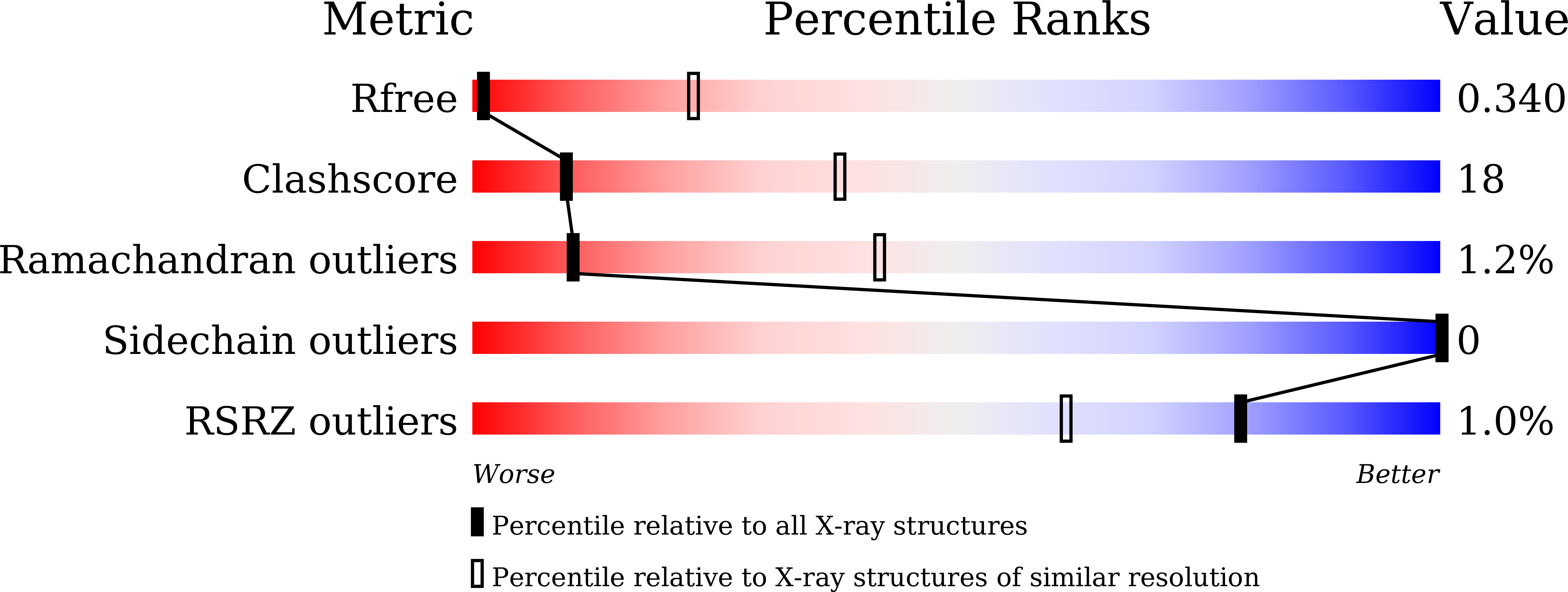
4.00 Å
R-Value Free:
0.33
R-Value Work:
0.25
R-Value Observed:
0.26
Space Group:
C 2 2 21
Macromolecular Entities
Polymer Type:polypeptide(L)
Molecule:Centromere protein S
Gene (Uniprot):CENPS
Mutagens:C26A, C28A, C55A
Chain IDs:A, C, E, G
Chain Length:108
Number of Molecules:4
Biological Source:Gallus gallus
Polymer Type:polypeptide(L)
Molecule:Centromere protein X
Gene (Uniprot):CENPX
Mutagens:L77C
Chain IDs:B, D, F, H
Chain Length:81
Number of Molecules:4
Biological Source:Gallus gallus
Ligand Molecules
Primary Citation
Disulfide engineering of the FANCM-MHF complex reveals constraints on crosslink design in symmetric oligomers.
Protein Sci. 35 e70761 e70761 (2026)
PMID: 42606197 DOI: 10.1002/pro.70761

Abstact

The Fanconi anemia complementation group M protein (FANCM)-MHF complex is required for branched DNA recognition in the Fanconi anemia pathway, but structural analysis of the intact complex has been hindered by dissociation of FANCM from the FANCM-associated histone fold (MHF) heterotetramer under crystallization conditions. Here, we used structure-guided disulfide engineering to stabilize the FANCM-MHF interface and test whether local geometry is sufficient to predict crosslinking specificity in a symmetric oligomeric assembly. Using endogenous FANCM Cys759 as an anchor, we designed two MHF2 variants, Q74C and L77C. Both supported oxidation-dependent crosslinking in the context of the FANCM-MHF complex, but with distinct outcomes. Q74C formed the intended FANCM-MHF2 disulfide, enabled crystallization of the intact heteropentamer, and preserved DNA-binding behavior under the tested conditions. In contrast, L77C favored a competing MHF2-MHF2 disulfide and yielded only the MHF heterotetramer after FANCM dissociation. Structural analysis further showed distinct crosslinking states for the two MHF tetramers in the asymmetric unit, consistent with local conformational heterogeneity at the MHF dimer-dimer interface. These results show that geometric plausibility alone does not predict crosslinking specificity in symmetric oligomers. Instead, symmetry-related competing pathways can redirect the reaction toward an alternative assembly state. This study provides a practical route to stabilizing FANCM-MHF and reveals a key design constraint for engineered disulfides in symmetric multimeric assemblies.

Legend

Protein

Chemical

Disease

Primary Citation of related structures
Feedback Form
Name
Email
Institute
Feedback