

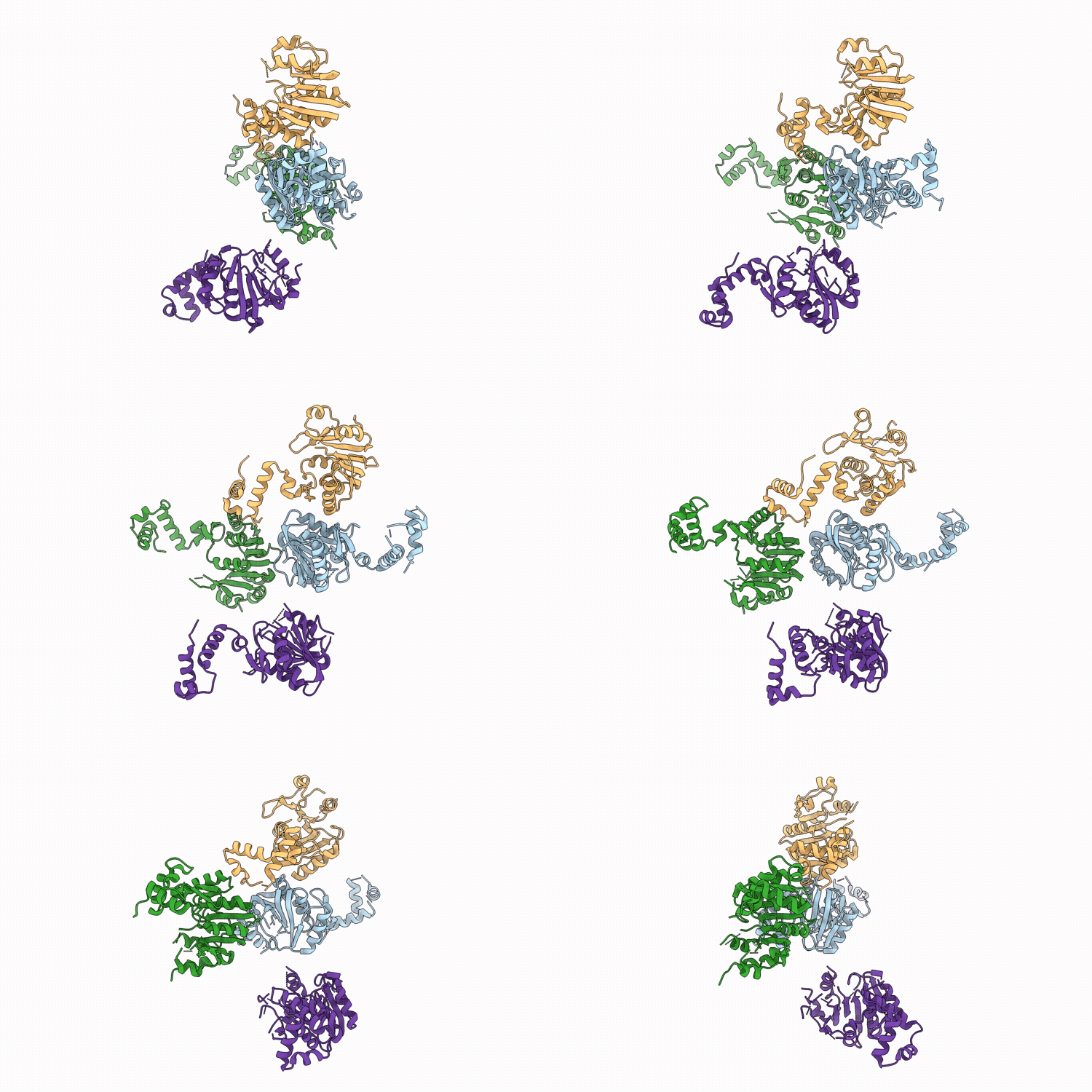
23LQ image
Deposition Date 2026-02-10
Release Date 2026-08-05
Last Version Date 2026-08-05
Entry Detail
PDB ID:
23LQ
Title:
Crystal structure of AprI
Biological Source:
Source Organism(s):
Expression System(s):
Method Details:
Experimental Method:
Resolution:
2.51 Å
R-Value Free:
0.27
R-Value Work:
0.21
R-Value Observed:
0.21
Space Group:
P 1 21 1
Macromolecular Entities
Polymer Type:polypeptide(L)
Molecule:Putative oxidase > apramycin
Gene (Uniprot):LX15_005066
Chain IDs:A (auth: B), B (auth: A), C, D
Chain Length:262
Number of Molecules:4
Biological Source:Streptoalloteichus tenebrarius
Primary Citation
Phosphate-tagged substrate recognition by a PrmC-like methyltransferase in apramycin biosynthesis.
Int.J.Biol.Macromol. 372 153063 153063 (2026)
PMID: 42297172 DOI: 10.1016/j.ijbiomac.2026.153063

Abstact

Apramycin biosynthesis features an unusual O-5 phosphorylation on octose-containing pseudotrisaccharide intermediates that functions as a pathway recognition tag. AprI catalyzes 7'-N-methylation of the phosphorylated intermediate. Unexpectedly, sequence and phylogenetic analysis place AprI within the HemK/PrmC superfamily of protein-targeting methyltransferases rather than among canonical small-molecule N-methyltransferases. Here, we report the crystal structures of AprI in apo and SAH-bound forms, revealing a clasp-like homodimer formed by the N-terminal region and a highly dynamic substrate-proximal loop. Structure-guided docking, molecular dynamics simulations, and mutational analysis show that the homodimer forms a composite, positively charged pocket for recognition of the O-5 phosphate tag, whereas the flexible loop positions the 7'-amino group of the pseudotrisaccharide substrate for methyl transfer. Together, these findings establish AprI as an unusual PrmC-like protein methyltransferase repurposed for tailoring phosphorylated natural products, and open opportunities to engineer biocatalysts for site-selective aminoglycoside diversification.

Legend

Protein

Chemical

Disease

Primary Citation of related structures
Feedback Form
Name
Email
Institute
Feedback