

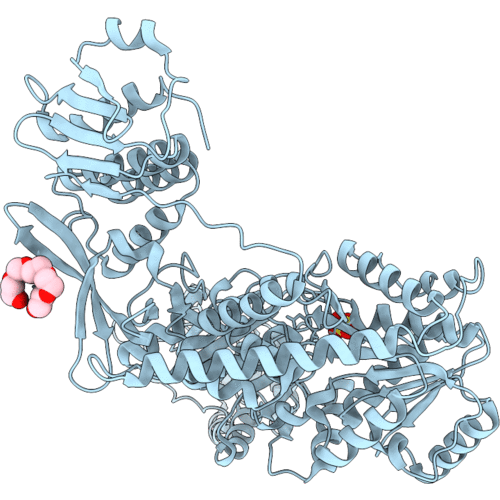
13JQ image
Deposition Date 2026-05-11
Release Date 2026-09-09
Last Version Date 2026-09-09
Entry Detail
PDB ID:
13JQ
Title:
Structure of Thermus thermophilus Mfd
Biological Source:
Source Organism(s):
Expression System(s):
Method Details:
Experimental Method:
Resolution:
2.60 Å
R-Value Free:
0.27
R-Value Work:
0.22
R-Value Observed:
0.22
Space Group:
I 2 2 2
Macromolecular Entities
Polymer Type:polypeptide(L)
Molecule:Transcription-repair-coupling
Gene (Uniprot):mfd
Chain IDs:A
Chain Length:981
Number of Molecules:1
Biological Source:Thermus thermophilus HB8
Modified Residue
Compound ID Chain ID Parent Comp ID Details 2D Image
MSE A MET modified residue
Primary Citation
Autoinhibition is not a universal feature of transcription-repair coupling factors.
J.Biol.Chem. 302 113280 113280 (2026)
PMID: 42331104 DOI: 10.1016/j.jbc.2026.113280

Abstact

Mfd, the canonical bacterial transcription-repair coupling factor, is a highly conserved ATP-dependent DNA translocase with a complex architecture undergoing major rearrangements during its functional cycle. These changes regulate its ATPase and motor activities and are tuned by Mfd interactions with DNA, RNA polymerase and the UvrA subunit of the nucleotide excision repair excinuclease, Uvr(A)BC. Due to its role in accelerating molecular evolution and the development of antibiotic resistance, Mfd is also rapidly emerging as a prime target for the development of anti-evolution drugs to be administered in combination with narrow-spectrum antibiotics to prevent the rise of resistance and combat infection over a wider time window. Here we present the crystal structure of Thermus thermophilus Mfd in its nucleotide-free state. We note the pronounced disorder of the N-terminal UvrB homology module, which was previously seen in Escherichia coli to be engaged in a "clamp" interaction with the C-terminal domain, resulting in autoinhibition of its ATP-dependent functions. Thus, we conclude that the autoinhibitory interdomain interactions, such as the clamp, are not a universal feature of transcription-repair coupling factors. Consistent with this, Thermus thermophilus Mfd, unlike Escherichia coli Mfd, translocates robustly on DNA even in the absence of RNA polymerase and displays DNA binding that is largely nucleotide independent. Our work brings mechanistic insight into the species-specific differences in Mfd structure and function and provides a structural framework for the design of anti-evolution drugs to combat antimicrobial resistance.

Legend

Protein

Chemical

Disease

Primary Citation of related structures
Feedback Form
Name
Email
Institute
Feedback