

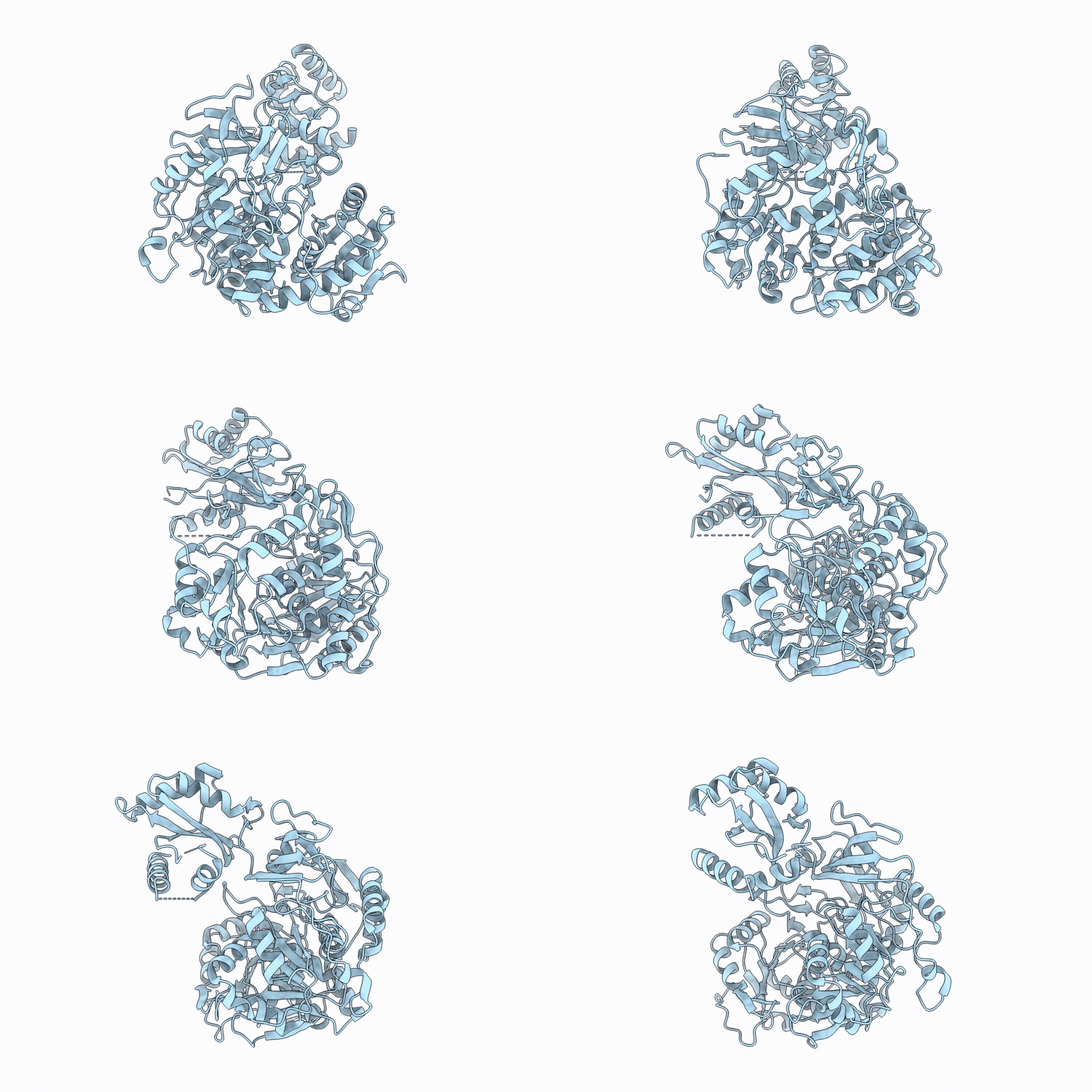
11WQ image
Deposition Date 2026-03-16
Release Date 2026-07-22
Last Version Date 2026-10-14
Entry Detail
PDB ID:
11WQ
Keywords:
Title:
Schizosaccharomyces pombe acetyl-CoA synthetase
Biological Source:
Source Organism(s):
Expression System(s):
Method Details:
Experimental Method:
Resolution:
3.20 Å
Aggregation State:
PARTICLE
Reconstruction Method:
SINGLE PARTICLE
Macromolecular Entities
Polymer Type:polypeptide(L)
Molecule:Acetyl-coenzyme A synthetase
Gene (Uniprot):SPCC191.02c, SPCC417.14c
Chain IDs:A
Chain Length:676
Number of Molecules:1
Biological Source:Schizosaccharomyces pombe
Ligand Molecules
Primary Citation
Ligand-dependent interdomain rearrangements drive catalysis by acetyl-CoA synthetases.
Structure 34 1336 ? (2026)
PMID: 42567156 DOI: 10.1016/j.str.2026.07.009

Abstact

Acetyl-coenzyme A synthetases convert ATP, acetate, and coenzyme A (CoA) into acetyl-CoA, a central metabolite that fuels lipid biosynthesis and regulates protein and RNA acetylation. ACS enzymes contain N- and C-terminal domains that coordinate a two-step ping-pong mechanism involving sequential adenylation and thioester formation at the interdomain interface. How domain motions coordinate these chemical steps remains unclear. Here, we report single-particle cryo-electron microscopy structures of Schizosaccharomyces pombe ACSA captured in apo, pre-adenylation, intermediate, and product states. These structures reveal ligand-dependent reorganization of the C-terminal domain: apo and pre-adenylation forms display increased conformational heterogeneity, whereas intermediate- and product-bound states adopt ordered conformations compatible with catalysis. Structure-guided mutagenesis and in vitro activity assays, together with sequence conservation, support the functional importance and evolutionary conservation of the observed conformational transitions across ACS homologs. These findings establish a ligand-coupled interdomain rearrangement mechanism underlying catalysis by ACS enzymes and a structural framework for inhibitor development.

Legend

Protein

Chemical

Disease

Primary Citation of related structures
Feedback Form
Name
Email
Institute
Feedback