

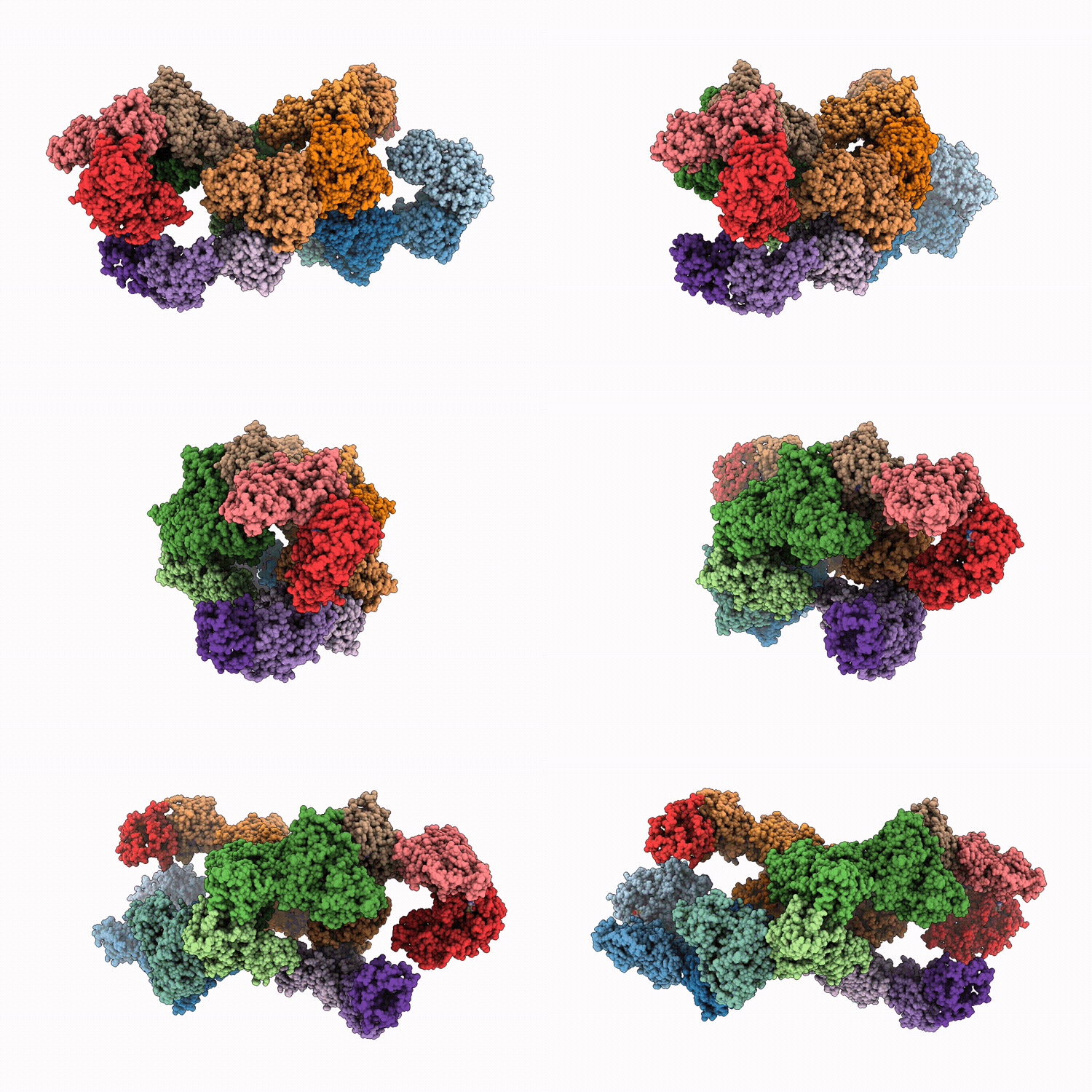
11OA image
Deposition Date 2026-03-05
Release Date 2026-08-19
Last Version Date 2026-09-02
Entry Detail
PDB ID:
11OA
Keywords:
Title:
Cryo-EM structure of human DNMT3A R882H octadecamer
Biological Source:
Source Organism(s):
Homo sapiens (Taxon ID: 9606)
Expression System(s):
Method Details:
Experimental Method:
Resolution:
5.04 Å
Aggregation State:
PARTICLE
Reconstruction Method:
SINGLE PARTICLE
Macromolecular Entities
Polymer Type:polypeptide(L)
Molecule:DNA (cytosine-5)-methyltransf
Gene (Uniprot):DNMT3A
Mutagens:R882H
Chain IDs:A, B, C, D, E, F, G, H, I, J, K, L, M, N, O, P, Q, R
Chain Length:633
Number of Molecules:18
Biological Source:Homo sapiens
Primary Citation
Multidomain interaction governs the filamentous assembly of the dominant-negative DNMT3A R882H mutant.
Proc.Natl.Acad.Sci.USA 123 e2609226123 e2609226123 (2026)
PMID: 42640801 DOI: 10.1073/pnas.2609226123

Abstact

DNA methyltransferase DNMT3A-mediated de novo DNA methylation is important for proper regulation of gene expression and genomic stability in development. The DNMT3A R882H (DNMT3A(R882H)) mutation, a hot-spot mutation in acute myeloid leukemia and developmental disorders, exerts a dominant-negative effect in DNMT3A-mediated DNA methylation through promoting high-order protein assembly. However, due to the lack of structural knowledge on DNMT3A homo-oligomers, the mechanism behind wild-type DNMT3A (DNMT3A(WT)) and DNMT3A(R882H) polymerization remains unclear. Here, we report the single-particle cryo-EM structures of homo-oligomeric DNMT3A(WT) and filamentous DNMT3A(R882H), revealing the role of the regulatory Pro-Trp-Trp-Pro (PWWP) and ATRX-DNMT3-DNMT3L (ADD) domains of DNMT3A in their dynamic assembly. While the oligomeric assembly of DNMT3A is mainly driven by the well-characterized oligomer interfaces in the methyltransferase domain, the autoinhibitory interaction of the PWWP and ADD domains in DNMT3A places them in a position for intermolecular contact, thereby contributing to the filamentous assembly of DNMT3A(R882H). Disrupting the autoinhibitory interaction facilitates the transition of DNMT3A(R882H) polymer toward the low-order oligomeric assembly, reinforcing the aggregation-attenuation effect of the previously characterized oligomer-interface mutation R676K. Together, this study uncovers a multidomain cooperated assembly mechanism for DNMT3A, with important implication in development of effective therapeutic strategies against DNMT3A(R882H)-associated diseases.

Legend

Protein

Chemical

Disease

Primary Citation of related structures
Feedback Form
Name
Email
Institute
Feedback