

11ME image
Deposition Date 2026-03-04
Release Date 2026-09-23
Last Version Date 2026-10-14
Entry Detail
PDB ID:
11ME
Keywords:
Title:
Cryo-EM of T2SS OutG pilus
Biological Source:
Source Organism(s):
Expression System(s):
Method Details:
Experimental Method:
Resolution:
3.60 Å
Aggregation State:
FILAMENT
Reconstruction Method:
HELICAL
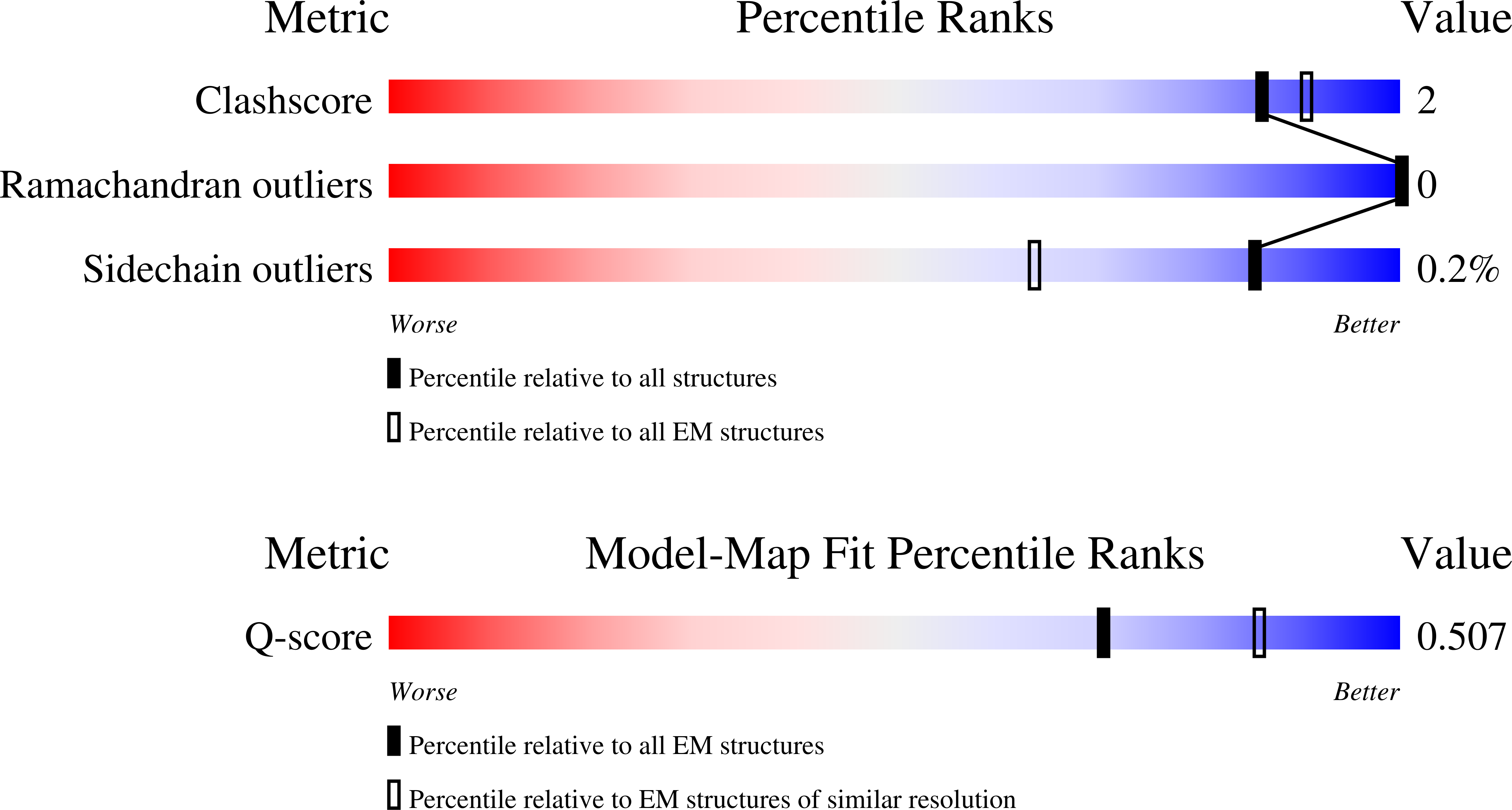
Macromolecular Entities
Polymer Type:polypeptide(L)
Molecule:Type II secretion system core
Gene (Uniprot):outG
Chain IDs:A (auth: B), B (auth: C), C (auth: D), D (auth: E)
Chain Length:132
Number of Molecules:4
Biological Source:Dickeya dadantii
Ligand Molecules
Primary Citation
Structural determinants of endopilus assembly, stability, and functional specificity in bacterial type II secretion.
Structure 34 1324 1335.e5 (2026)
PMID: 42624105 DOI: 10.1016/j.str.2026.07.013

Abstact

Gram-negative bacteria employ the type II secretion system (T2SS) to transport folded protein effectors via a periplasmic helical polymer called the endopilus, composed of one major and four minor pilin subunits. Endopili resemble type IV pili but feature a conserved calcium-binding site stabilizing their major pilins. Endopilus polymerization is coupled to substrate translocation through a dedicated outer membrane channel. We compared T2SSs from plant and human pathogens, Dickeya dadantii and Klebsiella oxytoca, respectively. Despite different ecological niches and secreted effectors, their major pilins (OutG and PulG) share >77% sequence identity. Using NMR and cryo-EM, we solved structures of calcium-bound OutG monomer, as well as OutG and PulG endopili at 3.6 A resolution. Combining structural, mutational, and biophysical analyses with in vivo assays, we identified key determinants of secretion specificity and endopilus stability. Our findings reveal how minor sequence variations in conserved nanomachines drive functional adaptation to diverse environments.

Legend

Protein

Chemical

Disease

Primary Citation of related structures
Feedback Form
Name
Email
Institute
Feedback