

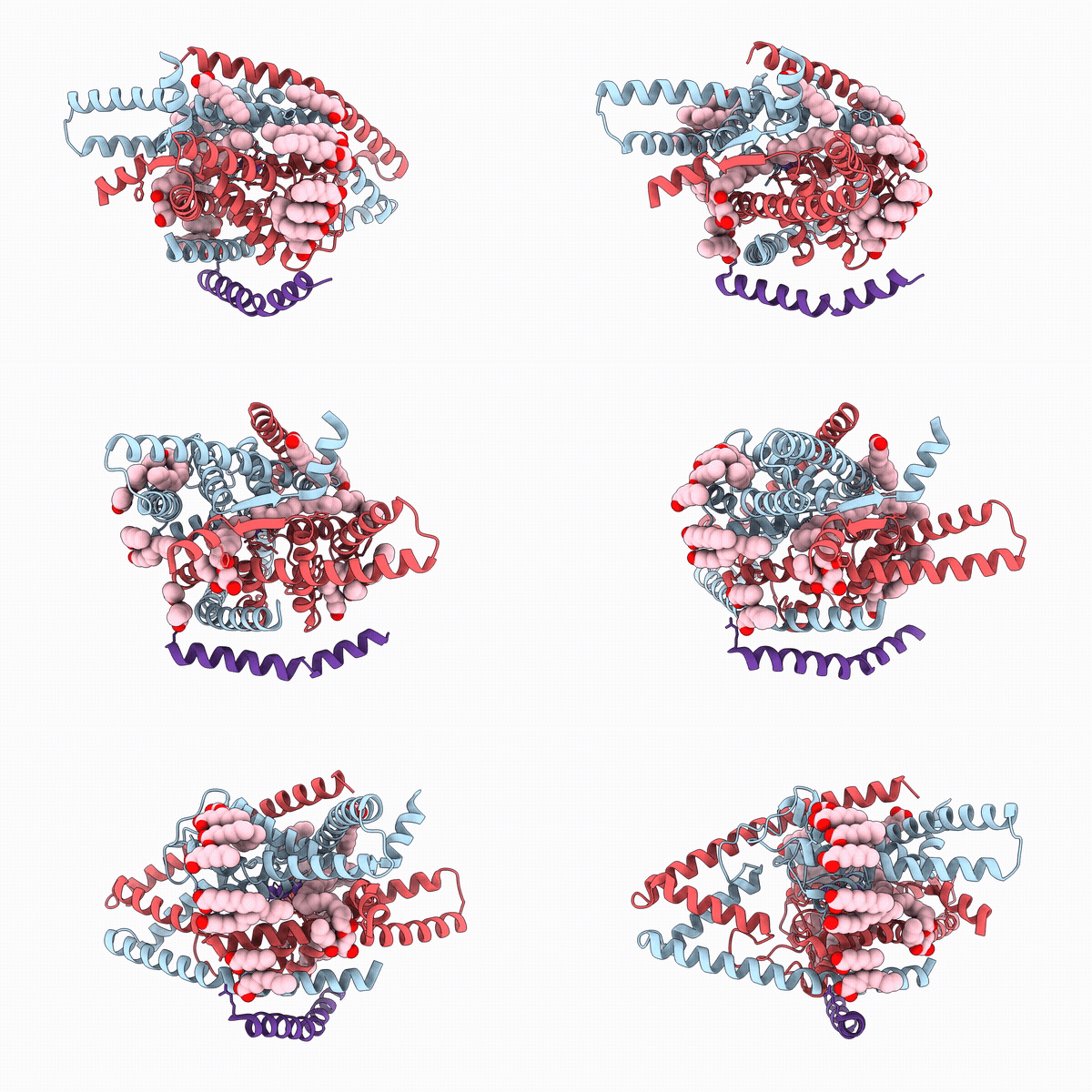
10PC image
Deposition Date 2026-01-30
Release Date 2026-10-07
Last Version Date 2026-10-21
Entry Detail
PDB ID:
10PC
Title:
TASK-2 at pH 6.5 with 100 uM Bupivacaine
Biological Source:
Source Organism(s):
Mus musculus (Taxon ID: 10090)
Homo sapiens (Taxon ID: 9606)
Method Details:
Experimental Method:
Resolution:
2.96 Å
Aggregation State:
PARTICLE
Reconstruction Method:
SINGLE PARTICLE
Macromolecular Entities
Polymer Type:polypeptide(L)
Molecule:Potassium channel TASK2
Gene (Uniprot):Kcnk5
Chain IDs:A, B
Chain Length:344
Number of Molecules:2
Biological Source:Mus musculus
Polymer Type:polypeptide(L)
Molecule:Apolipoprotein A-I
Gene (Uniprot):APOA1
Chain IDs:C (auth: D)
Chain Length:211
Number of Molecules:1
Biological Source:Homo sapiens
Primary Citation
Mechanisms of intracellular pH gating and local anesthetic inhibition of the two-pore domain K + channel TASK-2.
Proc.Natl.Acad.Sci.USA 123 e2604873123 e2604873123 (2026)
PMID: 42848420 DOI: 10.1073/pnas.2604873123

Abstact

TWIK-related acid-sensitive K+ channel 2 (TASK-2) is a pH sensing two-pore K(+) (K2P) channel that regulates respiration in brainstem neurons and systemic pH homeostasis in kidney. Despite its physiological importance and implication in disease, the molecular basis for intracellular gating and pharmacological inhibition of TASK-2 is incompletely understood. Here, we combine cryo-EM and single-channel electrophysiology to resolve the mechanisms of TASK-2 gating by intracellular protons and inhibition by the anesthetic bupivacaine. We show protonation of intracellular lysines triggers a unique stacked gating mechanism distinct from other K(+) channels. Inner helices unwind and domain swap to form a beta-zipper, which we call a Z-gate, that seals the cytoplasmic channel entrance. These conformational changes open lateral fenestrations to the membrane that permit lipids to invade the channel cavity and block the pore. Furthermore, we find bupivacaine inhibits the channel by competing with lipids in the cavity site in a state-dependent manner. These results define a paradigm for intracellular gating of K2Ps and provide a structural foundation for designing more potent and selective channel modulators.

Legend

Protein

Chemical

Disease

Primary Citation of related structures
Feedback Form
Name
Email
Institute
Feedback