

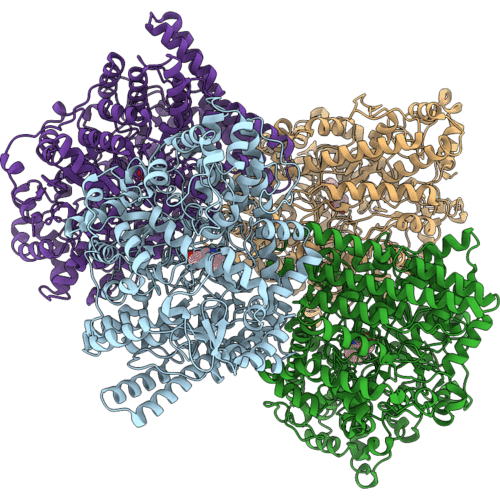
10AL image
Deposition Date 2026-01-08
Release Date 2026-09-16
Last Version Date 2026-09-30
Entry Detail
PDB ID:
10AL
Keywords:
Title:
indoleacetate decarboxylase with bound indole-3-acetate
Biological Source:
Source Organism(s):
Expression System(s):
Method Details:
Experimental Method:
Resolution:
2.45 Å
Aggregation State:
PARTICLE
Reconstruction Method:
SINGLE PARTICLE
Macromolecular Entities
Polymer Type:polypeptide(L)
Molecule:Formate C-acetyltransferase
Gene (Uniprot):Olsu_0124
Chain IDs:A, B (auth: D), C (auth: B), D (auth: C)
Chain Length:898
Number of Molecules:4
Biological Source:Olsenella uli DSM 7084
Ligand Molecules
Primary Citation
The structural basis of malodorant skatole formation by the glycyl radical enzyme indoleacetate decarboxylase.
Proc.Natl.Acad.Sci.USA 123 e2618341123 e2618341123 (2026)
PMID: 42758728 DOI: 10.1073/pnas.2618341123

Abstact

Glycyl radical enzymes (GREs) catalyze challenging chemical reactions using a posttranslationally installed glycyl radical cofactor. One such enzyme, indoleacetate decarboxylase (IAD), performs the radical-based decarboxylation of indole-3-acetate (I3A) to form the malodorant molecule skatole. In addition to being an odor nuisance, skatole is a human and livestock lung toxin, a suspected carcinogen, and a mosquito attractant, all of which impact human health, agriculture, food production, and wastewater treatment. Here, we use cryogenic electron microscopy to solve a 2.45-A resolution structure of IAD from the gut bacterium Olsenella uli. We observe IAD in a homotetrameric form with the substrate I3A bound in all four protomers. The positioning of I3A in the active site is unexpected and is more consistent with a Kolbe-type decarboxylation mechanism, i.e., a decarboxylation initiated by a 1-electron oxidation of the carboxylate moiety rather than being initiated by hydrogen atom transfer (HAT). Previously, a high deuterium content in skatole from IAD assays in D(2)O was used to support a HAT mechanism over a Kolbe-type mechanism. However, we show here that deuterium content does not necessarily inform on mechanism as IAD can catalyze the exchange of skatole's 3'-methyl hydrogens postturnover. Structural comparisons show that both IAD and hydroxyphenylacetate decarboxylase display structural features that are not found in other characterized GREs, suggesting that they represent a distinct GRE-subclass. Collectively, these insights will inform IAD inhibitor design aimed at decreasing skatole production.

Legend

Protein

Chemical

Disease

Primary Citation of related structures
Feedback Form
Name
Email
Institute
Feedback