

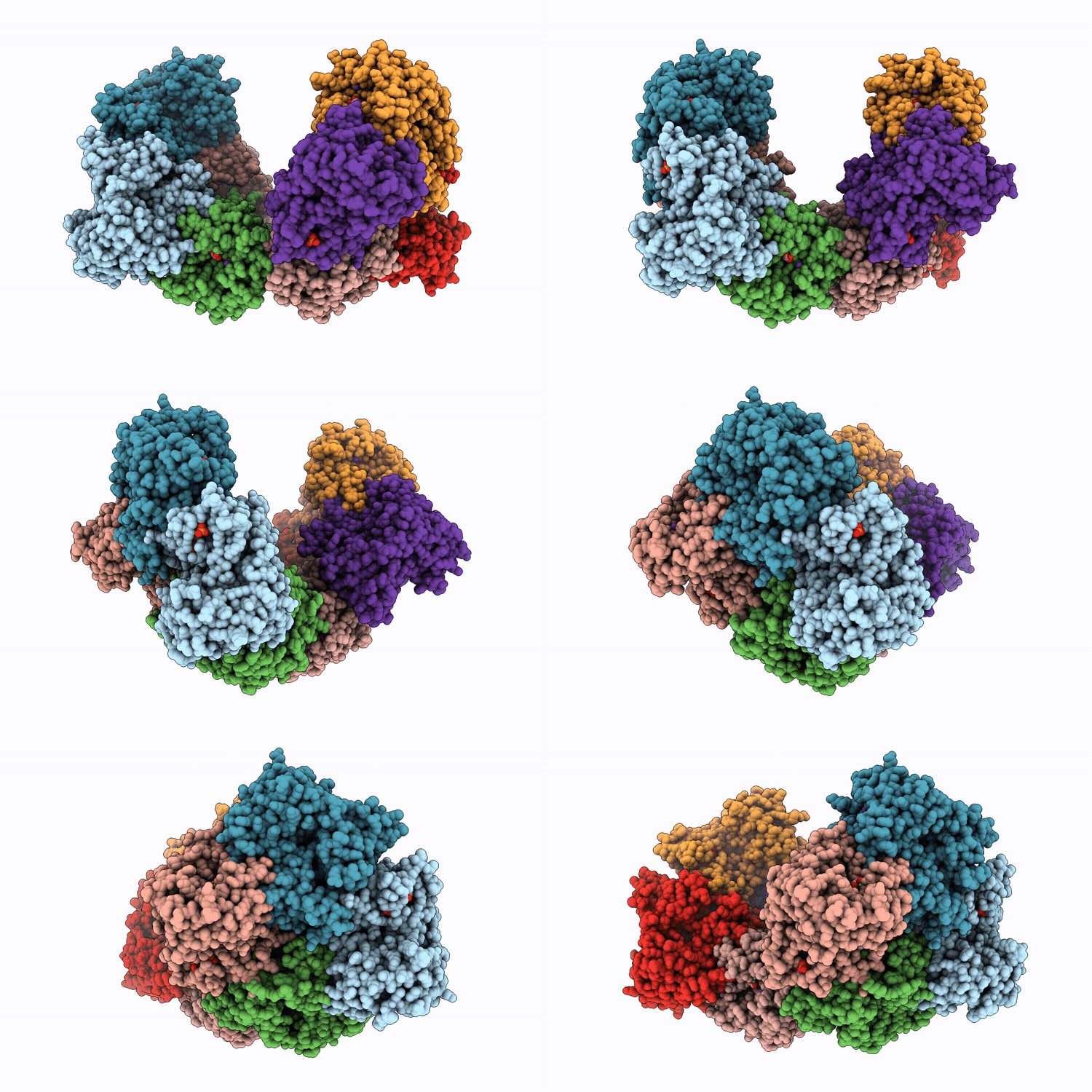
9rfq image
Deposition Date 2025-06-04
Release Date 2026-04-08
Last Version Date 2026-04-15
Entry Detail
PDB ID:
9RFQ
Keywords:
Title:
Structure of liver pyruvate kinase in complex with Liver pyruvate kinase in complex with fluorescent probe I
Biological Source:
Source Organism(s):
Homo sapiens (Taxon ID: 9606)
Expression System(s):
Method Details:
Experimental Method:
Resolution:
2.39 Å
R-Value Free:
0.24
R-Value Work:
0.20
R-Value Observed:
0.21
Space Group:
C 1 2 1

Macromolecular Entities
Structures with similar UniProt ID
Protein Blast
Polymer Type:polypeptide(L)
Molecule:Isoform L-type of Pyruvate ki
Gene (Uniprot):PKLR
Chain IDs:A, B, C, D, E, F, G, H
Chain Length:447
Number of Molecules:8
Biological Source:Homo sapiens
Primary Citation
Potent Fluorescent Probe for Target-Engagement Studies of Allosteric Pyruvate Kinase Modulators.
Angew. Chem. Int. Ed. Engl. 64 e202513969 e202513969 (2025)
PMID: 40884041 DOI: 10.1002/anie.202513969

Abstact

Pyruvate kinases (PKs) are highly allosterically regulated enzymes that play a central role in cellular metabolism and are increasingly recognized as valuable therapeutic targets in cancer, metabolic diseases, and diabetes. Despite their biological and clinical significance, methods to directly assess allosteric ligand engagement of PK isoforms remain limited. Here, we report the development of LumiPK, a novel, environment-sensitive fluorescent tracer designed to monitor allosteric binding to the liver isoform of pyruvate kinase (PKL). LumiPK integrates an environment-sensitive 4-sulfamonyl-7-aminobenzoxadiazole fluorophore into a potent allosteric modulator scaffold. It emerged as the lead compound from a small ligand series, showing high affinity for PKL (K(D) = 37 +/- 5 nM) in recombinant assays; the most potent fluorescent PK reporter reported to date. A NanoBRET assay using a PKL-Nluc fusion (PKL(Nluc)) enabled intracellular monitoring of unlabeled ligand engagement. LumiPK maintained high potency (EC(50) = 18.4 nM) in cellular experiments. Competitive NanoBRET and fluorescence titration assays confirmed binding of known PKL activators (mitapivat, TEPP-46, DASA-58) in both cellular and recombinant settings, with K(D) values remaining consistent across these methods. LumiPK thus provides a robust tool for probing PKL allosteric modulation and fills a key gap in target engagement technologies for PKL.

Legend

Protein

Chemical

Disease

Primary Citation of related structures
Feedback Form
Name
Email
Institute
Feedback