

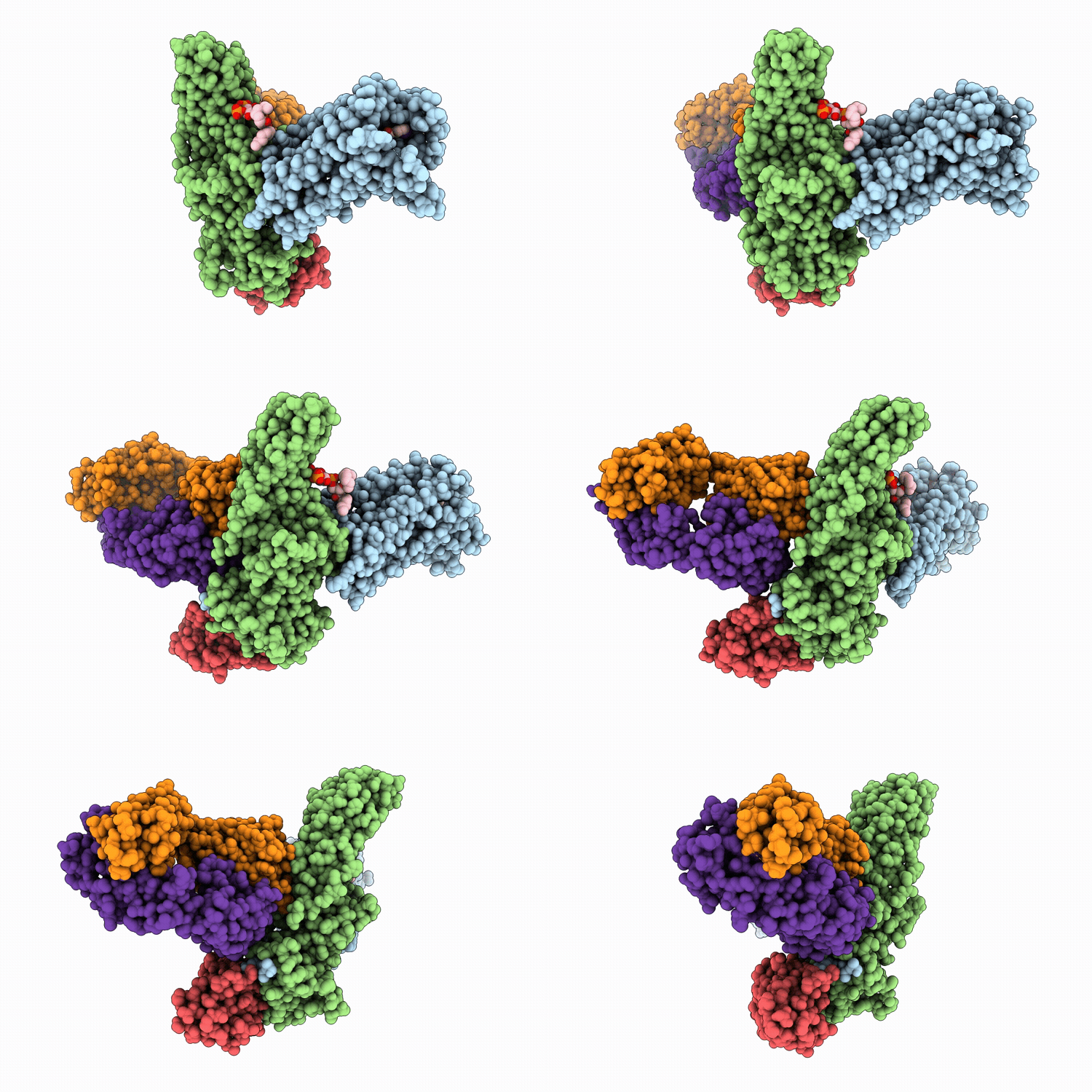
9ZZO image
Deposition Date 2026-01-07
Release Date 2026-06-17
Last Version Date 2026-06-17
Entry Detail
PDB ID:
9ZZO
Title:
MP1104-bound Kappa Opioid Receptor in complex with beta-arrestin1
Biological Source:
Source Organism(s):
Lama glama (Taxon ID: 9844)
Homo sapiens (Taxon ID: 9606)
synthetic construct (Taxon ID: 32630)
Method Details:
Experimental Method:
Resolution:
2.60 Å
Aggregation State:
PARTICLE
Reconstruction Method:
SINGLE PARTICLE
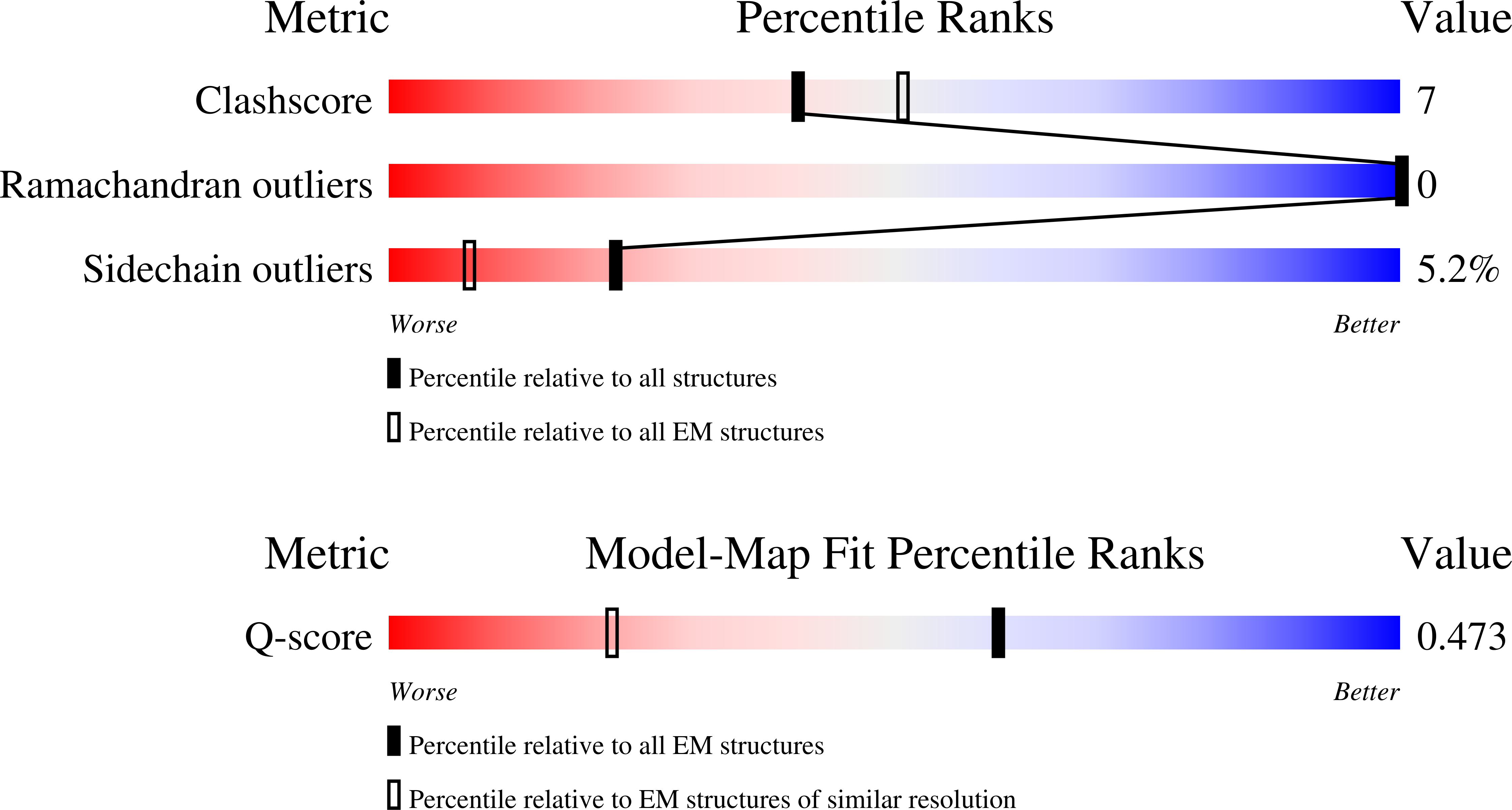
Macromolecular Entities
Protein Blast
Polymer Type:polypeptide(L)
Molecule:Kappa-type opioid receptor,Va
Gene (Uniprot):AVPR2, OPRK1
Chain IDs:C (auth: A)
Chain Length:341
Number of Molecules:1
Biological Source:Homo sapiens
Structures with similar UniProt ID
Protein Blast
Polymer Type:polypeptide(L)
Molecule:Isoform 1B of Beta-arrestin-1
Gene (Uniprot):ARRB1
Chain IDs:B (auth: C)
Chain Length:387
Number of Molecules:1
Biological Source:Homo sapiens
Protein Blast
Polymer Type:polypeptide(L)
Molecule:Nanobody 32
Chain IDs:A (auth: E)
Chain Length:124
Number of Molecules:1
Biological Source:Lama glama
Protein Blast
Polymer Type:polypeptide(L)
Molecule:Fab30 heavy chain
Chain IDs:D (auth: H)
Chain Length:241
Number of Molecules:1
Biological Source:synthetic construct
Protein Blast
Polymer Type:polypeptide(L)
Molecule:Fab30 light chain
Chain IDs:E (auth: L)
Chain Length:215
Number of Molecules:1
Biological Source:synthetic construct
Modified Residue
Compound ID Chain ID Parent Comp ID Details 2D Image
SEP C SER modified residue
TPO C THR modified residue
Primary Citation
Structural dynamics of kappa opioid receptor interactions with beta-arrestin 1.
Nat Commun ? ? ? (2026)
PMID: 42243110 DOI: 10.1038/s41467-026-73968-3

Abstact

Opioid receptors signal through Gi/o protein and beta-arrestin pathways that mediate distinct effects of opiate drugs. While opioid binding and G protein activation are well studied, beta-arrestin recruitment remains poorly understood. Here, we determine the complex structure of the kappa opioid receptor (KOR) with beta-arrestin1 (betaarr1) at 2.60 A resolution using cryogenic electron microscopy. Structural and mass spectrometry analyses reveal multiple phosphorylation sites and a phospholipid-binding site that specifically enhances arrestin recruitment. The KOR-betaarr1 complex adopts a core interaction and exhibits notable differences from other GPCR-betaarr1 complexes. Comparisons with the structures of KOR-Nb39 and KOR-Gi1 complexes also reveal distinct structural features in the orthosteric binding site and the KOR-transducer interface that affect signaling bias. Using extensive 3D variation analysis and molecular dynamics simulations, we identify a range of conformational dynamics in both the receptor and betaarr1, suggesting an allosteric pathway for arrestin's entry and exit.

Legend

Protein

Chemical

Disease

Primary Citation of related structures
Feedback Form
Name
Email
Institute
Feedback