

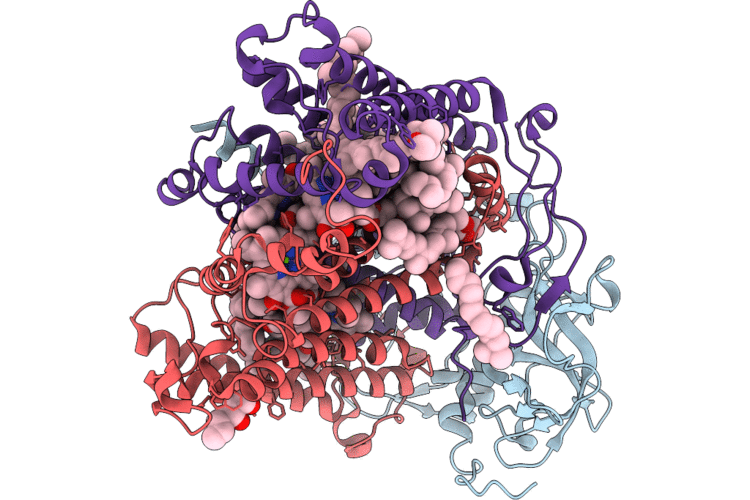
9ZS8 image
Deposition Date 2025-12-22
Release Date 2026-08-26
Last Version Date 2026-08-26
Entry Detail
PDB ID:
9ZS8
Keywords:
Title:
Structural and electrostatic analysis of a reaction center variant with high-yield charge separation along the alternative electron transfer path
Biological Source:
Source Organism(s):
Expression System(s):
Method Details:
Experimental Method:
Resolution:
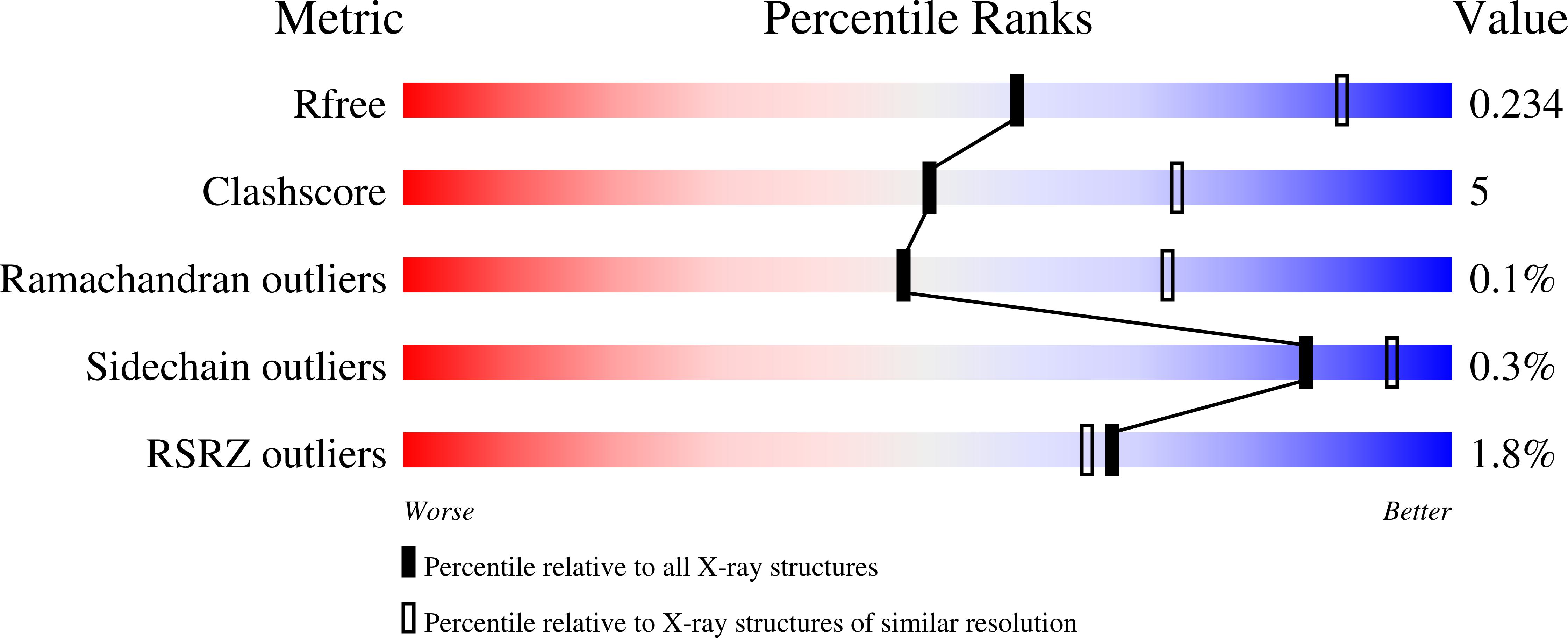
2.70 Å
R-Value Free:
0.23
R-Value Work:
0.21
R-Value Observed:
0.21
Space Group:
P 21 21 21
Macromolecular Entities
Polymer Type:polypeptide(L)
Molecule:Reaction center protein H cha
Gene (Uniprot):puhA
Chain IDs:A (auth: H)
Chain Length:245
Number of Molecules:1
Biological Source:Cereibacter sphaeroides
Polymer Type:polypeptide(L)
Molecule:Reaction center protein L cha
Gene (Uniprot):pufL
Chain IDs:B (auth: L)
Chain Length:281
Number of Molecules:1
Biological Source:Cereibacter sphaeroides
Polymer Type:polypeptide(L)
Molecule:Reaction center protein M cha
Gene (Uniprot):pufM
Chain IDs:C (auth: M)
Chain Length:302
Number of Molecules:1
Biological Source:Cereibacter sphaeroides
Primary Citation
High-yield charge separation along the alternative path in a photosynthetic reaction center: X-ray structure and electrostatic analysis.
Proc.Natl.Acad.Sci.USA 123 e2609063123 e2609063123 (2026)
PMID: 42574604 DOI: 10.1073/pnas.2609063123

Abstact

In all photosynthetic reaction centers (RC), transmembrane electron-transfer (ET) cofactor pathways are coordinated by homologous peptides and arranged with approximate C(2) symmetry, providing two possible paths for charge separation (designated A and B). In type II RCs-Photosystem II and the purple bacterial RCs-only the A branch is active for ET. A variant bacterial RC containing nine amino acid substitutions that result in high-yield ET along the normally nonfunctional B branch was designed. Structural and theoretical studies were combined to understand factors that control unique ET reactions in the complex. Serial femtosecond crystallography performed at an X-ray Free Electron Laser afforded the room temperature X-ray-damage-free crystal structure of the variant RC, revealing interactions between the substituted amino acids and the ET cofactors. The positions of the bacteriochlorin cofactors on the symmetry-related pathways are unaffected, underscoring that the substitutions alter the energetics of ET, leading to the functional changes. In the binding pockets for the terminal electron acceptor quinones, alterations in the positions of neighboring amino acids and water molecules are coordinated with the change of the substituted side chains. Modifications deactivated A-branch ET and activated transmembrane charge separation along the B branch. Electrostatic calculations based on the structure reveal how differences in stabilization of charge-separated states by the protein environment underlie the change in direction of electron flow in this variant RC and provide insights into mechanisms by which B-branch charge separation across the photosynthetic membrane can be achieved in high yield.

Legend

Protein

Chemical

Disease

Primary Citation of related structures
Feedback Form
Name
Email
Institute
Feedback