

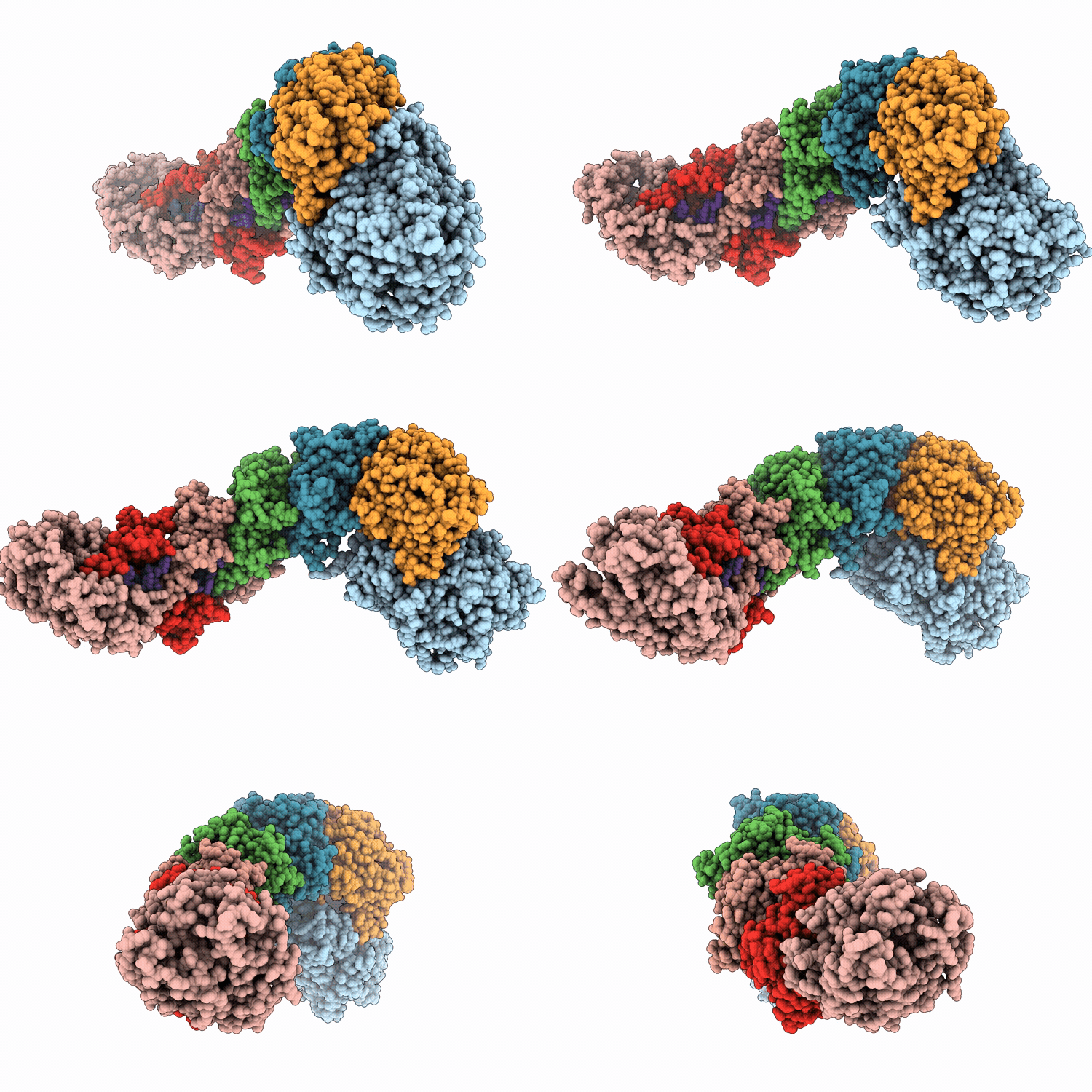
9ZS2 image
Deposition Date 2025-12-22
Release Date 2026-04-22
Last Version Date 2026-04-22
Entry Detail
PDB ID:
9ZS2
Title:
S. marcescens Cas10-Csm unbound to target RNA
Biological Source:
Source Organism(s):
Serratia (Taxon ID: 613)
Expression System(s):
Method Details:
Experimental Method:
Resolution:
4.40 Å
Aggregation State:
PARTICLE
Reconstruction Method:
SINGLE PARTICLE

Macromolecular Entities
Structures with similar UniProt ID
Protein Blast
Polymer Type:polypeptide(L)
Molecule:CRISPR system single-strand-s
Gene (Uniprot):cas10
Chain IDs:A
Chain Length:816
Number of Molecules:1
Biological Source:Serratia
Structures with similar UniProt ID
Protein Blast
Polymer Type:polypeptide(L)
Molecule:CRISPR system Cms endoribonuc
Gene (Uniprot):csm3
Mutagens:D43A
Chain IDs:B (auth: E), C (auth: F), D (auth: G), E (auth: H)
Chain Length:248
Number of Molecules:4
Biological Source:Serratia
Structures with similar UniProt ID
Protein Blast
Polymer Type:polypeptide(L)
Molecule:CRISPR system Cms protein Csm
Gene (Uniprot):CWC46_19915, Ser39006_019910
Chain IDs:F (auth: I)
Chain Length:326
Number of Molecules:1
Biological Source:Serratia
Structures with similar UniProt ID
Protein Blast
Polymer Type:polypeptide(L)
Molecule:CRISPR system Cms protein Csm
Gene (Uniprot):CWC46_19920, Ser39006_019915
Chain IDs:G (auth: J)
Chain Length:559
Number of Molecules:1
Biological Source:Serratia
Polymer Type:polyribonucleotide
Molecule:RNA (30-MER)
Chain IDs:H (auth: K)
Chain Length:42
Number of Molecules:1
Biological Source:Serratia
Ligand Molecules
Primary Citation
Structural insights into target detection by the S. marcescens type III CRISPR complex and its deployment in SNP identification.
Biorxiv ? ? ? (2026)
PMID: 41959359 DOI: 10.64898/2026.03.30.715313

Abstact

Type III CRISPR systems utilize a complex containing Cas10, additional Cas proteins and a crRNA to detect foreign transcripts. Upon detection, Cas10 synthesizes cyclic oligoadenylates (cOA), signaling molecules that coordinate interference by stimulating downstream enzymes with DNase, RNase, protease or other activities. Type III systems are among the most abundant CRISPR systems in prokaryotes and understanding the structure-function relationships that control transcript detection and cOA synthesis will advance the understanding of the broader physiological roles of these systems. Type III systems possess properties well-suited to their deployment as molecule diagnostics: specific detection and activation of a cascade of multi-turnover enzymatic reactions that can be harnessed for signal generation. We determined that Serratia marcescens Cas10-Csm (SmCas10-Csm) synthesizes predominantly cA(3) molecules and this synthesis is sensitive to mismatches in the crRNA-target RNA duplex adjacent to Cas10. We determined the structure of SmCas10-Csm unbound and bound to target RNA identifying conformational changes associated with target binding. We demonstrate that SmCas10-Csm can distinguish between single nucleotide polymorphisms that occur in the human HBB transcript that are associated with sickle cell disease indicating an additional role for type III CRISPR systems in point-of-care diagnostics in low-resource settings.

Legend

Protein

Chemical

Disease

Primary Citation of related structures
Feedback Form
Name
Email
Institute
Feedback