

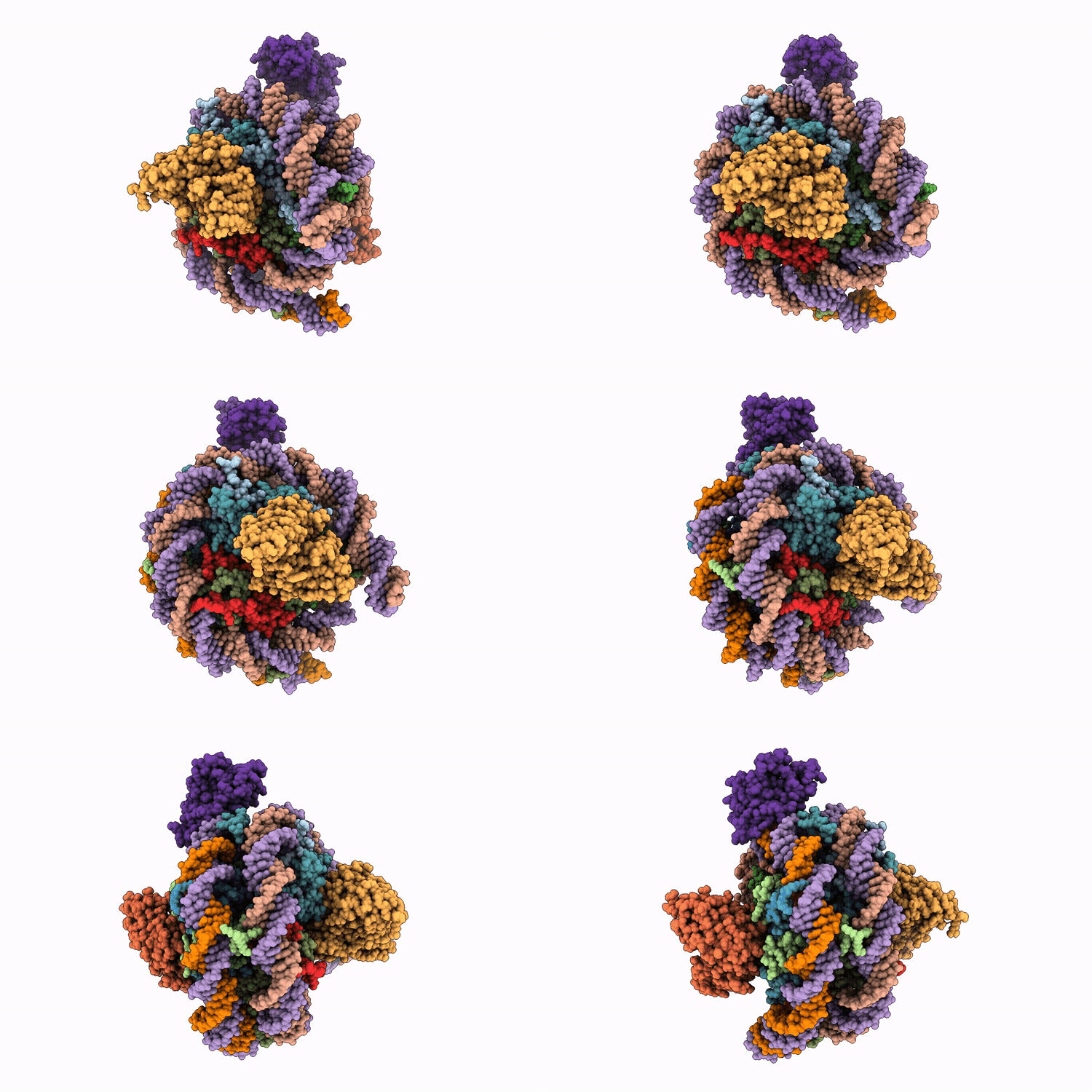
9ZQ9 image
Deposition Date 2025-12-18
Release Date 2026-03-25
Last Version Date 2026-04-08
Entry Detail
PDB ID:
9ZQ9
Title:
Nucleosome with an SSB at SHL -2.8 in complex with the WGR domain of human PARP2, Class 1
Biological Source:
Source Organism(s):
Expression System(s):
Method Details:
Experimental Method:
Resolution:
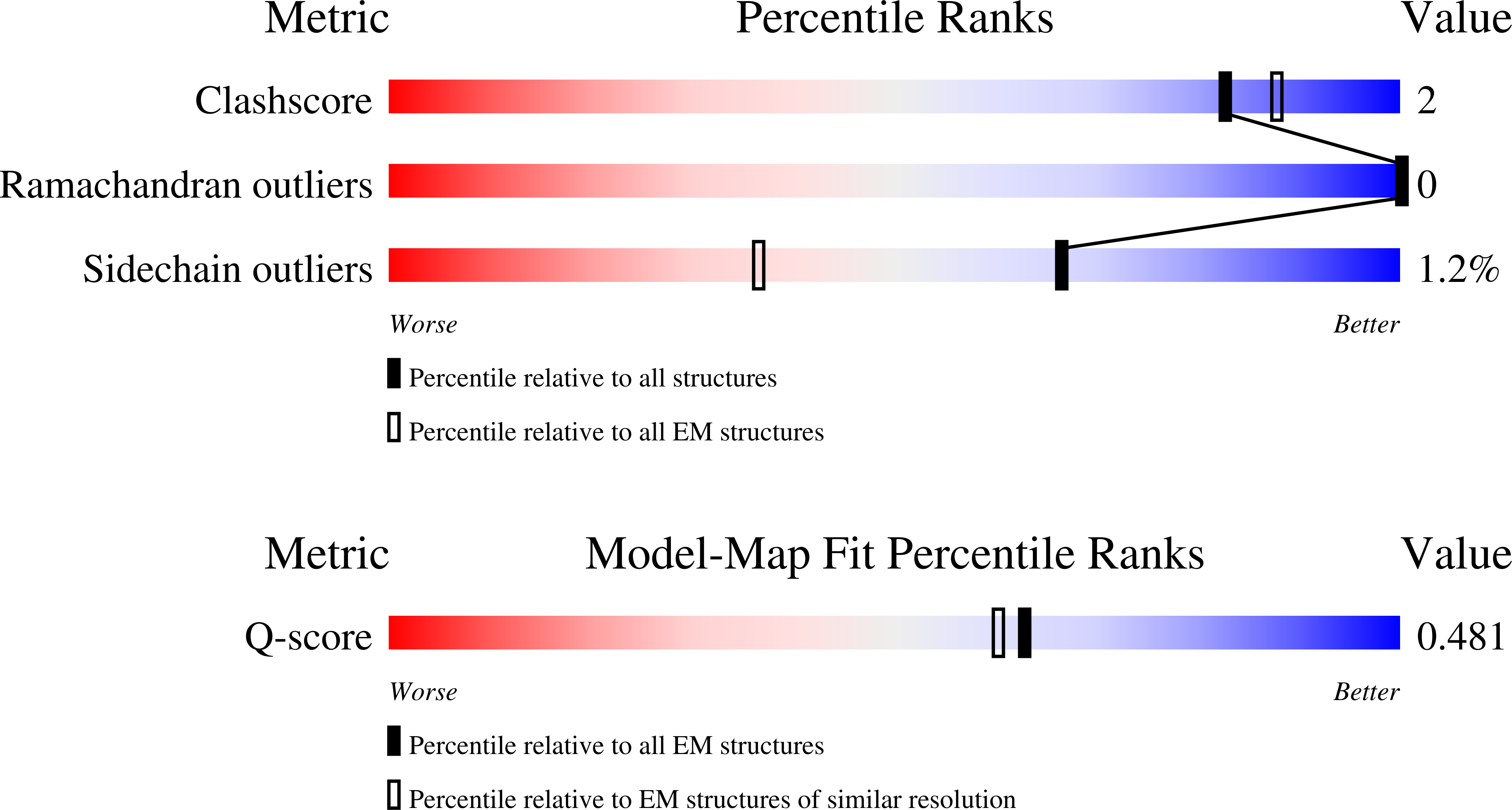
3.30 Å
Aggregation State:
PARTICLE
Reconstruction Method:
SINGLE PARTICLE
Macromolecular Entities
Structures with similar UniProt ID
Protein Blast
Polymer Type:polypeptide(L)
Molecule:Histone H2A
Gene (Uniprot):His2A, His2A:CG31618, His2A:CG33808, His2A:CG33814, His2A:CG33817, His2A:CG33820, His2A:CG33823, His2A:CG33826, His2A:CG33829, His2A:CG33832, His2A:CG33835, His2A:CG33838, His2A:CG33841, His2A:CG33844, His2A:CG33847, His2A:CG33850, His2A:CG33862, His2A:CG33865
Chain IDs:A, B
Chain Length:124
Number of Molecules:2
Biological Source:Drosophila melanogaster
Structures with similar UniProt ID
Protein Blast
Polymer Type:polypeptide(L)
Molecule:Histone H2B
Gene (Uniprot):His2B, His2B:CG17949, His2B:CG33868, His2B:CG33870, His2B:CG33872, His2B:CG33874, His2B:CG33876, His2B:CG33878, His2B:CG33880, His2B:CG33882, His2B:CG33884, His2B:CG33886, His2B:CG33888, His2B:CG33890, His2B:CG33892, His2B:CG33894, His2B:CG33896, His2B:CG33898, His2B:CG33900, His2B:CG33902, His2B:CG33904, His2B:CG33906, His2B:CG33908, His2B:CG33910
Chain IDs:C, D
Chain Length:125
Number of Molecules:2
Biological Source:Drosophila melanogaster
Structures with similar UniProt ID
Protein Blast
Polymer Type:polypeptide(L)
Molecule:Histone H3
Gene (Uniprot):His3, His3:CG31613, His3:CG33803, His3:CG33806, His3:CG33809, His3:CG33812, His3:CG33815, His3:CG33818, His3:CG33821, His3:CG33824, His3:CG33827, His3:CG33830, His3:CG33833, His3:CG33836, His3:CG33839, His3:CG33842, His3:CG33845, His3:CG33848, His3:CG33851, His3:CG33854, His3:CG33857, His3:CG33860, His3:CG33863, His3:CG33866
Chain IDs:E, F
Chain Length:136
Number of Molecules:2
Biological Source:Drosophila melanogaster
Structures with similar UniProt ID
Protein Blast
Polymer Type:polypeptide(L)
Molecule:Histone H4
Gene (Uniprot):His4, His4r, His4:CG31611, His4:CG33869, His4:CG33871, His4:CG33873, His4:CG33875, His4:CG33877, His4:CG33879, His4:CG33881, His4:CG33883, His4:CG33885, His4:CG33887, His4:CG33889, His4:CG33891, His4:CG33893, His4:CG33895, His4:CG33897, His4:CG33899, His4:CG33901, His4:CG33903, His4:CG33905, His4:CG33907, His4:CG33909
Chain IDs:G, H
Chain Length:104
Number of Molecules:2
Biological Source:Drosophila melanogaster
Protein Blast
Polymer Type:polypeptide(L)
Molecule:Ig-like domain-containing pro
Chain IDs:M (auth: J), N (auth: I)
Chain Length:274
Number of Molecules:2
Biological Source:Mus musculus
Polymer Type:polydeoxyribonucleotide
Molecule:DNA (69-MER)
Chain IDs:K
Chain Length:69
Number of Molecules:1
Biological Source:synthetic construct
Polymer Type:polydeoxyribonucleotide
Molecule:DNA (128-MER)
Chain IDs:L
Chain Length:128
Number of Molecules:1
Biological Source:synthetic construct
Polymer Type:polydeoxyribonucleotide
Molecule:DNA (197-MER)
Chain IDs:J (auth: M)
Chain Length:197
Number of Molecules:1
Biological Source:synthetic construct
Structures with similar UniProt ID
Protein Blast
Polymer Type:polypeptide(L)
Molecule:Poly [ADP-ribose] polymerase
Gene (Uniprot):PARP2
Chain IDs:I (auth: P)
Chain Length:123
Number of Molecules:1
Biological Source:Homo sapiens
Ligand Molecules
Primary Citation
High-Yield Production of Modified DNA Enables Structural Analysis of PARP2 Recognition of Nucleosomal Single-Strand Breaks.
J. Mol. Biol. 438 169753 169753 (2026)
PMID: 41819421 DOI: 10.1016/j.jmb.2026.169753

Abstact

Preparation of high-quality nucleosomal DNA substrates in milligram quantities remains a major bottleneck for mechanistic studies of chromatin-associated processes. Here, we present an optimized large-scale PCR workflow that enables rapid, low-cost production of diverse nucleosomal DNAs suitable for biochemical assays and high-resolution cryo-EM. Systematic optimization of amplification conditions yields milligram quantities of homogeneous DNA that can be fluorescently or biotin-labeled and enzymatically modified to introduce site-specific single-strand breaks (SSBs) or epigenetic marks. We also engineered an improved Nt.BsmAI nickase variant (R386D) that minimizes undesired double-strand cleavage while maintaining robust nicking activity. Using nucleosomes reconstituted with these engineered DNAs, we demonstrate the versatility of this platform across EMSA, biolayer interferometry, and cryo-EM. Structural analysis reveals how the PARP2 WGR domain engages an SSB within the nucleosome and uncovers associated shifts in H2B tail conformation that facilitate access to lesions positioned near the tail. Overall, this workflow provides a robust and scalable method for generating precisely modified nucleosomal substrates, enabling quantitative and structural dissection of PARP2-mediated DNA damage recognition and the coupled histone H2B tail rearrangements that facilitate lesion accessibility in chromatin.

Legend

Protein

Chemical

Disease

Primary Citation of related structures
Feedback Form
Name
Email
Institute
Feedback