

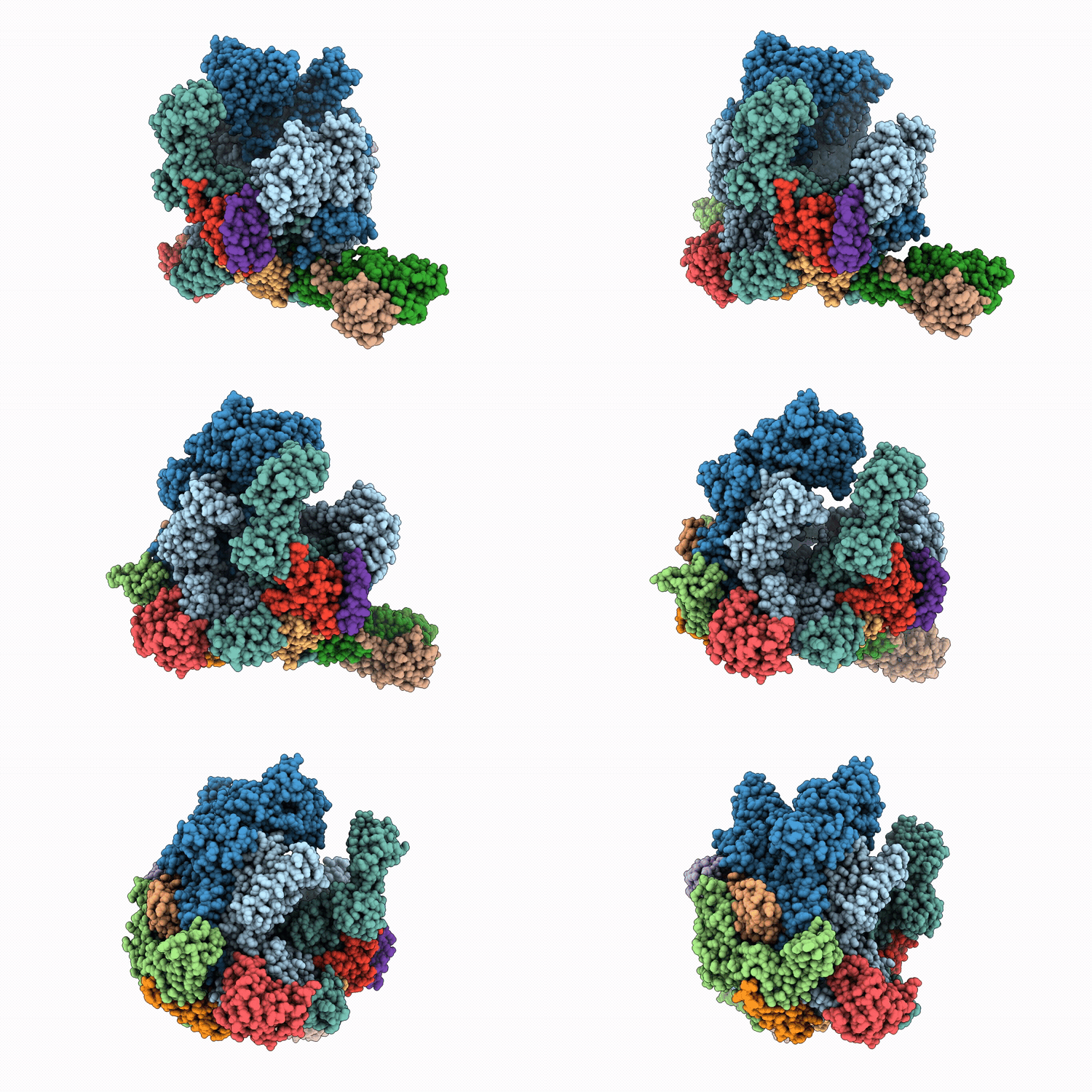
9ZOH image
Deposition Date 2025-12-15
Release Date 2026-08-05
Last Version Date 2026-09-09
Entry Detail
PDB ID:
9ZOH
Keywords:
Title:
Cryo-EM structure of the complete Sulfolobus acidocaldarius RNA polymerase in open clamp conformation
Biological Source:
Source Organism(s):
Method Details:
Experimental Method:
Resolution:
3.87 Å
Aggregation State:
PARTICLE
Reconstruction Method:
SINGLE PARTICLE
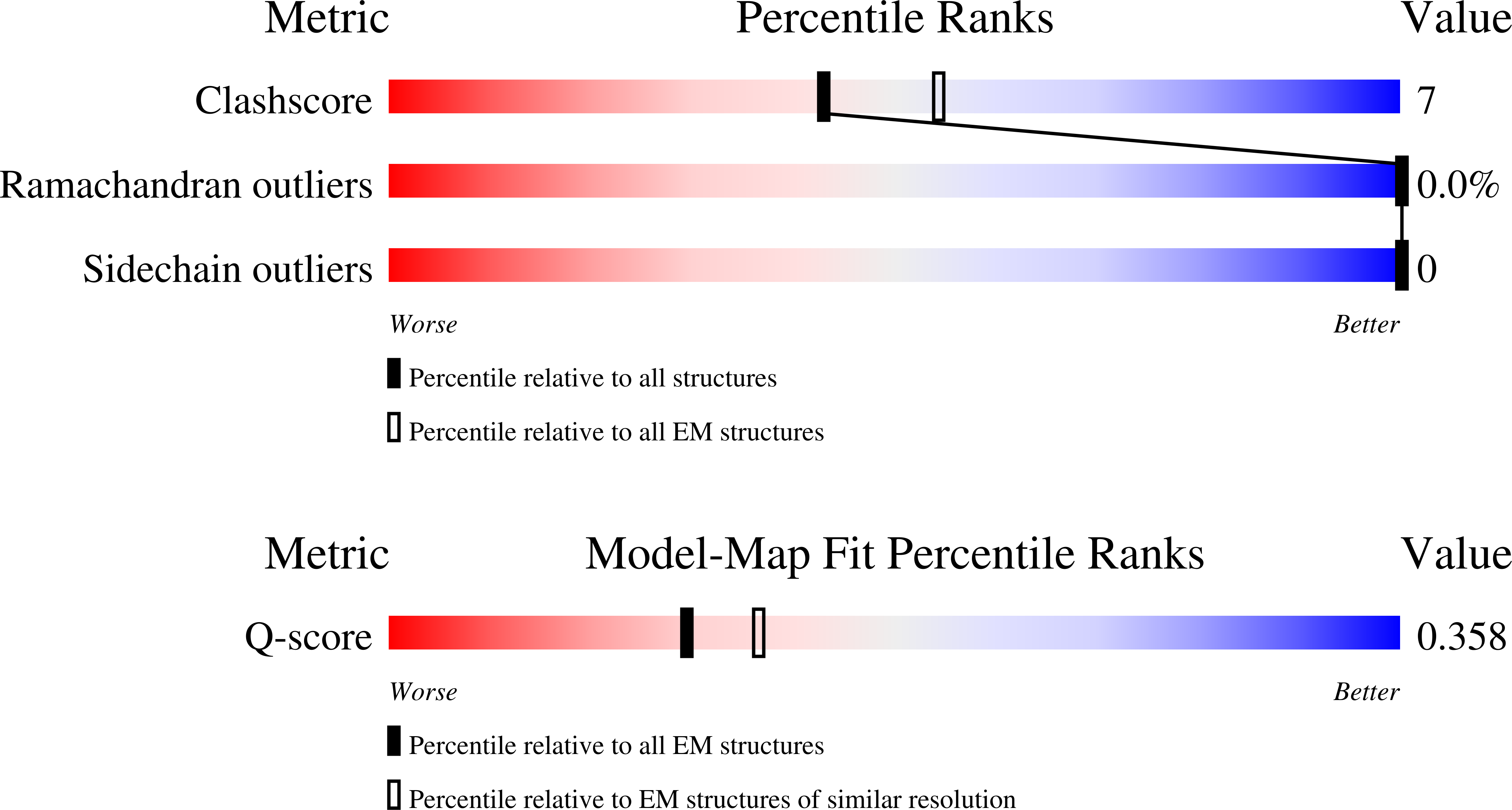
Macromolecular Entities
Polymer Type:polypeptide(L)
Molecule:DNA-directed RNA polymerase s
Gene (Uniprot):rpo1N
Chain IDs:A
Chain Length:0
Number of Molecules:1
Biological Source:Sulfolobus acidocaldarius DSM 639
Polymer Type:polypeptide(L)
Molecule:DNA-directed RNA polymerase s
Gene (Uniprot):rpo2
Chain IDs:B
Chain Length:0
Number of Molecules:1
Biological Source:Sulfolobus acidocaldarius DSM 639
Polymer Type:polypeptide(L)
Molecule:DNA-directed RNA polymerase s
Gene (Uniprot):rpo1C
Chain IDs:C
Chain Length:0
Number of Molecules:1
Biological Source:Sulfolobus acidocaldarius DSM 639
Polymer Type:polypeptide(L)
Molecule:DNA-directed RNA polymerase s
Gene (Uniprot):rpo3
Chain IDs:K (auth: D)
Chain Length:0
Number of Molecules:1
Biological Source:Sulfolobus acidocaldarius DSM 639
Polymer Type:polypeptide(L)
Molecule:DNA-directed RNA polymerase s
Gene (Uniprot):rpo7
Chain IDs:D (auth: E)
Chain Length:0
Number of Molecules:1
Biological Source:Sulfolobus acidocaldarius DSM 639
Polymer Type:polypeptide(L)
Molecule:DNA-directed RNA polymerase s
Gene (Uniprot):rpo4
Chain IDs:M (auth: F)
Chain Length:0
Number of Molecules:1
Biological Source:Sulfolobus acidocaldarius DSM 639
Polymer Type:polypeptide(L)
Molecule:DNA-directed RNA polymerase s
Gene (Uniprot):rpo8
Chain IDs:E (auth: G)
Chain Length:0
Number of Molecules:1
Biological Source:Sulfolobus acidocaldarius DSM 639
Polymer Type:polypeptide(L)
Molecule:DNA-directed RNA polymerase s
Gene (Uniprot):rpo5
Chain IDs:F (auth: H)
Chain Length:0
Number of Molecules:1
Biological Source:Sulfolobus acidocaldarius DSM 639
Polymer Type:polypeptide(L)
Molecule:DNA-directed RNA polymerase s
Gene (Uniprot):rpo6
Chain IDs:G (auth: K)
Chain Length:0
Number of Molecules:1
Biological Source:Sulfolobus acidocaldarius DSM 639
Polymer Type:polypeptide(L)
Molecule:DNA-directed RNA polymerase s
Gene (Uniprot):rpo11
Chain IDs:H (auth: L)
Chain Length:0
Number of Molecules:1
Biological Source:Sulfolobus acidocaldarius DSM 639
Polymer Type:polypeptide(L)
Molecule:DNA-directed RNA polymerase s
Gene (Uniprot):rpo10
Chain IDs:I (auth: N)
Chain Length:0
Number of Molecules:1
Biological Source:Sulfolobus acidocaldarius DSM 639
Polymer Type:polypeptide(L)
Molecule:DNA-directed RNA polymerase s
Gene (Uniprot):rpo12
Chain IDs:L (auth: P)
Chain Length:0
Number of Molecules:1
Biological Source:Sulfolobus acidocaldarius DSM 639
Polymer Type:polypeptide(L)
Molecule:DNA-directed RNA polymerase s
Gene (Uniprot):rpo13
Chain IDs:J (auth: Y)
Chain Length:0
Number of Molecules:1
Biological Source:Sulfolobus acidocaldarius DSM 639
Primary Citation
Clamp conformational flexibility and dynamics in archaeal and eukaryotic RNA polymerases revealed by cryo-EM.
J.Biol.Chem. 302 113389 113389 (2026)
PMID: 42551829 DOI: 10.1016/j.jbc.2026.113389

Abstact

All cellular RNA polymerases (RNAPs) across Bacteria, Archaea, and Eukarya share a conserved catalytic core, yet bacterial and archaeal-eukaryotic RNAPs diverged after separation from the last universal common ancestor. This evolutionary split produced distinct subunit compositions and fundamentally different requirements for external factors during transcription initiation. Bacterial RNAP relies on a sigma factor, whereas archaeal-eukaryotic RNAPs require a more extensive set of general transcription factors (GTFs) to bind promoter DNA, unwind the duplex, and position the template strand within the active site cleft. Notably, despite the close structural similarity between archaeal and eukaryotic RNAPs, the requirement for GTFs became further specialized after the emergence of Eukarya. This divergence raises the question of whether differences in intrinsic conformational flexibility and dynamics of these RNAPs contribute to distinct promoter-loading pathways. In this study, we addressed this question using cryo-electron microscopy (cryo-EM) to examine archaeal RNAPs from Euryarchaeota and Crenarchaeota alongside yeast RNAP II. Archaeal RNAP displays a highly dynamic DNA binding clamp domain that samples a broad spectrum of open and closed states, whereas RNAP II predominantly adopts a closed clamp state. Both archaeal and eukaryotic RNAPs can be found in stalk-bound and stalk-less forms. Comparative structural analyses further reveal a unique conformational transition in crenarchaeal RNAP associated with clamp opening. Together, these findings define the intrinsic clamp-conformational landscapes across the archaeal-eukaryotic lineage and suggest that evolutionary tuning of clamp flexibility and dynamics contributes to distinct GTF-dependent promoter-loading mechanisms.

Legend

Protein

Chemical

Disease

Primary Citation of related structures
Feedback Form
Name
Email
Institute
Feedback