

9ZLL image
Deposition Date 2025-12-08
Release Date 2026-04-08
Last Version Date 2026-07-08
Entry Detail
PDB ID:
9ZLL
Title:
Complex of N-terminal BrxC walker B, BrxB, and N-termianl PglZ from the Acinetobacter BREX system
Biological Source:
Source Organism(s):
Expression System(s):
Method Details:
Experimental Method:
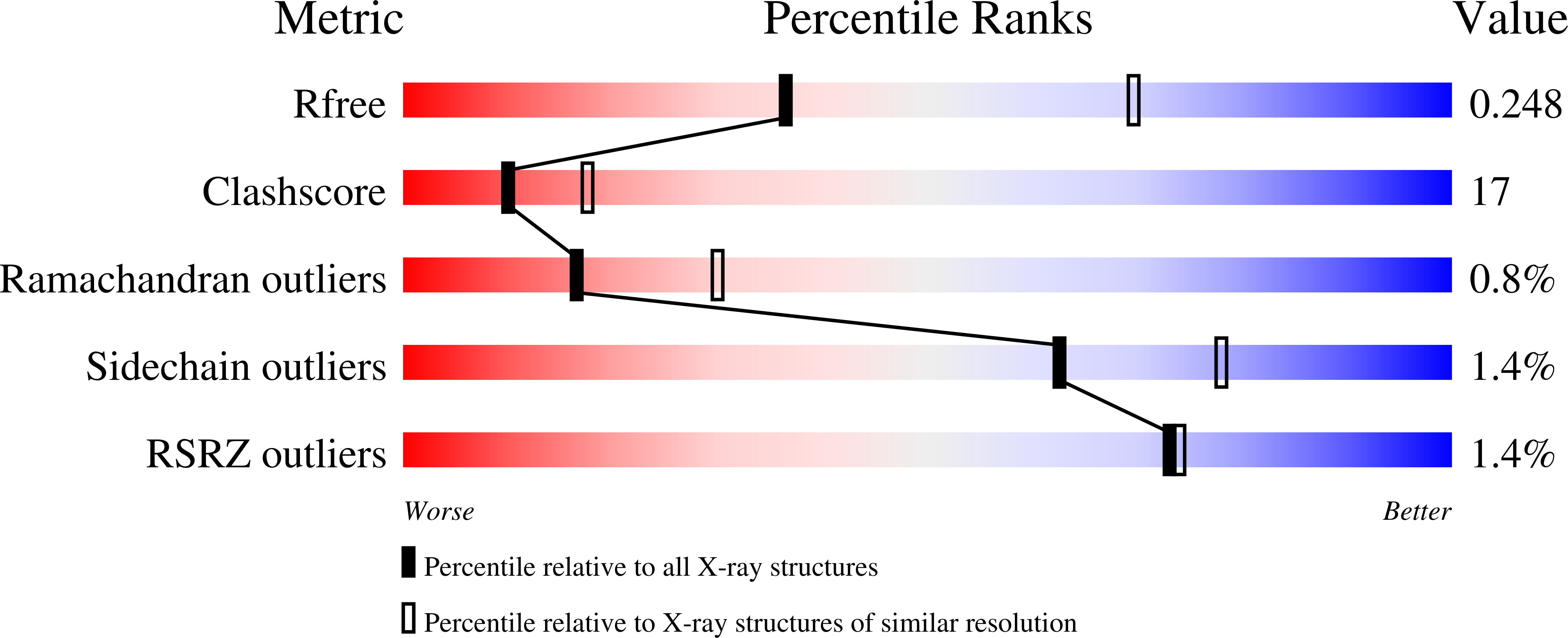
Resolution:
2.74 Å
R-Value Free:
0.24
R-Value Work:
0.20
R-Value Observed:
0.20
Space Group:
I 1 2 1
Macromolecular Entities
Structures with similar UniProt ID
Protein Blast
Polymer Type:polypeptide(L)
Molecule:Putative conjugative transfer
Gene (Uniprot):ABAC_0086
Mutagens:E269Q
Chain IDs:A, B, C, D
Chain Length:561
Number of Molecules:4
Biological Source:Acinetobacter sp. NEB 394
Structures with similar UniProt ID
Protein Blast
Polymer Type:polypeptide(L)
Molecule:DUF1788 domain-containing pro
Gene (Uniprot):AhaeAN43_17405, J5N55_15600
Chain IDs:E, G
Chain Length:192
Number of Molecules:2
Biological Source:Acinetobacter sp. NEB 394
Structures with similar UniProt ID
Protein Blast
Polymer Type:polypeptide(L)
Molecule:BREX-1 system phosphatase Pgl
Gene (Uniprot):pglZ
Chain IDs:F, H
Chain Length:105
Number of Molecules:2
Biological Source:Acinetobacter sp. NEB 394
Primary Citation
Competing forms of protein-protein association and DNA binding exhibited by BrxC from the BREX phage restriction system.
Biorxiv ? ? ? (2026)
PMID: 41993295 DOI: 10.64898/2026.04.09.717308

Abstact

Bacteriophage exclusion (BREX) defense systems restrict phage infection via inhibition of phage DNA replication, while also modifying and protecting the bacterial genome. Type I BREX systems encode six conserved proteins, including a site-specific DNA methyltransferase. Host methylation requires a subset of BREX proteins, whereas phage restriction generally requires them all, suggesting that distinct but overlapping complexes mediate these activities. Full details of the mechanism and regulation of BREX remains to be understood. Here, we characterize the behavior and structures of the conserved BrxC AAA+ ATPase protein. BrxC forms multiple competing assemblages - various self-associating multimers, as well as a complex with BrxB-PglZ - that can be uncoupled via distinct point mutations, leading to differing effects on host methylation versus phage restriction. BrxC's self-association, as well as its ability to bind DNA, is regulated by ATP binding and hydrolysis; BrxA and BrxB appear to also regulate those behaviors. These collective results suggest that BrxC may play a key role in controlling the two activities of BREX, with BrxB, BrxC and PglZ forming a core complex, and the equilibrium among competing assemblies containing those proteins modulating the balance between idling and activated restrictive states.

Legend

Protein

Chemical

Disease

Primary Citation of related structures
Feedback Form
Name
Email
Institute
Feedback