

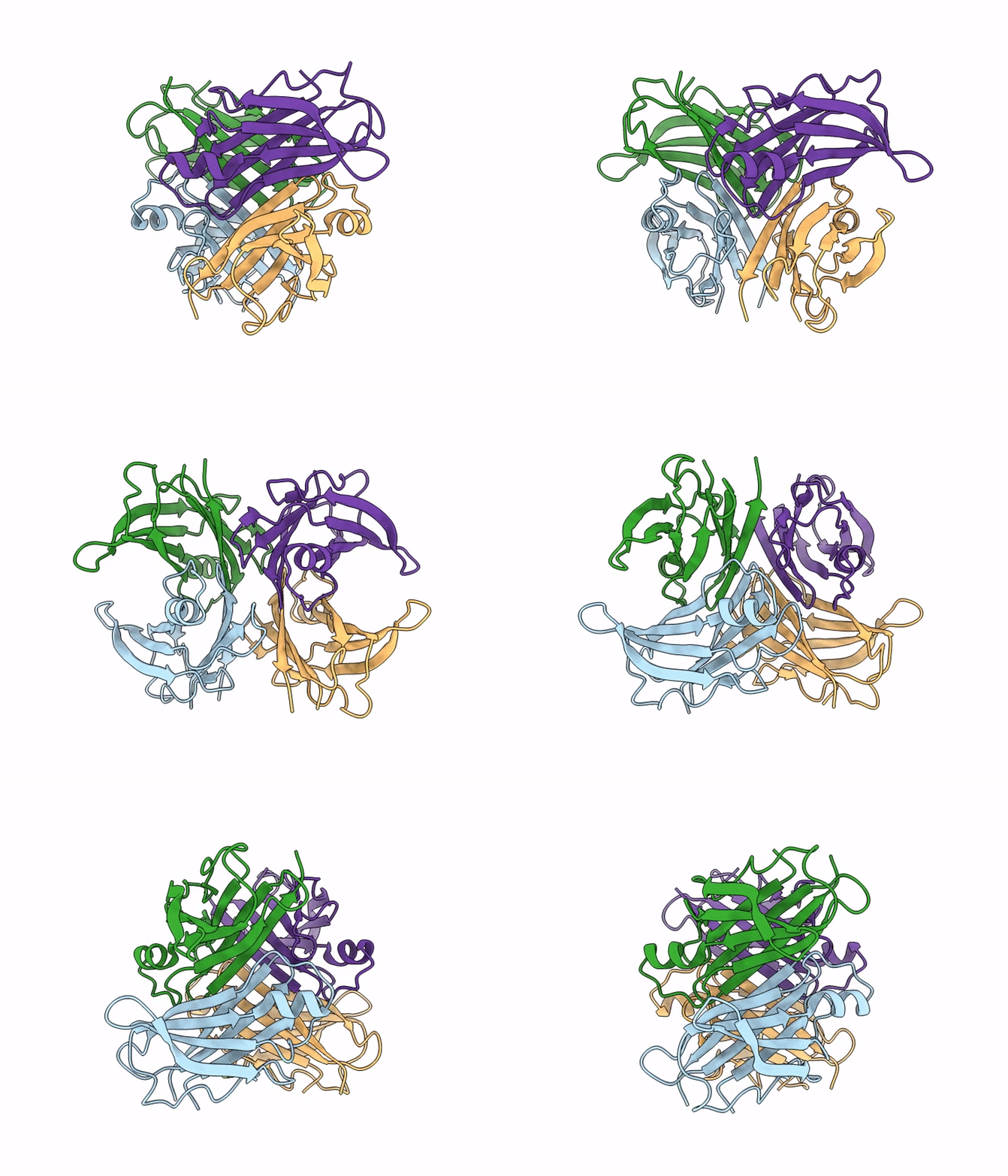
9ZBV image
Deposition Date 2025-11-21
Release Date 2026-01-21
Last Version Date 2026-08-05
Entry Detail
PDB ID:
9ZBV
Title:
Human TTR-C10A at pH 7.4
Biological Source:
Source Organism(s):
Homo sapiens (Taxon ID: 9606)
Expression System(s):
Method Details:
Experimental Method:
Resolution:
3.20 Å
Aggregation State:
PARTICLE
Reconstruction Method:
SINGLE PARTICLE

Macromolecular Entities
Polymer Type:polypeptide(L)
Molecule:Transthyretin
Gene (Uniprot):TTR
Mutagens:C10A
Chain IDs:A, B, C, D
Chain Length:0
Number of Molecules:4
Biological Source:Homo sapiens
Ligand Molecules
Primary Citation
DM: a simple solution to suppress air-water interface interactions in cryo-EM.
Biorxiv ? ? ? (2026)
PMID: 41959516 DOI: 10.64898/2026.04.02.716008

Abstact

The air-water interface (AWI) remains the primary barrier to routine high-resolution cryo-EM structure determination, driving protein adsorption, structural denaturation, and restricted particle orientations during vitrification. Here, we describe a simple and broadly applicable strategy to mitigate these effects using the mild non-ionic detergent n-decyl-beta-D-maltopyranoside (DM). Addition of DM at low millimolar concentrations immediately prior to vitrification consistently suppresses AWI-driven artifacts, resulting in improved angular sampling, reduced structural damage, and enhanced reconstruction quality across diverse macromolecular systems. Using this approach, we obtained a high-resolution reconstruction of the 65 kDa Nucleophosmin 1 pentamer, a target previously limited by severe preferred orientation issues. We further show that DM promotes isotropic particle distributions for high-resolution reconstruction of hemagglutinin, transthyretin, as well as suppressing denaturation of aldolase while stabilizing its C-terminus. Our results indicate that DM effectively passivates deleterious air-water interface interactions without compromising particle integrity. These results establish DM as an effective additive for improving the robustness of single-particle cryo-EM sample preparation.

Legend

Protein

Chemical

Disease

Primary Citation of related structures
Feedback Form
Name
Email
Institute
Feedback